What Is Your Solar Business Worth After the Collapse?
Editorial update: October 14, 2026. Original reporting dates are unchanged.
California changed its net-metering rules in 2023. This article looks at the drop in home solar sales, signed service work, and the risks of relying on incentives.
California’s 2023 net-metering change and higher financing costs disrupted residential solar installation. Reported valuation ranges distinguish installation-heavy shops from businesses with contracted operations and maintenance work, but no multiple applies to every seller. Check current earnings, service obligations, and actual offers before estimating value.
What went wrong
Why solar failed the test
The bankruptcies
What a solar business is worth now
The lesson for every trade
Frequently asked questions
- Residential solar attracted installers and investors while financing and customer savings supported new projects. California’s 2023 net-metering change exposed that reliance on policy and financing.
- CALSSA reported rooftop solar sales down 66 to 83 percent year over year in November 2023. Its survey estimated 17,000 jobs already lost or expected to be lost by year-end, not a subsequently verified employment total.
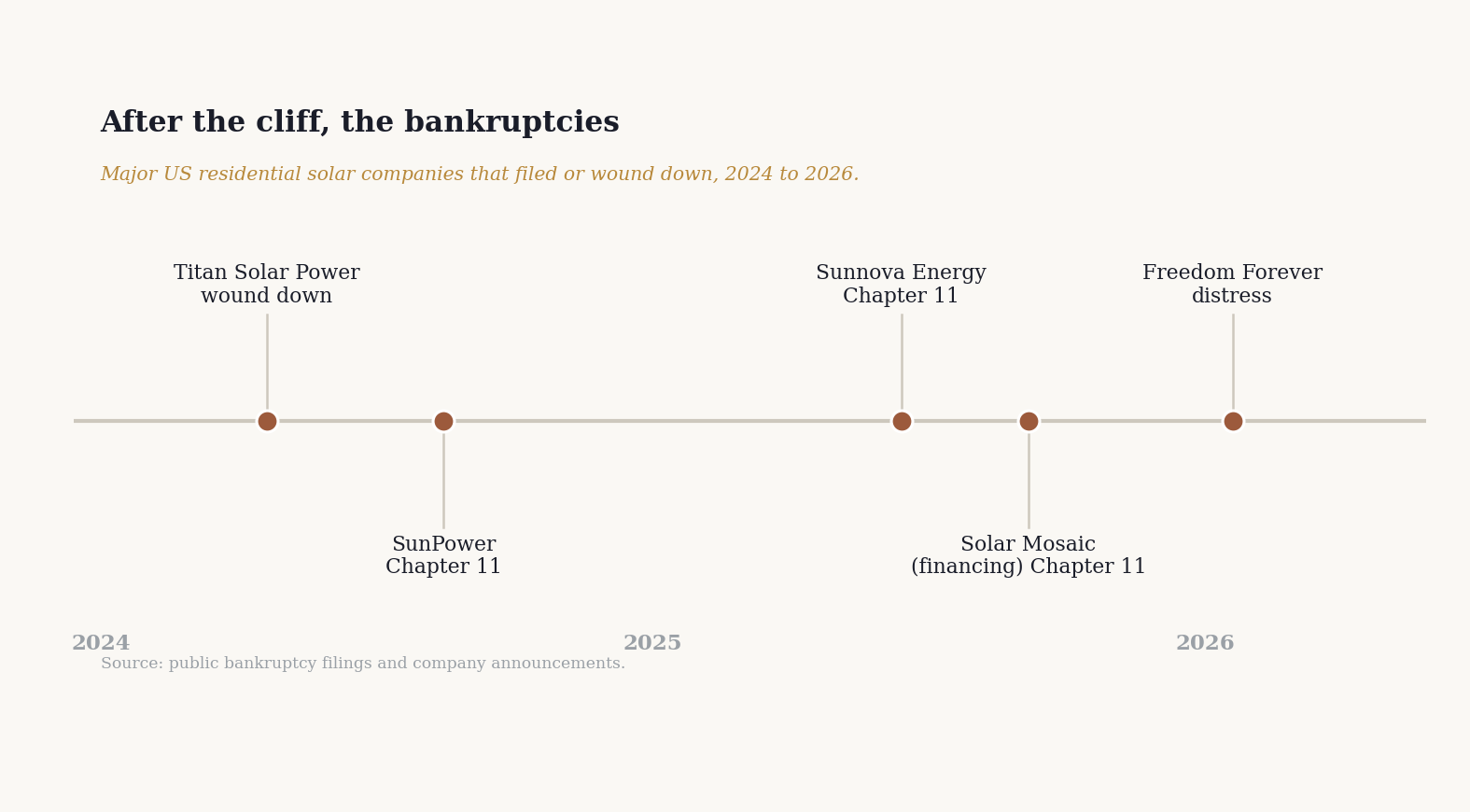
- SunPower and Titan Solar filed or ceased operations in 2024; Sunnova Energy and lender Solar Mosaic filed in 2025. Their individual causes differ.
- Some solar transactions involve distressed assets, customers, and service obligations. The evidence here does not establish that all consolidation is distressed or that every buyer pays a discount.
- Test whether customers still buy if incentives or financing terms change. Demand for roofing, HVAC, and electrical work also varies by project and market; none is immune to policy or construction cycles.
Residential solar attracted installers and private capital when the economics of a new installation looked favorable. California then changed its net-metering rules, interest rates rose, and several large companies later filed for bankruptcy or ceased operations. The effect on a particular business depends on its mix of new installations and contracted service work.
What went wrong
In April 2023, California changed its net-metering rules. The cited estimate says homeowners then received roughly 75 percent less credit for power sent to the grid. Higher interest rates also raised the cost of financing installations. Those changes made many new projects less attractive, although the effect varies with each household’s rates and system costs.
In its November 30, 2023 analysis, the California Solar & Storage Association reported rooftop solar sales down 66 to 83 percent from a year earlier. Its industry survey estimated that 17,000 jobs had been lost or would be lost by the end of 2023. Those figures combine reported conditions and an employment forecast; they are not a completed-installation count or a later verified job-loss total.
| CALSSA measure | November 30, 2023 finding |
|---|---|
| Rooftop solar sales | Down 66 to 83 percent year over year |
| Solar employment survey | 17,000 jobs already lost or expected to be lost by the end of 2023 |
Source: CALSSA, November 30, 2023 analysis.
Why installation demand contracted
Residential solar attracted many installers, as discussed in The Great Trades Roll-Up, but new installation demand depends on financing, customer savings, and policy. That exposure became clear after California changed net-metering credits and borrowing costs rose. An existing service book can have a different demand pattern, though its contracts and margins still need review.
A failed roof or furnace usually needs repair or replacement. A homeowner can more easily postpone a solar installation when its projected savings fall. Solar installation demand depended in part on net-metering credits and financing costs. Once those changed, the sales case weakened. An owner should distinguish work driven by a physical need from work that depends on a policy or financing assumption.
The bankruptcies
SunPower filed for Chapter 11 in 2024, and Titan Solar Power ceased operations that year. Sunnova Energy and lender Solar Mosaic filed in 2025. Those failures show stress in parts of the solar industry, but their individual causes differ. This article does not treat one policy change as the sole explanation for each company’s failure.
How buyers may assess a solar business
Some solar buyers take on customers, service obligations, or assets of failed companies. Terms for those transactions differ from a healthy operating-company sale. Review the installation pipeline and signed service contracts separately before comparing any reported platform price.
Reported trade benchmarks place some installation-dependent solar businesses around 3 to 5 times EBITDA, with service-heavy businesses sometimes assessed differently. These are not verified transaction prices for any company in this article. Debt, warranties, contract transfer rights, and buyer terms can change an offer substantially.
Operations and maintenance contracts on installed systems can provide repeat work, as discussed in the one number that decides what your trades business is worth. Their value depends on signed terms, renewals, pricing, customer retention, and the cost of honoring warranties. A buyer must examine the actual service book rather than assume every installed system produces recurring profit.
A business reliant on new residential installations may face a cautious buyer after the market contraction. Crews, licenses, customer relationships, and a forward pipeline can matter, but their value depends on the current contracts and obligations. The market downturn alone cannot price a particular business.
Test the demand behind your revenue
Owners in other trades can test demand in the same way. Would customers still buy the work without an incentive or cheap financing? The answer helps show how much future sales depend on those terms.
Roof replacement and emergency HVAC repair can remain necessary without a tax credit or net-metering rule. Electrical work also includes essential repair, though its projects vary by customer and purpose. Solar installation demand proved more sensitive to policy and financing changes. Buyers should examine that exposure in the actual revenue mix rather than label an entire trade safe or fragile.
Frequently asked questions
What is my solar business worth after the collapse?
No fixed multiple describes every solar company. The cited 3-to-5-times EBITDA range is a trade benchmark for installation-heavy businesses, not an appraisal. Contracted service, cash flow, warranty liabilities, and actual buyer terms determine the company-specific result.
Is the residential solar industry recovering?
Residential installation demand has faced pressure from California’s net-metering change and higher financing costs. Battery storage and service work may offer other revenue, but project economics vary by customer and market. Review signed work, margins, and applicable incentives before using a forecast.
Why did so many solar companies go bankrupt?
CALSSA reported a sharp California rooftop solar sales decline after net-metering credits changed. Bankruptcies of several large firms illustrate the sector’s stress, but this article cannot assign each failure to one policy. Solar owners should separate policy exposure from company-specific debt and execution.
Does my solar service and maintenance book have value?
A contracted service book may have value if its agreements transfer, customers renew, and service margins hold. Monitoring, maintenance, and warranty obligations need separate accounting. A buyer will not treat informal repeat work as contracted revenue.
Should I diversify into storage, electrical, or roofing?
Battery storage, electrical work, and roofing can diversify a solar installer’s offerings where it has the licenses, staff, and customer demand to do that work. None is a guaranteed survival path; evaluate the economics and obligations of each service.
What is the lesson of solar for other trades?
Test how customers would respond if an incentive or financing terms changed. Compare installation margins, signed service revenue, and warranty costs. A policy change can hurt demand without determining the value of every solar business.
Whether you are in solar and weighing your options or in another trade and stress-testing your own demand, your market is its own story: who is consolidating it, which operators are durable, and where your business stands. That market-specific read is exactly what an Echelon Intel Report delivers, built from the same data behind this analysis.
The Great Trades Roll-Up: why Wall Street buys some trades and walks past others
The one number that decides what your trades business is worth
What is your roofing business worth: a trade whose demand passes the test
Methodology and sources. CALSSA’s November 30, 2023 analysis reports a 66-to-83-percent year-over-year decline in rooftop solar sales and estimates 17,000 jobs already lost or expected to be lost by the end of 2023. Sales are not completed installations, and the employment estimate included a forecast. California’s NEM 3.0 took effect in April 2023. Bankruptcy and wind-down events come from public filings and company announcements. Valuation observations are analysis, not appraisals. Echelon takes no position on whether an owner should buy, sell, hold, or diversify.