
Hub and project index updated October 24, 2026. Original publication and source dates are unchanged.
ECHELON REPORTS · DATA CENTER PROJECT FINDER
Data center construction: project reports, contractors and jobs
Find data center projects, documented builders and contractor or employer routes in 13 source-backed reports. Search by project, state or company below. Each entry keeps its own research date so you can judge how recently the evidence was checked.
New report: Monarch Compute Campus, West Virginia. The phase-one guide covers named employers, trade-referral and apprenticeship contacts, contractor inquiries, and the customer and financing agreements behind the project. Its two direct Nscale applications are for senior management roles, not craft jobs.
Start with the contractor guidance if you sell a trade or service. Use the worker guidance if you need an employer, a worksite and employment terms. The workforce research remains available below the project index.
Compare data center construction projects
Compare 13 selected projects by location, documented builders and dated construction evidence. The links lead to our source-backed reports, including contractor inquiry routes and employer leads. This is a research index, not a live list of open bids or available jobs.
13 projects. Research dates belong to individual reports.
A builder named on an earlier phase is not automatically the buyer for an expansion. Construction milestones and planned opening dates are not vacancies or bid invitations. Check the report date before relying on a listing.
| Project and research date | Companies and roles | Dated project evidence | Read before contacting a buyer or employer |
|---|---|---|---|
| Meta Beaver Dam Beaver Dam, Wisconsin Report research: | Owner: Meta General contractor: Mortenson. Helm documents HVAC, plumbing and piping. | 2026-07-24Construction continuing in July reporting. Initial opening forecast for 2027. | Contractor routes and scopeEmployer leads and site limitsLocation and assignment limitsBeaver Dam Commerce Park, Dodge County. The park sheet does not establish the campus boundary or an entry gate; Mortenson job listings do not name Meta. |
| The Barn Saline Township, Michigan Report research: | Developer: Related Digital General contractor: Walbridge. Named trade partners and their roles appear in the report. | 2026-06-01Developer said all three buildings were under construction. Phased delivery forecast through 2027. | Contractor routes and scopeEmployer leads and site limitsLocation and assignment limitsSaline Township, Washtenaw County, Michigan; not the Texas Stargate campus. Local 252 dated dispatch calls are not verified remaining vacancies or each employer’s entire contract scope. |
| Meta Hyperion Richland Parish, Louisiana Report research: | Campus venture: Meta and Blue Owl-managed funds General contractors: DPR, Turner and Mortenson. Responsibilities differ across buildings and infrastructure. | 2026-07Expanded campus announced in July. Report also covers interior work in the first buildings; later package awards need confirmation. | Contractor routes and scopeEmployer leads and site limitsLocation and assignment limitsRichland Parish/Holly Ridge, Louisiana; Rayville in job listings does not confirm worksite or gate. Separate Entergy generation/transmission approvals from campus permits and packages. |
| Meta Eagle Mountain Eagle Mountain, Utah Report research: | Owner: Meta Mortenson documents multi-phase campus work. New expansion packages are not confirmed; RK Mechanical describes earlier work. | 2026-09-14Expansion announced in September. Earlier campus work does not establish new-building trade awards. | Contractor routes and scopeEmployer leads and site limitsLocation and assignment limitsEagle Mountain, Utah. Separate QTS campus means city-only job listing cannot be assigned to Meta; historical contractor role does not prove a new expansion award. |
| Lighthouse (Port Washington) Port Washington, Wisconsin Report research: | Developer: Vantage Data Centers Weitz identifies itself as a general contractor. OSHA also names Whiting-Turner and Turner McCarthy JV; building assignments differ. | 2026-09-21September reporting describes work inside Building 12. Campus completion targeted for 2028; the power connection has a separate review. | Contractor routes and scopeEmployer leads and site limitsLocation and assignment limitsPort Washington, Ozaukee County, Wisconsin. 672-acre campus is distinct from Vantage’s larger landholding. Construction organizations are not a complete building/package allocation; ATC line is a separate utility process. |
| Project Jupiter Santa Teresa, New Mexico Report research: | Project leaders: STACK Infrastructure and BorderPlex Digital Assets Clayco and Kiewit participate in construction. The report does not establish the complete general-contracting arrangement. | 2026-09-30First structural-beam milestone reported. The October report also covers a separate pending microgrid air permit. | Contractor routes and scopeEmployer leads and site limitsLocation and assignment limitsSanta Teresa, Doña Ana County, New Mexico in the El Paso border region. Four-building/full-development scope differs from initial 400-acre phase; microgrid authorization and campus construction are separate. Job location is not automatic assignment to a construction package. |
| Project Dazzler Franklin Furnace, Ohio Report research: | Owner: Google Holder is the Google-linked construction contact. A sole general-contractor appointment was not verified. | 2026-09-02Federal notice records an application, not an issued permit. The reported 2026–29 construction schedule is a plan. | Contractor routes and scopeEmployer leads and site limitsLocation and assignment limitsFranklin Furnace, Scioto County, Ohio, not PORTS-Pike in Pike County. Google’s area figure and Army Corps proposal describe different scopes without established phase relationship; Holder regional form excludes some site-service categories. |
| PORTS-Pike Piketon area, Ohio Report research: | Developer: SB Energy Bechtel: data-center portion. Kiewit: generation workstream. AEP Ohio has a separate transmission role. | 2026-09-28Federal review extended. Final environmental assessment and Section 10/404 decision target January 29, 2027; this is not an issued permit. | Contractor routes and scopeEmployer leads and site limitsLocation and assignment limitsPike County/Piketon area, Ohio, separate from Dazzler. Data-center, gas generation, AEP transmission, cleanup and federal waters review follow distinct scopes and dates; owner recruitment is not craft vacancies. |
| Abilene Stargate Abilene, Texas Report research: | Project entities: Crusoe: data-center developer and builder. Lancium: original land and power infrastructure DPR: lead construction partner. Rosendin and Southland are named multiprimes; confirm individual package scope. | 2026-06-09Crusoe reported two buildings operating and six under construction. October completion by building was not verified. | Contractor routes and scopeEmployer leads and site limitsLocation and assignment limitsOriginal eight-building Stargate at Lancium Clean Campus near Abilene, Texas. Adjacent Crusoe Microsoft campus is a different project; multiprime names do not prove sole GC or individual trade-package awards. |
| xAI Colossus Memphis, Tennessee, and Southaven, Mississippi Report research: | Owner: SpaceXAI / xAI Darana Hybrid is a reported contractor. Present buying authority is unconfirmed; read the payment-risk context before approaching. | 2026-10-16Report covers separate Memphis campus, Southaven power and water-project workstreams. Job advertisements do not establish overall completion. | Contractor routes and scopeEmployer leads and site limitsLocation and assignment limitsMemphis, Tennessee and Southaven, Mississippi are different jurisdictions and job sites. Regional Gephart/Copperhead union calls are not confirmed Colossus awards; worker assignments can move between active projects. |
| Meta El Paso El Paso, Texas Report research: | Announced campus venture: Meta and BlackRock General contractors: JE Dunn and Hensel Phelps. S&P also names Faith Technologies; its exact package is unspecified. | 2026-07July announcement described construction underway. Capacity expected from 2028; that remains a forecast. | Contractor routes and scopeEmployer leads and site limitsLocation and assignment limitsNortheast El Paso, Texas; road description is not an entrance. Faith Technologies’ separate Excellerate El Paso manufacturing jobs are not confirmed Meta-campus jobs; multi-location Meta listings do not guarantee assignment. |
| Monarch Compute Campus (phase one) Mason County, West Virginia Report research: | Developer: Nscale Ames Construction, Apex, Boyd CAT, ERM, Kiewit, Rettew and Thrasher are named job-fair employers. The announcement does not identify a campus-wide general contractor or their packages. | 2026-09-20Reporting described civil work and preparations for vertical construction. Early 2028 is the owner’s phase-one delivery target, not a guaranteed opening. | Contractor inquiry and scope checksTrade contacts, training and applicationsScope and hiring limitsNo open project bid package or Monarch-named craft vacancy was verified. Nscale applications are senior management roles; trade and training contacts do not establish vacancies or placements. |
| Project Camellia Rincon area, Effingham County, Georgia Report research: | Developer: OpenAI; filing applicant: Octans GA LLC OpenAI reports a competitive process for the campus construction and operating partner. Charles Abbott Associates supports county reviews and inspections, not campus construction. | 2026-10-20County oversight hiring and first-reading zoning vote reported. November 3 is the next scheduled zoning reading. Phased delivery in 2028–2032 remains the owner’s plan. | Supplier registration and buyer checksTalent interest and regional trainingWork and legal limitsInterest forms are not bid packages or confirmed craft vacancies. The report separates two lawsuits, the zoning debate and county oversight from construction awards. |
No projects match these filters. Reset the filters or try another company or state.
The download contains project links, documented company names and report research dates, not live vacancies. Cite Echelon Reports and follow each report for its original sources.
Find the right route for bids or jobs
Contractors and suppliers
Open the project report and identify the company responsible for your scope. A supplier portal or prequalification form starts a business review; an open bid requires a defined package, issuing company and submission deadline. Ask who holds the contract, which phase needs pricing, and whether the buyer is accepting new firms before committing estimating time.
Tradespeople looking for work
Use the employer application or trade-hall route identified in the report. Confirm the exact site, employer, trade classification, start date and required credentials. Get wage, overtime, travel, lodging and per diem terms in writing before accepting an assignment. A regional job listing does not necessarily identify the campus where you will work.
For licensing and relocation questions, use our electrician license reciprocity and relocation guide. For credential supply and hiring research, see licensed trades workforce data.
ECHELON WORKFORCE SIGNAL
Verified credentials. Confirmed mobility. Recruiter-ready leads.
License counts establish the workforce baseline. They do not show who is available or willing to move. Workforce Signal adds verified interest, mobility preferences, and controlled sharing permission.
Get data-center report updates by email
Choose contractor updates for documented builders and procurement routes, or worker updates for dated hiring and referral information. We send occasional updates when our reporting changes materially, not a live feed of jobs or bids.
Each button opens an email draft. Send the request, then reply to our confirmation email before we add you. Clicking alone does not subscribe you. If the button does not open your mail app, email mike@echelonreports.com and ask for contractor or worker report updates.
We use your email address and chosen interests for these report updates. This is separate from hiring intake and marketing lists. Reply STOP to end both types of updates.
Find projects by construction company
These companies appear in the reports with different roles. Follow the linked project for the documented assignment and inquiry route. This index does not rank contractors or imply that their packages are open.
Ames Construction
- Monarch phase one
Named job-fair employer; package not specified in that announcement.
Apex
- Monarch phase one
Named job-fair employer; package not specified in that announcement.
Bechtel
Boyd CAT
- Monarch phase one
Named job-fair employer; package not specified in that announcement.
Clayco
Darana Hybrid
- xAI Colossus
Reported contractor; current buying authority unconfirmed. Read payment-risk context.
DPR Construction
ERM
- Monarch phase one
Named job-fair employer; package not specified in that announcement.
Faith Technologies
Hensel Phelps
Holder Construction
JE Dunn
Kiewit
- PORTS-Pike
- Monarch phase one
Named job-fair employer; package not specified in that announcement.
Kiewit New Mexico Co.
Mortenson
- Meta Beaver Dam
- Meta Hyperion
- Meta Eagle Mountain
Earlier multi-phase campus work; new expansion packages unconfirmed.
Rettew
- Monarch phase one
Named job-fair employer; package not specified in that announcement.
Rosendin
Southland
Thrasher
- Monarch phase one
Named job-fair employer; package not specified in that announcement.
Turner Construction Company
Turner McCarthy Joint Venture
- Lighthouse (Port Washington)
OSHA-named participant; Buildings 13 and 14 attributed in dated reporting.
Walbridge
Weitz
- Lighthouse (Port Washington)
Self-identified general contractor; confirm the relevant building.
Whiting-Turner
- Lighthouse (Port Washington)
OSHA-named participant; exact building assignment unverified.
Latest report research updates
These are dated reporting updates. Each linked report separates the date of a source from the date we reviewed it.
- : The Barn adds the October 26 union call sheet, separating data-center positions from water-treatment work. Meta El Paso adds the October 23 utility-docket filing. The judges recommend broader customer cost protection; their letter is not final approval.
- : Project Camellia added with county review, planned power, zoning and litigation evidence, supplier registration and worker training routes. The proposed campus is in the Rincon area; county proceedings take place in Springfield.
- : Monarch phase one added with Anthropic agreement and financing evidence, named employers, trade-referral contacts and management applications. Further customer talks are separate from signed agreements.
- : Meta El Paso added with JE Dunn and Hensel Phelps routes, Faith Technologies attribution, dated employer leads and training limits.
- : The Barn covers dated union dispatch calls and Walbridge prequalification. Dispatch counts are not confirmed vacancies remaining.
- : Beaver Dam covers Mortenson inquiries, Helm work and dated employer leads.
- : PORTS-Pike report records the September federal extension to January 29, 2027. The new target is not a permit approval.
Send a source or report correction. Include the project name and a link to the owner, employer or public record.
Read the individual project summaries
Data center construction project reports
This index contains thirteen published project reports, checked against our published coverage on October 24, 2026. We monitor these projects and update the reports when new information can be verified. Each research date below belongs to its individual report; updating this index does not refresh the underlying evidence.
Meta Beaver Dam: Beaver Dam, Wisconsin
Project research: October 21, 2026.
Mortenson contractor inquiries, five dated job leads, Helm mechanical work and site-location guidance.
Distinguishes construction reporting from the 2027 opening forecast, and advertised jobs from confirmed vacancies.
Read the Beaver Dam reportThe Barn: Saline Township, Michigan
Project research: October 24, 2026. Earlier source observations retain their dates.
Named contractors, Walbridge prequalification, dated union calls and Saline employer job leads.
Separates advertised dispatch calls from remaining vacancies and the wastewater draft-permit hearing from final approval.
Read The Barn reportMeta Hyperion: Richland Parish, Louisiana
Project research: October 19, 2026.
Builder responsibilities, supplier routes, inspected craft jobs, Louisiana licensing and training options.
Separates the expanded campus from utility projects and job forecasts from inspected openings.
Read the Hyperion reportMeta Eagle Mountain: Eagle Mountain, Utah
Project research: October 19, 2026.
Documented contractors, qualification routes, inspected job leads and Utah trade contacts for the September expansion.
Separates Meta from nearby QTS work, earlier campus phases from new awards, and workforce forecasts from current openings.
Read the Eagle Mountain reportLighthouse: Port Washington, Wisconsin
Project research: October 16, 2026.
Named builders, supplier registration, employer job listings and union contacts, with campus permits and the revised power-connection review.
Company qualification is separate from an open bid. Check each listing for its actual site and project assignment.
Read the Port Washington reportProject Jupiter: Santa Teresa, New Mexico
Project research: October 16, 2026.
Clayco and Kiewit qualification routes, local construction supervision and facilities jobs, trade halls and power-permit constraints.
Supplier registration is separate from an open bid. Confirm the project assignment and current availability with the employer.
Read the Project Jupiter reportProject Dazzler: Franklin Furnace, Ohio
Project research: October 16, 2026.
Holder prequalification, project contacts and a local operator-job lead.
Business registration and job applications use separate routes. No open Dazzler bid package was verified.
Read the Project Dazzler reportPORTS-Pike: Piketon area, Ohio
Project research: October 16, 2026.
January 2027 federal permit target, contractor inquiry routes and dated SB Energy job listings.
Owner-side recruiting is separate from craft hiring. Supplier registration does not establish an open bid package.
Read the PORTS-Pike reportAbilene Stargate: Abilene, Texas
Project research: October 13, 2026.
Crusoe, DPR and named project partners, with electrical, cooling, civil and other trade workstreams.
The original Stargate campus is separate from the adjacent Microsoft campus. A named partner is not proof of a current vacancy.
Read the Abilene Stargate reportxAI Colossus: Memphis, Tennessee, and Southaven, Mississippi
Project research: October 16, 2026.
Owner-direct job applications, supplier registration, regional trade halls and payment-risk checks.
Memphis facilities and Southaven power work have separate sites. Registration does not establish an open subcontract bid.
Read the xAI Colossus reportMeta El Paso: El Paso, Texas
Project research: October 24, 2026. Earlier source observations retain their dates.
JE Dunn and Hensel Phelps contractor routes, Faith Technologies involvement, four dated employer job leads and local training guidance.
Separates campus construction from the McCloud power case, and training registration from confirmed admission or placement.
Read the El Paso reportMonarch Compute Campus: Mason County, West Virginia
Project research: October 21, 2026.
Named employers, contractor inquiries, trade-referral contacts, apprenticeships and two Nscale management applications.
Separates signed Anthropic agreements from further talks, dated financing limits from company-wide funding, and phase-one compute from proposed power.
Read the Monarch phase-one reportProject Camellia: Effingham County, Georgia
Project research: October 21, 2026.
OpenAI’s proposed campus, supplier registration, talent interest and regional trade training.
Separates county oversight from campus construction, planned power from operating capacity, and the zoning debate from two separate lawsuits.
Read the Project Camellia reportThese reports cover selected projects, not every U.S. data center development. Follow each report for its sources, named participants and outstanding questions. Confirm availability with the issuing contractor or employer before pricing work or traveling.
Workforce research: licensing, capacity and training
North America had more than 66 gigawatts of data center capacity under construction in August 2026, according to JLL. Seventy-seven percent of that capacity was being built outside the traditional core markets.[7] The power has to be generated and delivered. The buildings have to be wired, cooled, piped, tested, commissioned, and maintained.
Electricians, plumbers, pipefitters, HVAC and refrigeration technicians, welders, equipment operators, fiber technicians, and licensed contractors do this work.
Those trades install and maintain the systems behind a data center. Their availability can affect project schedules and costs when several owners need the same workers.
Echelon tracks public license records and keeps dated snapshots. This article introduces the Wednesday series on the people and companies building data centers, power systems, factories, and other large projects.
The short answer
Is there a skilled-trade labor shortage affecting AI data center construction?
Yes, but a national headcount cannot tell a developer whether workers are available for one project. The answer depends on the trade, market, schedule, and experience required. General construction labor can be available while licensed electricians or controls technicians are scarce.
How many additional workers could the AI buildout require?
A September 2025 CSIS model put additional skilled-trade demand for generative AI infrastructure at about 74,000 to more than 140,000 positions by 2030, depending on the buildout. It included 19,000 to 37,000 electricians and 12,000 to 25,000 HVAC pipefitters.[1]
What does Echelon currently measure?
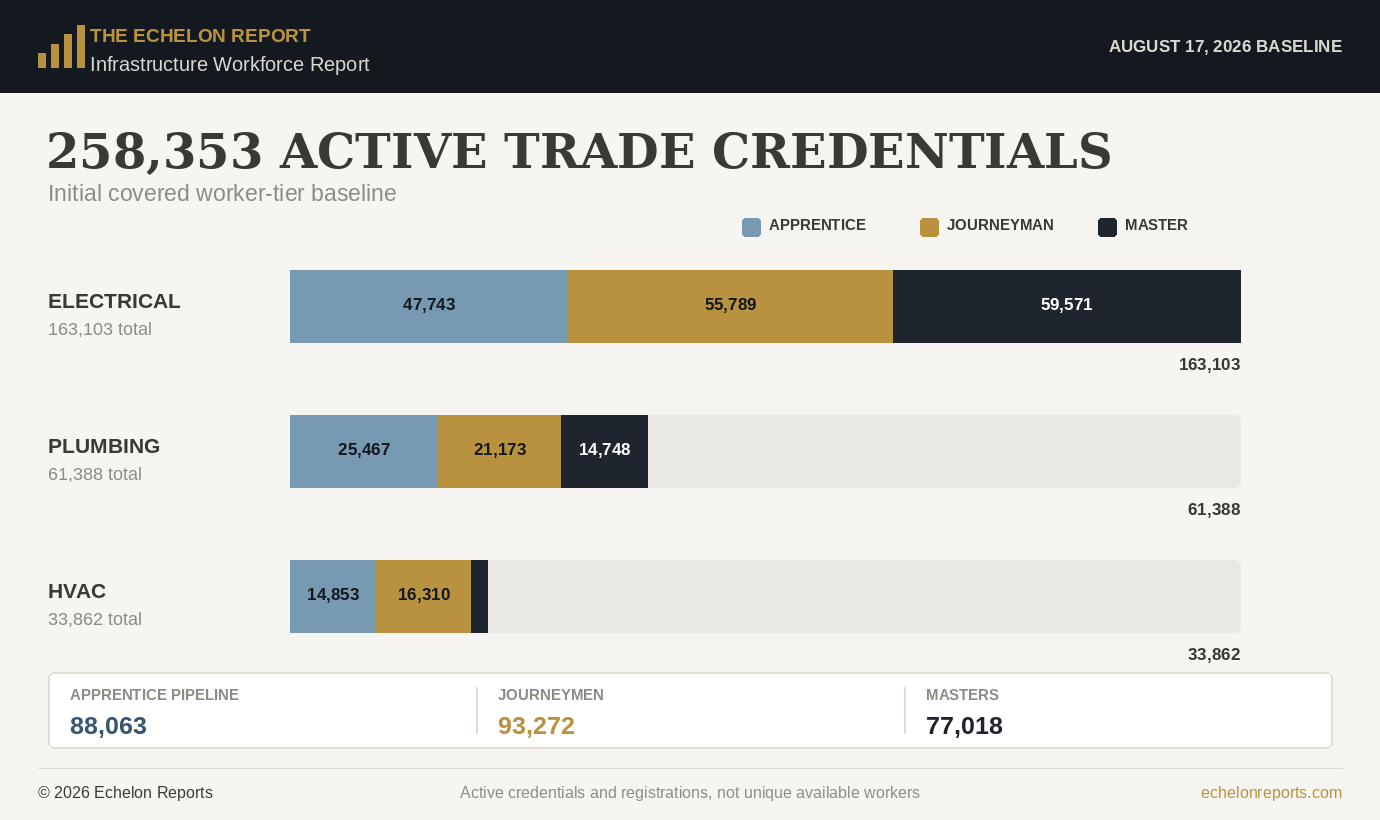
The August 17, 2026 baseline counted 258,353 active electrical, plumbing, and HVAC credentials in the covered states and tiers. That included 163,103 electrical, 61,388 plumbing, and 33,862 HVAC credentials.
These are credentials, not 258,353 unique workers. They do not prove that a worker is employed, available, willing to travel, or qualified for a data center assignment.
The numbers that define the problem
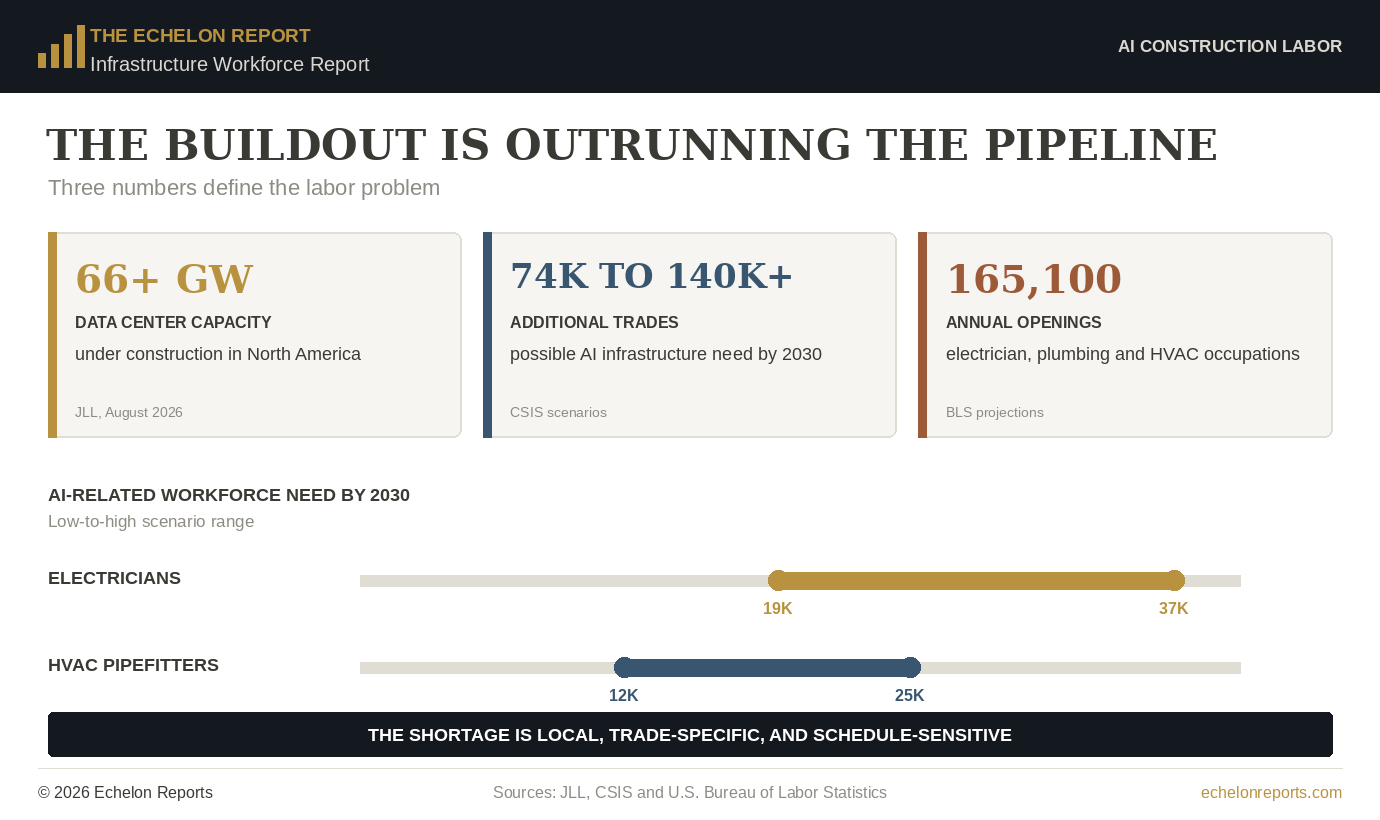
| Measure | Current figure | What it tells us |
|---|---|---|
| North American data center capacity under construction | More than 66 GW | The construction wave is already in the field, not merely announced.[7] |
| Share under construction in frontier markets | 77% | Much of the work is moving beyond established data center labor pools.[7] |
| Potential additional skilled-trade demand from generative AI by 2030 | About 74,000 to more than 140,000 | The range is large, but every scenario requires material workforce expansion.[1] |
| Potential additional electricians | 19,000 to 37,000 | Electrical labor is one of the clearest constraints in every AI buildout scenario.[1] |
| Potential additional HVAC pipefitters | 12,000 to 25,000 | Cooling and mechanical systems create a second major labor requirement.[1] |
| Annual electrician openings projected by BLS | 81,000 | The market must replace workers who retire or leave while also supporting new demand.[2] |
| Annual plumbing and pipefitting openings projected by BLS | 44,000 | AI projects compete with every other user of the same trade workforce.[3] |
| Annual HVAC openings projected by BLS | 40,100 | Cooling demand arrives in a labor market already handling replacement pressure.[4] |
| Additional construction workers ABC says the industry must attract in 2026 | 349,000 | Data centers are competing inside a wider construction labor shortage.[6] |
| Echelon active tiered credentials in the initial covered database | 258,353 | This is the starting measurement base, subject to explicit coverage limits. |
National totals can hide a local shortage. A Minnesota credential does not fill a West Texas job. Residential electrical experience does not automatically qualify someone for medium-voltage work or data center commissioning. Apprentices also need supervision and time in training before they can take on journey-level work.
The relevant question is whether qualified people can work on this project during its construction window while other projects draw from the same market.
Check the required trades, location, schedule, and competing projects before calling a market short of workers.
AI is becoming a physical construction industry
AI infrastructure needs more than chips and utility power. Workers must connect that power to a working server hall.
A large data center needs substations, backup power, distribution, cooling, piping, controls, fire protection, fiber, security, and commissioning. Each system has its own work sequence, labor needs, and inspection rules.
The scale of the electrical load explains why this matters. The Department of Energy reported that data centers consumed about 4.4 percent of U.S. electricity in 2023. DOE projected that share could reach 6.7 to 12 percent by 2028, with total consumption rising from 176 terawatt-hours in 2023 to between 325 and 580 terawatt-hours in 2028.[5]
The labor demand extends beyond the data center. Power plants, lines, substations, and equipment factories need skilled workers too. An electrician may be assigned to a hospital, battery plant, utility upgrade, or semiconductor factory instead of an AI campus.
McKinsey projected more than $250 billion in data center mechanical and electrical procurement and installation spending by 2030. Money can buy equipment, but training hours, licensing, and field experience take time.[12]
Why the national workforce statistics do not answer the local question
The Bureau of Labor Statistics provides the best broad view of U.S. occupations. It counted 818,700 electrician jobs in 2024 and projected 9 percent growth from 2024 to 2034. BLS also projected 81,000 electrician openings a year, with many caused by retirement, occupational transfers, and other exits from the labor force.[2]
For plumbers, pipefitters, and steamfitters, BLS projected 44,000 annual openings and 4 percent employment growth.[3] For HVAC and refrigeration mechanics and installers, it projected 40,100 annual openings and 8 percent growth.[4]
Those figures describe national job openings and growth. They cannot show how many people can take one data center assignment.
Five gaps separate a national occupational estimate from actual project capacity:
- Geography. Construction labor markets are local until travel becomes economical. Per diem, overtime, housing, licensing, and schedule length determine whether workers move.
- Licensing. States classify electricians, plumbers, HVAC workers, contractors, and qualifiers differently. Reciprocity ranges from useful to nonexistent.
- Skill. A license establishes a legal credential. It does not establish medium-voltage, controls, clean-room, industrial refrigeration, liquid-cooling, or commissioning experience.
- Availability. An employed worker is not spare capacity. A license database does not reveal current assignments, overtime, backlog, or willingness to travel.
- Timing. Two viable projects can become a labor bottleneck when their peak electrical or mechanical schedules overlap.
There is no single worker gap that fits every site. Shortages depend on the trade, market, and construction schedule.
What Echelon’s license database sees
Licensing records show active credentials, classifications, status, and recorded locations. Some states also identify business affiliations and changes between snapshots.
Echelon’s first covered baseline contains:
| Trade | Apprentice | Journeyman | Master | Total active credentials |
|---|---|---|---|---|
| Electrical | 47,743 | 55,789 | 59,571 | 163,103 |
| Plumbing | 25,467 | 21,173 | 14,748 | 61,388 |
| HVAC | 14,853 | 16,310 | 2,699 | 33,862 |
| Total | 88,063 | 93,272 | 77,018 | 258,353 |
The first electrical worker-tier panel covers Colorado, Idaho, Kentucky, Minnesota, Oklahoma, Texas, Virginia, and Wisconsin. Plumbing covers Colorado, Idaho, Kentucky, Minnesota, Oklahoma, Rhode Island, and Wisconsin. HVAC covers Idaho, Kentucky, and Oklahoma.
California and Ohio are in Echelon’s database, but these tables count contractor licenses rather than apprentice, journeyman, and master worker tiers. California’s August 15 snapshot has 27,940 clear C-10 electrical contractor licenses, 17,381 C-36 plumbing licenses, and 11,470 C-20 HVAC licenses. Ohio has 3,504 active electrical contractor licenses, 2,740 plumbing, 2,641 HVAC, 866 hydronics, and 693 refrigeration licenses. Adding them to the worker panel would mix different kinds of credentials. Echelon measures contractor and qualifier capacity separately. California worker-level coverage would require Division of Labor Standards Enforcement electrician certification and trainee records. Ohio’s construction licensing board does not publish an equivalent statewide apprentice-to-master roster.
The underlying source observations range from July 31 through August 16, 2026. We aggregated the baseline on August 17.
The 258,353 figure counts credentials in the covered panels, not a national workforce.
One person can hold more than one credential. States also differ in whether they license individual workers, contractors, or qualifying people. HVAC rules can be statewide or partly local.
Each release needs to state its coverage and counting limits alongside its totals.
What license records can tell us
A license record is not a worker-availability record. It is still useful.
Repeated snapshots can show:
- New apprentice registrations
- New journeyman and master credentials
- Renewals, lapses, and reinstatements
- Contractor entry and exit
- Qualifier movement between businesses
- Geographic expansion into another state
- Concentration of scarce qualifying credentials
- The time required for a new cohort to move through the licensing structure
Comparing snapshots can reveal changes worth investigating. Apprentice growth without similar journey-level growth may leave a near-term gap. Concentrated master credentials may leave a market dependent on a few contractors. Flat license counts alongside more project starts may add wage and schedule pressure. None of these patterns alone proves a shortage.
None of those signals confirms that a shortage caused a delayed project. They identify where to look before the delay becomes public.
The apprentice pipeline cannot solve a 2027 deadline by itself
Apprenticeships matter because licensed trades cannot expand without new entrants. They also take time.
In its high-case scenario, CSIS estimated roughly 37,000 additional electricians and 25,000 HVAC pipefitters by 2030. It recommended expanding registered apprenticeships in priority trades by 50 percent.[1]
Google has begun funding that pipeline. In 2025, the company announced support for an electrical training effort intended to reach 100,000 electrical workers and train 30,000 new apprentices. The program aims to increase the electrical workforce pipeline by 70 percent over five years.[8] In June 2026, Google expanded its skilled-trades commitment to $50 million, with a stated goal of helping train more than 300,000 workers through unions and trade associations.[9]
Meta and CBRE launched a separate multiyear program in April 2026 to recruit and train thousands of fiber technicians for U.S. data center construction.[10] The federal AI Action Plan also called for initiatives to increase high-demand occupations such as electricians and HVAC technicians while accelerating data center and semiconductor-fab development.[11]
The training programs show that buyers are investing in future labor supply. They do not show that workers are available for current projects.
Someone starting an apprenticeship in 2026 will not finish the required hours in time to serve as an experienced journey-level worker on a 2027 schedule. Instructors, completion rates, work hours, and supervision rules all affect how many new workers can qualify.
Near-term projects will still rely on the existing workforce, travel labor, overtime, prefabrication, schedule sequencing, and competition among contractors.
The bottleneck will move
Power may be the first obstacle. After a developer secures it, equipment can delay construction. Once the equipment arrives, qualified people still have to install and test it.
Labor shortages rarely stop every project at once. They change the order of completion.
Large owners can pay travel packages, lock in contractors early, standardize designs, and secure manufacturing capacity. Their best response is to reserve labor before the market tightens further. That response makes labor less available to smaller projects, municipal work, hospitals, manufacturers, and local contractors.
Contractors may recruit across state lines, sponsor apprentices, use prefabricated assemblies, or buy firms with licenses and customer relationships. They still need enough supervisors and field crews for the work they accept.
The pressure will not stay inside data centers. It will move through every market that shares the same electricians, pipefitters, HVAC technicians, and equipment.
What this Wednesday series will measure
The Echelon Infrastructure Workforce Report will publish every Wednesday.
We will distinguish changes in long-term labor capacity from weekly changes. Government rosters, apprentice counts, BLS employment data, and project news update on different schedules.
The series will examine five questions:
1. Is the licensed workforce growing?
We will track active credentials by trade and level, then distinguish apprentice formation from journey-level and master capacity.
2. Where is demand arriving?
We will map data centers, power infrastructure, semiconductor plants, advanced manufacturing, and other projects that compete for the same workers.
3. When will projects collide?
A market can absorb one large project and still fail under three overlapping schedules. Timing matters as much as announced capital.
4. Which credentials and contractors are hard to replace?
Qualifier concentration, specialty classifications, reciprocity barriers, and contractor control can turn a modest headcount issue into a serious execution risk.
5. What changed this week?
New licenses, lapses, reinstatements, contractor entry, qualifier movement, project milestones, and schedule changes will form the weekly pulse.
Echelon will consider a capacity index after it has enough history to set a baseline and test the weighting. The first observation alone cannot establish a normal level.
What buyers should watch now
Developers, contractors, utilities, investors, economic-development groups, and equipment suppliers should watch the same early indicators:
- Apprentice growth without matching journeyman growth
- Flat active-license counts during accelerating project starts
- Multiple projects entering electrical or mechanical peak at the same time
- Rising dependence on a small number of master or qualifier licenses
- Interstate expansion by large contractors
- Increased use of travel labor, overtime, and per diem
- Project announcements in markets without an established industrial-trades base
- Training announcements that begin after the construction schedule already needs workers
No single signal proves a market is constrained. Several moving in the same direction deserve attention.
The finding to carry forward
Data center construction also competes with grid upgrades, factories, and existing building work for the same trades.
The country is trying to add tens of gigawatts of data center capacity while replacing workers who retire, expanding the grid, building factories, and maintaining everything already in service. The same licensed trades sit underneath all of it.
Echelon’s initial database is a defined set of dated license records. It does not count every skilled worker in America, but later snapshots can be compared within the stated coverage.
Every Wednesday, we will show what changed.
Workforce intelligence in this cluster
This page is the demand-side hub. The connected reports separate licensed supply, worker-level credential capacity, project demand, and verified mobility.
The supply-and-hiring hub for credential counts, mobility definitions, worker signals, and real Hiring Mandates. How many licensed electricians are there?
Electrical license totals and worker-credential panels, with their different counting rules explained. Piketon, Ohio project file
A site-level view of contractor formation, local licensing capacity, and the gap between announcement and executable workforce. Licensed contractors by state
State-by-state contractor credential coverage, with collection dates and counting rules. Licensed Trades Workforce Board
Current Hiring Mandates, qualified mobility signals, coverage, and privacy-limited public counts.
ECHELON INFRASTRUCTURE WORKFORCE INTELLIGENCE
A national shortage figure cannot tell you whether one market can deliver one project.
Echelon builds market-specific capacity reads from licensing records, contractor and qualifier movement, project schedules, and the local trade structure. The public report publishes every Wednesday.
Methodology and limitations
Echelon assembled the baseline from state records for covered electrical, plumbing, and HVAC licenses. We counted records with active status under each state’s rules. We mapped apprentice, journeyman, and master tiers only where the source supported that mapping.
The unit is an active credential or registration, not necessarily a unique worker. It does not show employment, availability, or data center experience.
State systems use incompatible classifications and publication schedules. Coverage is incomplete and uneven by trade. Counts may include cross-state and cross-tier duplication. We will preserve source-native classifications, snapshot dates, and coverage disclosures as the system expands.
External demand estimates model scenarios or broad job markets, not verified data center vacancies. To assess one project, we need its location, schedule, trades, likelihood, contractor commitments, and whether workers can travel or obtain the needed credentials.
Project, contractor and job questions
How do I find the contractor for a data center project?
Use the company column and open the linked project report. The reports distinguish owner-named general contractors, other construction participants and historical assignments. Confirm which company buys your scope and phase before submitting qualifications.
Does a supplier registration link mean bidding is open?
No. Registration or prequalification starts a company review. An open bid needs an identified buyer, defined package and submission deadline. Ask the issuing company whether it is accepting proposals for the specific project.
Are the listed jobs confirmed campus vacancies?
No. Reports retain the dates and locations of employer advertisements or union dispatch notices. A local listing may cover another site, and an advertised position may already be filled. Confirm the assignment and terms directly before traveling.
How current is this project index?
Each row shows the research date of its linked report. Construction evidence has a separate date, and forecasts remain forecasts. Updating this hub does not refresh every employer listing, permit record or contractor appointment.
Workforce questions
Is AI causing an electrician shortage?
AI data center projects add electrical work to demand from utilities, factories, commercial buildings, housing, and maintenance. They add pressure but are not the only cause of electrician scarcity.
How many electricians are needed for AI data centers?
CSIS modeled about 19,000 to 37,000 additional electricians for generative AI infrastructure by 2030, depending on the scenario. That range is not a count of current vacancies.[1]
Which skilled trades are needed to build a data center?
Building a data center takes electricians, plumbers, pipefitters, HVAC and refrigeration technicians, welders, fiber technicians, equipment operators, controls specialists, fire-protection workers, and other trades. The mix depends on design, cooling, power, and project phase.
Why are electricians important to AI infrastructure?
Electricians install and maintain the large power systems a data center needs. Their work includes distribution gear, feeders, backup systems, controls, and the connections from utility service to computing equipment.
Can apprentices fill the data center labor gap?
Apprentices help grow the workforce but cannot immediately replace experienced journey-level workers. Required training hours, supervision, license rules, and project demands limit how fast they can work independently.
Does an active license equal an available worker?
No. An active license means the credential met the state’s status rules when Echelon collected the record. It does not show employment, availability, trade experience, location, or willingness to travel.
What will Echelon publish every Wednesday?
The Echelon Infrastructure Workforce Report will track licensing changes, workforce formation, contractor and qualifier movement, project demand, geographic pressure, and evidence of emerging trade bottlenecks.
Sources
- The Generative AI Infrastructure Challenge
- Electricians: Occupational Outlook Handbook
- Plumbers, Pipefitters, and Steamfitters: Occupational Outlook Handbook
- HVAC Mechanics and Installers: Occupational Outlook Handbook
- DOE Evaluates Increase in Electricity Demand from Data Centers
- Construction Industry Must Attract 349,000 Workers in 2026
- North America Data Center Report Midyear 2026
- Google Electrical Worker and Apprentice Training
- Google Skilled Trades Training Investment
- Meta and CBRE LevelUp Technician Training
- America’s AI Action Plan
- AI Power: Expanding Data Center Capacity
- PORTS-Piketon: The contractor and skilled-trades map behind America’s largest proposed AI campus
MIKE WARNER | ECHELON REPORTS
mike@echelonreports.com | linkedin.com/in/jmichaelwarner | x.com/_Mike_Warner
Public-records intelligence. Not accounting, legal, or investment advice.