
What Is Your Roofing Business Worth in 2026?
Editorial update: October 14, 2026. Original reporting dates are unchanged.
Roofing buyers have multiplied, but the price for a shop still depends on its earnings, management, service work, and customer mix. The platform market and a small owner-run company are different valuation cases.
Why roofing, and why now
How hot, exactly
What roofing businesses actually sell for
How a buyer reads your business: assets, liabilities, and booked work
The timing question
Frequently asked questions
- Roofing has attracted institutional buyers. Demand and margins still vary with weather, insurance, customer budgets and local conditions.
- Reported private-equity-backed platform counts rose from about 17 in early 2023 to 56 by late 2024. Those totals do not establish a constant acquisition pace.
- The quoted 2.0-to-2.7 SDE range and larger-company EBITDA ranges concern different business tiers and earnings definitions. They are benchmarks, not offers.
- Service contracts, management depth, financial records and business risks affect an offer. No single improvement guarantees a particular multiple.
- Review obligations and the time needed to address them before negotiations. The appropriate preparation period depends on the business.
A roofing owner may hear from local competitors and private-equity-backed buyers. The number of interested parties varies by market and company. The buyer for a roofing company depends on its location, service mix, and scale. Reported platform deal counts are not a promise of bidders for a particular shop.
Reported deal activity shows why roofing owners are hearing from more buyers. This review separates that market activity from the valuation of an individual shop, including the risks that can move an offer below a headline multiple.
Why roofing, and why now
Roofing has drawn institutional buyers, as discussed in The Great Trades Roll-Up. Repair and replacement demand varies with weather, insurance, and household budgets. A national deal count cannot predict the offer for one shop.
Roof repair and replacement can be necessary work, but demand and margins vary by market, storm exposure, insurance coverage, and customer budgets. A reported estimate about replacement and repair does not make every roofing dollar recession-proof or recurring.
KPMG estimated a $50 billion to $100 billion roofing market and put the two largest operators’ combined share near 4 to 6 percent. Census counted roughly 25,500 roofing firms with employees, fewer than one in ten with at least 20 people. These measures use different definitions and periods; neither count establishes a buyer for an individual company.
How hot, exactly
Industry trackers reported an increase in private-equity-backed roofing platforms from roughly 17 in early 2023 to 56 by the end of 2024. Counts depend on the tracker’s definitions and do not show how many bidders would pursue an individual business.
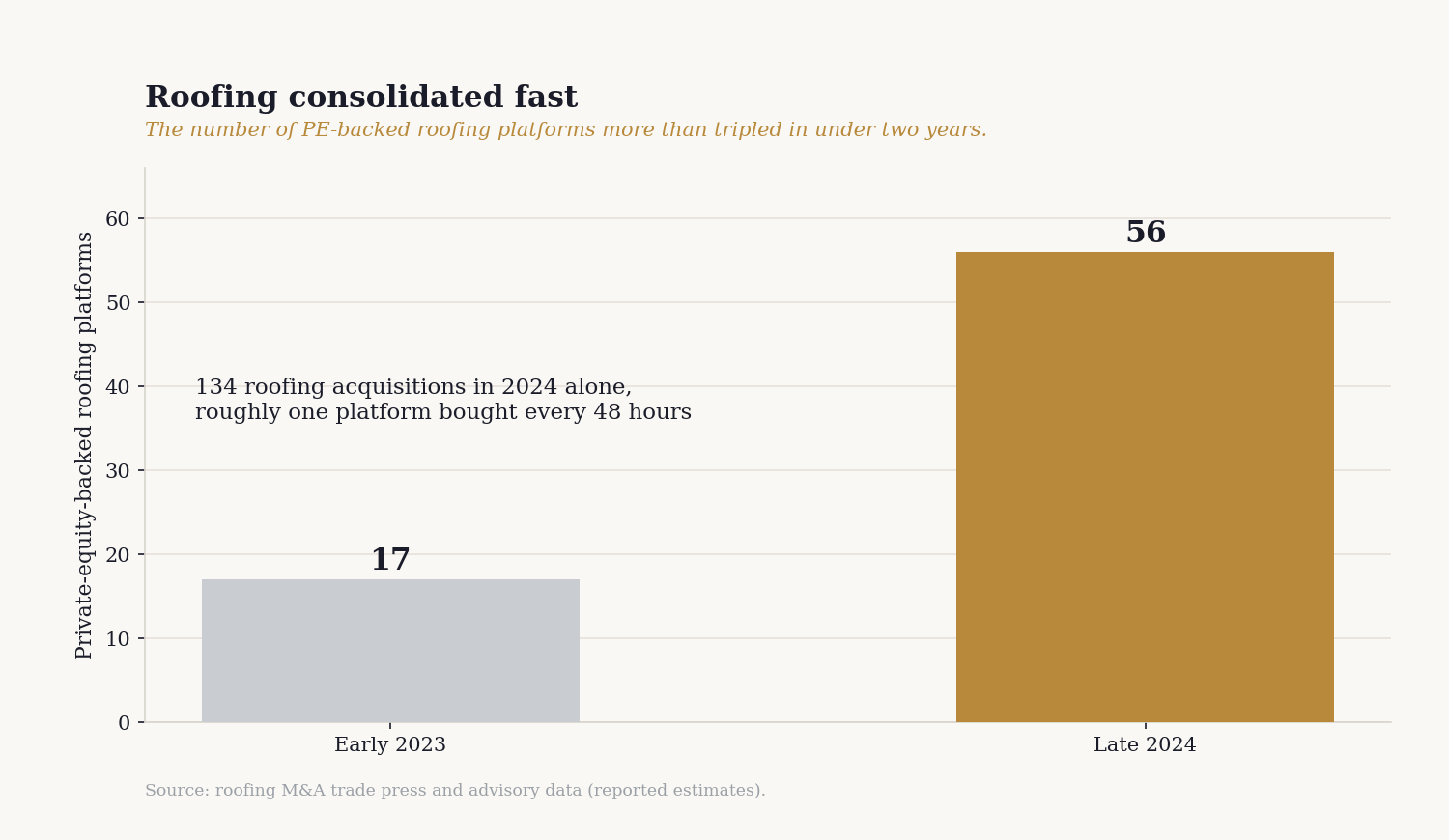
More buyers can give a seller choices, but the article’s reported dozen-or-more bidders applies to some deals rather than every roofing company. Owners need to know whether a buyer sees their shop as a platform, an add-on, or a business that requires management changes before it can be acquired.
What roofing businesses actually sell for
Roofing valuations differ substantially between owner-run shops and larger businesses with management and recurring work. Compare offers within the right size and earnings tier rather than using a platform multiple as a benchmark for every sale.
At the smaller end, buyers may use seller’s discretionary earnings for owner-operated shops. The cited 2.0-to-2.7 range is a trade benchmark, not an offer to every company with $1.5 million to $5 million in revenue. Recast expenses and owner compensation before comparing multiples.
Larger roofing businesses with management and documented service work are often assessed using EBITDA. Reported ranges from larger deals cannot be applied to a smaller shop without adjusting for earnings quality, customer mix, and transaction terms.
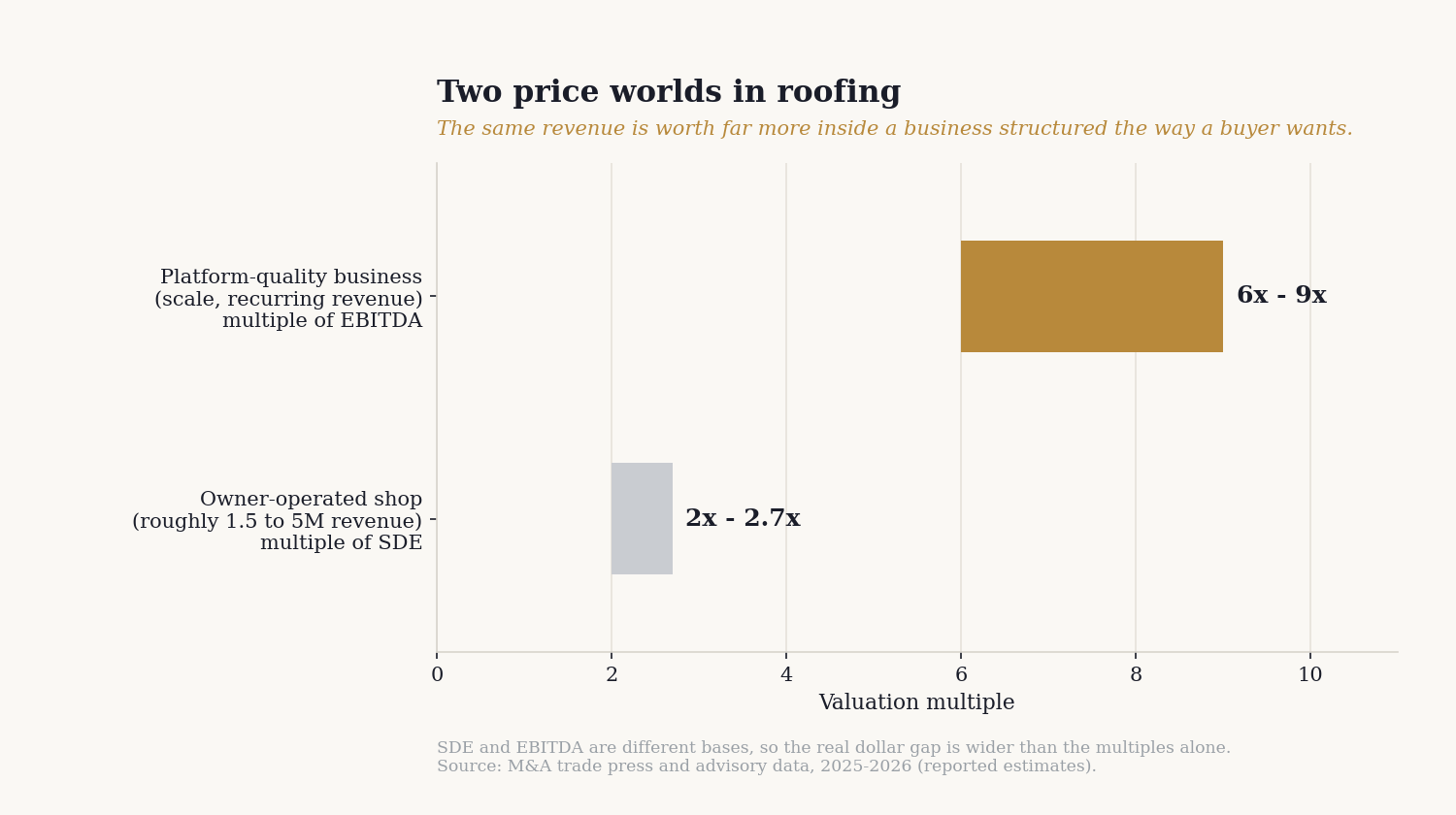
The valuation gap depends on more than one factor. The one number that decides what your trades business is worth discusses service agreements; management depth, financial records, and risk also matter. Compare the basis of each offer rather than assume a platform multiple is available.
How a buyer reads your business: assets, liabilities, and booked work
A buyer examines future cash flow rather than revenue alone. Service contracts, management depth, and crew stability can support that assessment. Owner dependence, concentration in a few customers, and unresolved warranty claims can reduce it. Review those items before using a reported industry multiple to estimate the value of your own company.
What a buyer can assess includes crew stability, equipment, licenses, safety records, service contracts, and the sources of new customers. Verify whether a designation or license can transfer after a sale rather than assuming it will. Signed commercial contracts may make future work easier to forecast, but renewal rates, margins, and concentration matter. Website and review performance can be assessed; they are not automatically transferable assets or guaranteed leads.
Risks a buyer tests include debt, leases, owner dependence, customer concentration, warranty claims, safety records, litigation, and reliance on one lead channel. A concentration threshold is not universal. The buyer will price the specific contracts, crew, and obligations rather than apply one rule to every roofing business.
Booked work needs diligence. Check which jobs are signed, their projected margin, customer payment risk, and whether the crew can complete them without the owner. Backlog ends when those jobs are done; a service contract may renew, subject to its terms and fulfillment costs. TopBuild’s reported roughly $810 million Progressive Roofing transaction illustrates interest in commercial roofing, but it does not prove a higher price per dollar for every service contract.
The timing question
An early offer can undervalue a roofing company that still needs clean financials, management depth, and documented service revenue. Waiting indefinitely carries its own risk: reported multiples have eased from their peak even as buyers remain active. Prepare the records and team a buyer will test, then judge an offer against the business as it exists, not against a hoped-for future cycle.
A roofing owner can choose to sell or remain independent. Either decision is easier with clear earnings, a stable crew, customer records, and a realistic view of which buyers would consider the business.
Frequently asked questions
What is my roofing business worth in 2026?
A buyer may use seller’s discretionary earnings for a smaller owner-operated shop and EBITDA for a larger business with management depth. The quoted ranges are trade benchmarks, not a current valuation of your company. Check the earnings definition and offer terms before comparing them.
Are roofing companies actually in demand right now?
Reported counts show private-equity-backed roofing platforms increased from roughly 17 in early 2023 to 56 by the end of 2024. Activity varies by place and by the size of the target; the national count does not establish that your business will receive an offer.
How do I get a higher multiple for my roofing business?
Document service agreements, develop managers, keep reliable financials, and track warranty and safety obligations. Commercial work may help if contracts and margins support it. None of these steps guarantees a particular earnings multiple.
Should I sell my roofing business to private equity?
Selling to private equity depends on your goals, the offered price, debt and rollover terms, and whether you want to stay in the business. Compare more than the headline multiple and seek professional advice on the agreement.
What hurts a roofing business’s valuation?
Owner dependence, customer concentration, incomplete books, warranty or safety exposure, litigation, and reliance on one lead source can reduce an offer. Review each risk and its cost to correct before entering negotiations.
Does commercial or residential roofing sell for more?
Commercial roofing may bring longer customer relationships and service agreements. Whether it earns a higher valuation depends on contract duration, renewal history, concentration, safety risk, and margins; this article does not establish a premium for every commercial mix.
This is the national picture. Your market is its own story: how many scaled roofing operators actually compete in your metro, which platforms are already buying there, what the demand signals say, and where your business stands in that field. That market-specific read is exactly what an Echelon Intel Report delivers, built from the same data behind this analysis.
The Great Trades Roll-Up: why Wall Street buys some trades and walks past others
The one number that decides what your trades business is worth
Electrical is the next HVAC: what your business is worth before the wave peaks
Methodology and sources. Establishment counts and the scaled-tier share are from U.S. Census County Business Patterns 2023. Market-size and concentration figures are from KPMG Corporate Finance. Platform counts, deal cadence, and valuation multiples are aggregated from M&A trade press and advisory data and are presented as reported estimates, not audited figures. Transaction values are from public announcements. Echelon takes no position on whether any owner should buy, sell, or hold.