Echelon Reports · Water & Underground Infrastructure
Water and underground infrastructure construction covers the pipes, drains and buried utility networks that serve towns, cities and industrial sites. Crews build water lines, repair sewers and manage stormwater. They use open trenches as well as methods such as horizontal directional drilling, hydro excavation and trenchless pipe repair.[1][2][8]
Use this guide to find work that fits your skills, check employer and training routes, and assess what a project announcement means for your business. The examples below separate approved funding from work advertised for bids. Employer links lead to their own career pages. Check each listing for its location and terms.
Looking for work or hiring a crew?
Echelon Trades Jobs accepts employer openings and private worker-interest profiles across construction trades. Listings and worker-interest forms are free. Employers make hiring decisions; a worker profile is not a job application or a promise of placement.
For direct applications, use the employer routes below. Before accepting an assignment, confirm the location, employer, pay, overtime, travel arrangements and expected duration. Do not travel on the strength of a project announcement alone.
Roles, locations and application requirements
These employer pages were checked on October 28, 2026. The first four links open individual listings; L&M describes roles on its general careers page. These are application leads, not employer-confirmed unfilled positions, and none is tied to the Tennessee projects below.
| Employer and role | Location | Work | Requirements to compare |
|---|---|---|---|
| Insituform / Azuria: Laborer[22] | Layton, Utah | Sewer and stormwater rehabilitation; CIPP experience preferred. | High-school diploma or equivalent; 2+ years of outdoor construction; up to 70% overnight travel. |
| AQUALIS: Sewer CCTV Technician[23] | Edmonds, Washington | Camera inspection of sanitary, combined and storm sewers. | CCTV pipeline-inspection experience; unrestricted driver’s license; occasional nights, weekends and out-of-town work. |
| AQUALIS: Vac Truck Driver – Operator[24] | Edmonds, Washington | Vacuum-truck work includes hydro excavation and catch-basin cleaning. | Class B CDL; at least 1 year of recent Class B driving; DOT health-card eligibility. Vacuum-truck experience preferred, not required. |
| AQUALIS: Landscape Technician (ASDM)[25] | Elkhorn City, Kentucky | Stormwater drainage and pond maintenance. | Landscaping-equipment and truck/trailer experience; driver’s license; regional overnight travel 4–5 days a week; DOT medical certification. |
| L&M: Utility Excavation Laborer[19] | Colorado careers page; confirm assignment | Utility potholing, hand excavation, restoration and pipe/cable handling. | Excavation experience preferred, not required; valid driver’s license and clean record; background check and drug screen. General careers route, not an individual requisition. |
Entry routes depend on the role
L&M’s laborer description gives a practical starting point for applicants without excavation experience: experience is preferred rather than required. Its CDL driver/excavator role instead requires a Class A license or permit and previous excavation experience. Its HDD operator and locator roles require at least three years of experience.[19]
AQUALIS’s vacuum-truck listing offers a different transition for an experienced Class B driver. It requires recent commercial driving experience but treats vacuum-truck experience as preferred. Compare these requirements before paying for training, and ask the employer which qualifications must be in place before you apply.[24]
Seven specialties, different equipment and experience
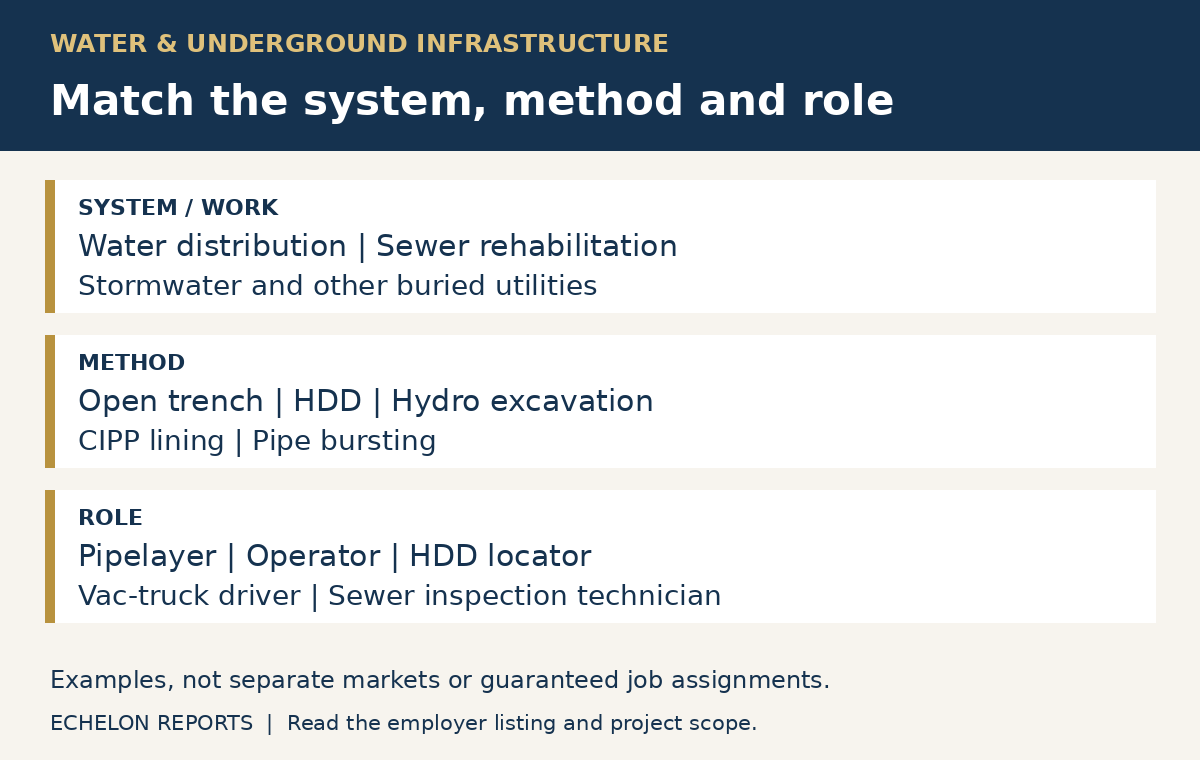
Water distribution and stormwater describe the systems being built. Sewer rehabilitation means work on an existing sewer system. HDD and hydro excavation describe methods. Trenchless work includes several ways to install or repair pipe. One contractor can work across these groups, so they are not seven separate sets of companies.[1][2][3]
Water distribution
Water-main and service-line crews install or replace the pipes and connections that carry drinking water. EPA funding rules cover these systems. The owner’s plans set the pipe size, material and other work requirements.[1]
Look for pipelayer, laborer, equipment operator and pipe-installation roles. Garney’s craft board lists these kinds of work. Check the location and skills required for each role.[11]
Water distribution construction jobs: employers, pay and crew requirements. Compare employer application routes, experience requirements and travel questions in the first report in this series.
Sewer rehabilitation
Sewer repair can renew a pipe rather than dig up the whole line. Cured-in-place pipe, or CIPP, forms a lining inside the old pipe. Pipe bursting breaks the old pipe and pulls in a new one along its route.[4][5]
Check the method in the plans before approaching an employer or buyer. Pipe lining and replacement need different tools and skills. NASTT offers separate courses for these methods.[13]
Sewer rehabilitation jobs: pay, requirements and employers. Compare inspection, cleaning, lining and pump-support roles, with employer application links and an offer checklist.
Stormwater management
Stormwater work includes drainage pipes and structures as well as green infrastructure such as bioretention and permeable pavement. EPA identifies both green and gray infrastructure within its stormwater financing guidance.[2]
Read the actual scope: excavation and pipe installation call for different experience from planting, surface work or ongoing maintenance. Granite’s craft careers page identifies equipment, concrete, traffic-control and general-labor routes.[12]
Horizontal directional drilling
HDD installs a new underground line through a pilot bore that is enlarged before the product pipe is pulled into place. It is a construction method used for crossings and utility installations, not a separate type of water system.[3]
Drill operation and tracking are different responsibilities. L&M Underground describes both HDD operators and locators, including digital tracking, utility verification and work to the bore specifications.[19]
Hydro excavation
Hydro excavation uses water and vacuum equipment to expose buried lines or remove soil. Vacuum units also support HDD crews. Ground conditions, site access, water supply and the material being removed affect which machine fits the job.[6][7]
Compare the truck or trailer duties with your skills. L&M’s CDL driver/excavator role combines hauling with equipment and potholing work. Its license rules apply to that role, not to every helper in the industry.[19]
Trenchless technology
Trenchless methods include new installation and rehabilitation. HDD, CIPP and pipe bursting solve different problems. The project design and existing pipe condition determine which method is suitable.[3][4][5]
Trenchless does not mean excavation hazards disappear. OSHA’s HDD guidance addresses underground utility strikes and the entry or receiving excavations that can remain part of the work.[21]
Underground utility construction
Underground utility construction covers several kinds of buried networks. NUCA represents utility and excavation contractors. Each company has its own mix of equipment, skills and places where it works.[8]
A utility contractor’s service list does not tell you where you will work. L&M describes electric, communications, gas, water and sewer work. Ask which crew and project the role supports.[19]
Employer and training routes
Start with a role you can describe precisely: pipelayer, equipment operator, HDD locator, vacuum-excavation driver or lining technician. Search by location and read the employer’s application requirements. The routes below are selected resources, not a count of open jobs or endorsements of particular employers.
| Route | What you can use it for | Check before applying |
|---|---|---|
| Garney skilled-craft board | Search craft roles including labor, pipe installation and equipment operation.[11] | Read the individual listing for location, qualifications and current availability. |
| Granite craft careers | Find the company’s craft categories and link to its recruitment system.[12] | Granite works across infrastructure sectors; a craft opening is not automatically a water-project assignment. |
| L&M Underground careers | Compare published laborer, CDL/excavator and HDD operator/locator duties.[19] | Confirm the actual work location, requirements and whether the role is still being filled. |
| Apprenticeship Finder | Search registered apprenticeship opportunities by occupation and location.[15] | Apply through the sponsor’s route and check intake dates. Search results do not guarantee a training place. |
| NASTT training | Compare courses covering HDD, CIPP, pipe bursting and other trenchless methods.[13] | Check the current course calendar, fees and suitability for your experience. |
| NUCA training | Review excavation safety, confined-space and crew-leader courses.[14] | The published NUCA training programs are available to member companies. Ask your employer about access. |
Excavation work requires appropriate safety controls regardless of the job title. OSHA requires utility-location steps and competent-person inspections, with protective-system requirements addressed separately. Training information in this guide is not a substitute for an employer’s site-specific safety procedures.[9][10]
Project examples: financing is different from a bid
The following Tennessee examples show two different stages of work. They are selected source-backed cases checked on October 28, 2026, not a national inventory. Follow the owner’s latest documents before relying on a deadline or approaching a contractor.
| Check | McKenzie | Columbia |
|---|---|---|
| Owner and location | City of McKenzie, Tennessee | City of Columbia, Tennessee |
| Work | About 5,000 feet of six-inch water line; 120 calendar days | Treatment-capacity expansion of 12 million gallons per day |
| Verified stage | Bid advertisement | TDEC loan announcement, August 17, 2026 |
| Next step | Confirm addenda and November 5, 2026, 10:30 a.m. Central deadline | Find the owner’s procurement notice and package schedule; neither verified here |
| Company role | GRW Engineers supplies bid documents; contractor award not verified | No construction contractor identified in the cited financing announcement |
| Contractor route | Obtain complete documents and join the engineer’s plan-holder list | Confirm the buyer and qualification requirements for the actual package |
| Worker route | No project-specific hiring verified; use named employer listings | No project-specific hiring verified; financing is not a job application |
McKenzie, Tennessee: water-line construction
The city’s 2025 CDBG water-system advertisement describes approximately 5,000 linear feet of six-inch water line and allows 120 calendar days for construction. The advertised bid deadline is November 5, 2026, at 10:30 a.m. Central. The notice does not disclose a contract value.[18]
The advertisement requires qualified licensed general contractors to obtain the complete bid documents from GRW Engineers and appear on the engineer’s plan-holder list. Confirm the current deadline and any addenda with the issuing authority. This is procurement evidence, not a job advertisement.[18]
Read the city’s bid advertisementColumbia, Tennessee: treatment expansion
TDEC announced a $75 million drinking-water loan on August 17, 2026, for a 12-million-gallon-per-day treatment-capacity expansion. That financing decision identifies a substantial water project, but the announcement is not an invitation to bid or a list of hiring contractors.[17]
Contractors should look for the owner’s procurement documents and package responsibilities before preparing a proposal. Workers need a named employer and a current application route; the financing amount alone does not identify either.
Read the TDEC financing announcementHow contractors reach the work
Start with the utility, municipality or other project owner. Tennessee’s GO-BID grant page links to local procurements, but the local entity holds the documents and answers questions. The page removes notices after 45 days, so retain the original advertisement and follow the owner’s subsequent records.[16]
For each opportunity, establish who buys your scope: the owner, a general contractor or a specialist subcontractor. Check the package, license and bonding requirements, plan-holder rules, addenda and submission deadline. McKenzie’s notice shows why a public link alone is not enough to qualify a bidder.[18]
- 1. Need identifiedA plan describes required improvements.
- 2. Financing approvedA funding decision has conditions and a defined scope.
- 3. Package advertisedA buyer publishes requirements and a deadline.
- 4. Contract awardedAn award identifies a contractor and scope.
- 5. Construction underwayDated evidence shows work on site.
- 6. Employer recruitingA named employer provides an application route.
Echelon’s reporting checklist, not a universal project schedule. Packages can overlap, and employers may recruit before construction starts. Verify each claim separately.
Check Tennessee’s local grant procurement links or use the relevant owner’s procurement page for other states.
Companies, capabilities and ownership
Ownership research helps distinguish a local operating company from a larger platform. Azuria announced its combination with Inframark in April 2026, bringing infrastructure rehabilitation and water operations into the combined business. Those activities are related, but they do not involve identical equipment, customers or field roles.[20]
When comparing contractors, record the operating name, documented specialty, service territory and ownership evidence separately. A company can perform several methods under one ownership structure. An acquisition announcement does not tell a worker which entity will employ them or tell a subcontractor which office buys their services.
For related large-project work, see Echelon’s data-center construction reports. Use the same distinction there between project participants, awarded scope and verified employment routes.
Questions about work and project status
Do these project examples mean jobs are available?
No. A financing announcement or bid notice establishes a project stage, not a vacancy. Use the employer’s application route and confirm the location, work assignment and employment terms directly.
Are HDD and trenchless construction the same thing?
HDD is one trenchless installation method. Trenchless work also includes methods such as CIPP lining and pipe bursting, which address existing pipelines differently.
Where should an entry-level worker start?
Compare an employer’s laborer requirements with your experience, or search registered apprenticeships by occupation and location. Entry requirements and recruitment dates belong to the employer or apprenticeship sponsor.
Can an employer post a water or underground utility job?
Yes. Echelon Trades Jobs accepts construction and related trades openings for review. Listings are free. Submit the actual employer, location, role, application route and closing date; submission does not publish a listing automatically.
Does this guide cover every contractor or project?
No. It covers selected specialties, employer resources and documented project examples. Each source has its own date, and a hub update does not refresh every employer listing or procurement document.
Put your trade and location on record
Tell Echelon what work you want, where you can work and whether you are willing to travel. Your worker-interest profile stays private. Employers can submit a real opening for review through the same jobs service.
Read the jobs privacy and listing termsSources and reporting method
Research checked October 28, 2026. This guide uses public-agency documents, technical association definitions and first-party employer pages. Product descriptions identify equipment capabilities rather than independent performance tests. Career resources are links to inspect, not employer-confirmed vacancies. No job totals, wage estimates or complete contractor counts are inferred from these sources.
- Drinking-water infrastructure eligibility
- Stormwater infrastructure and financing
- Horizontal directional drilling
- Cured-in-place pipe
- Pipe bursting
- Vacuum excavation on HDD sites
- Vacuum excavation equipment
- About underground utility construction
- Excavation safety requirements
- Protective systems
- Garney skilled-craft careers
- Granite craft and skilled trades
- NASTT training
- NUCA member training
- Apprenticeship Finder
- Tennessee local grant procurement notices
- Columbia drinking-water financing
- McKenzie bid advertisement
- L&M Underground careers
- Azuria and Inframark combination
- HDD utility-strike prevention
- Azuria Laborer employer listing
- Aqualis Sewer Cctv employer listing
- Aqualis Vac Driver employer listing
- Aqualis Landscape Tech employer listing