

The One Number That Decides What Your Trades Business Is Worth
Of everything that moves a trades valuation, one factor moves it most. Here is why recurring revenue is the lever, what counts and what does not, and how to build it whether or not you ever plan to sell.
Why recurring revenue is the lever
What actually counts as recurring revenue
What it is worth
How to build it
Why most trades shops never do
Frequently asked questions
- Recurring, contracted revenue is the single biggest lever on what a trades business is worth, more than size, reputation, or even profit.
- A high share of recurring revenue commonly adds one to two turns of EBITDA to the multiple, because predictable cash flow is discounted far less than work that must be won again every year.
- The test is simple: would the revenue still arrive next year if you stopped selling? If yes, it counts. Project backlog and break-fix work do not.
- The lever does not require growing the business. It requires changing the composition of the revenue you already have, which is why it sits almost entirely in the owner’s hands.
- It is available to every operator and built by few, which is exactly what makes it worth so much.
Two roofing companies sit a few miles apart. Same trade, same town, same five million in revenue, same trucks and crews. One sells for four and a half million. The other sells for six and a half. The difference is not size, not reputation, not even how much profit they make. It is that the second company built a stream of revenue that comes back on its own, and the first one starts every January at zero. How much of your revenue repeats without being re-sold moves a trades valuation more than anything else you control.
This is the lever the rest of this series keeps pointing at. The roofing breakdown and the electrical breakdown both come back to it, because it is the one factor that works across every trade and sits almost entirely in the owner’s hands. We are not here to push you toward an exit. The goal is to show you the lever clearly enough that you can decide what to do with it.
Why recurring revenue is the lever
A buyer is not really buying your trucks or your past results. They are buying your future cash flow, and then discounting it for risk. That discount is where recurring revenue does its work. One-time project revenue has to be won all over again next year. It is real, but it is uncertain, so a buyer marks it down. Recurring revenue under contract arrives whether or not anyone goes out and sells it again. It is predictable, so it is barely marked down at all, and predictable cash flow commands a higher multiple than the same dollar of unpredictable cash flow.
Put plainly, recurring revenue is an annuity living inside an operating business. It is the closest a trade comes to the kind of income a buyer can underwrite with confidence, which is why it ties directly to the demand-durability filter we laid out in The Great Trades Roll-Up. A dollar that repeats on its own is simply worth more than a dollar you have to chase, and the gap between the two is where most of your valuation is won or lost.
What actually counts as recurring revenue
This is where owners fool themselves, so it is worth being strict. Recurring revenue is revenue that is committed in advance and would keep arriving without a new sale. That means signed service agreements and maintenance contracts, membership plans that auto-renew, monitoring and subscription fees, and standing commercial service accounts under contract. A homeowner on an annual maintenance plan, a property manager on a service contract, a building on a monitoring subscription: those are recurring.
What does not count is the part owners want to count most. Loyal customers who “always call us” are not recurring unless something is signed, because loyalty cannot be transferred to a buyer on paper. Break-fix and on-demand work is not recurring, because nothing commits the customer to next year. And project backlog, however large, is not recurring. Backlog is finite. It proves demand exists and it smooths a transition, but it runs out, and a buyer underwrites it as a one-time asset, not a stream. The clean test cuts through all of it: would this revenue still arrive next year if you stopped selling? If the answer is yes, it counts. If the answer is no, it does not, no matter how reliable it feels.
What it is worth
The premium is large and well documented. Across home-services mergers and acquisitions, a high share of recurring, contracted revenue commonly adds one to two turns of earnings before interest, taxes, depreciation, and amortization (EBITDA) to the multiple a business commands. A shop that would trade around five times earnings as a project-based operator can trade closer to seven once a meaningful share of its revenue is contracted and repeating.
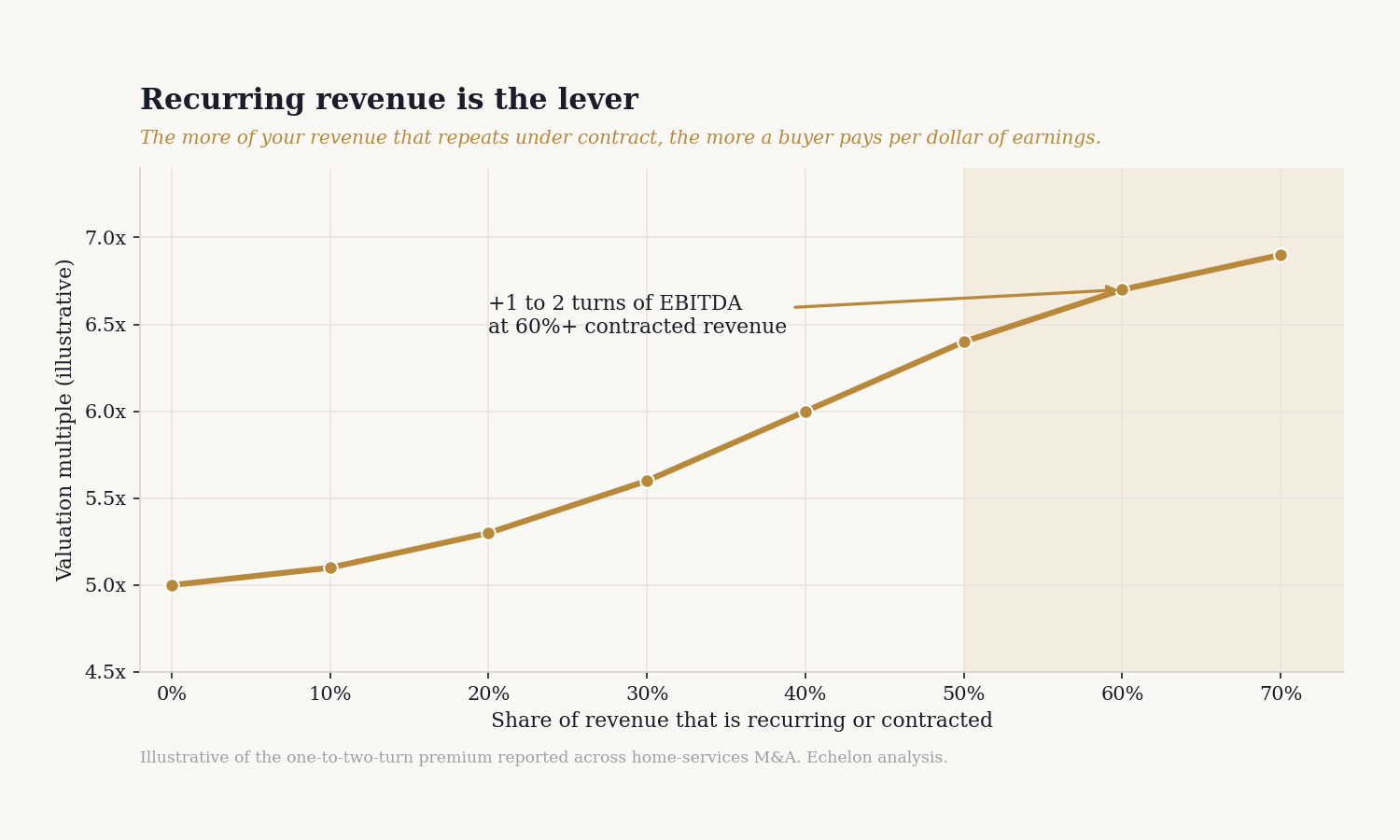
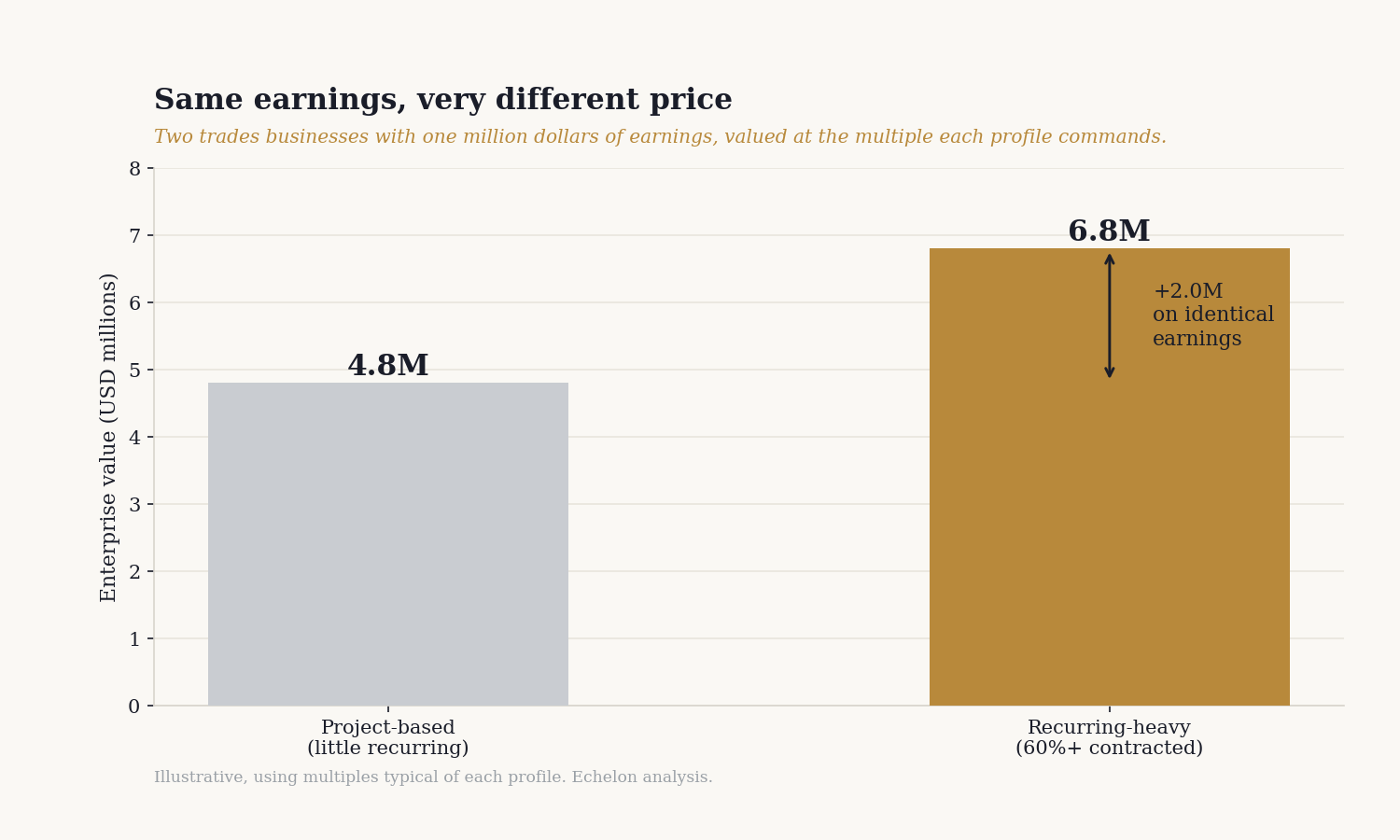
The reason this lever matters so much is that it works on the multiple, not just the earnings. Grow your profit and you get paid for the new profit once. Shift your revenue mix toward recurring and you get paid more for every dollar of profit you already make, including all the profit you will make in the years ahead. On a business earning a million dollars, moving from project-based to recurring-heavy can mean roughly two million dollars more in enterprise value on identical earnings. Same trade, same crews, same bottom line, a very different price.
How to build it
The good news is that the raw material walks through your door on every job. Building recurring revenue is mostly a matter of systematically converting work you already do into commitments that renew.
Turn every job into an enrollment. Every install and every repair is a chance to put that customer on a maintenance or service plan before you leave the site. The companies that win at this do not treat it as an upsell. They treat it as the default close on every ticket.
Run a real membership program. An annual or monthly plan with priority scheduling, scheduled visits, and member pricing gives the customer a reason to stay and gives you a renewing line of revenue. The mechanics matter: it should auto-renew, and it should be easy to keep and a small hassle to cancel.
Chase contracted commercial service. Property managers, facilities teams, and builders buy recurring maintenance and service on contract. That work is less glamorous than a big install, but it is exactly the predictable, repeating revenue a buyer pays the premium for, and it tends to come with better customers and steadier cash flow.
Make it contractual, transferable, and visible. A handshake understanding is worth nothing at the table. A signed, assignable agreement is worth a great deal. And it only earns you the premium if a buyer can see it, so track recurring revenue as its own line, report renewal rates, and be able to show exactly how much of next year is already committed. Recurring revenue you cannot prove is recurring revenue you will not get paid for.
Why most trades shops never do
If the lever is this powerful and the raw material is this available, why does most of the industry leave it on the table? Because it is slow, unglamorous, and the payoff arrives years later, at a sale most owners are not thinking about yet. Signing a customer to a maintenance plan does not feel like the win that landing a big install does, so it gets skipped, one job at a time, for years.
That is precisely what makes it a lever rather than a commodity. It is available to every operator and built by few. It is no accident that the largest, most established operators in any market, the bundled home-services platforms that sit at the top of the review counts in our roofing and electrical pulls, are disproportionately the ones running structured membership and service-contract models. They did not get big and then add recurring revenue. They got big because recurring revenue gave them the predictable cash flow to keep buying. The independent operator who builds the same thing, deliberately and early, is building the exact asset the market pays the most for.
And this is the rare lever you can start pulling today, with no buyer in sight and no intention to sell. Every agreement you sign this year compounds quietly into your multiple, whenever and whether you ever choose to use it. That is the whole point. The number that decides what your business is worth is one you can change, starting on your next job.
Frequently asked questions
What is recurring revenue for a trades business?
It is revenue committed in advance that would keep arriving without a new sale: signed service agreements and maintenance contracts, auto-renewing membership plans, monitoring and subscription fees, and standing commercial service accounts under contract. The defining feature is that it repeats on its own rather than having to be won again each year.
How much does recurring revenue raise a trades valuation?
Across home-services M&A, a high share of recurring, contracted revenue commonly adds one to two turns of EBITDA to the multiple. Because the lift applies to the multiple rather than just the earnings, the dollar effect is large: on a business earning a million dollars, it can mean roughly two million more in enterprise value on identical earnings.
What counts as recurring revenue, and what does not?
Use one test: would the revenue still arrive next year if you stopped selling? Signed maintenance plans, auto-renewing memberships, monitoring subscriptions, and contracted commercial service all pass. Loyal but uncontracted customers, break-fix work, one-time installs, and project backlog all fail, because none of them commit the customer to next year.
How do I build recurring revenue in a trades business?
Convert every job into an enrollment on a maintenance or service plan, run an auto-renewing membership program, pursue contracted commercial service work, and make every agreement signed, assignable, and tracked as its own line in your books. Recurring revenue you cannot prove on paper will not earn you the premium.
Is project backlog the same as recurring revenue?
No. Backlog is finite. It proves demand exists and helps smooth a transition, but it runs out, and a buyer underwrites it as a one-time asset. Recurring revenue repeats on its own, which is why a buyer weights it far more heavily.
Does recurring revenue matter for project-based trades like electrical or concrete?
It matters even more, because it is rarer there and therefore more differentiating. A project-heavy electrical contractor that builds a real service-contract and maintenance book stands out sharply from peers living job to job, and that contrast is exactly what lifts the multiple.
This is the lever every trades owner can pull. Your market is its own story: who is consolidating it, how the established operators are built, and where your business stands against them. That market-specific read is exactly what an Echelon Intel Report delivers, built from the same data behind this analysis.
The Great Trades Roll-Up: why Wall Street buys some trades and walks past others
What is your roofing business worth in 2026?
What is your electrical business worth in 2026?
Methodology and sources. The one-to-two-turn recurring-revenue premium is a relationship reported across home-services mergers and acquisitions; the curve and the dollar comparison shown here are illustrative of that relationship, not figures from a single transaction. Operator and review observations are drawn from Echelon’s own pull of roofing and electrical businesses across the 20 largest US metros from Google business listings. Echelon takes no position on whether any owner should buy, sell, or hold.