Issue 002 · Week of July 6, 2026
The Echelon Report, Issue 002: State of the Residential Trades
Editorial update: October 14, 2026. Original reporting dates are unchanged.
The archived 104.0 index was computed July 5 and assigned a July 11 week-ending label. This issue was published July 6. That label identifies the historical reporting slot, not observations collected through July 11.
The Mix Shifts: Search Stays High as Weather Eases
1 · The Number
104.0
down 1.6 on the week, still above the seasonal norm
v1.1 · 5 of 6 live
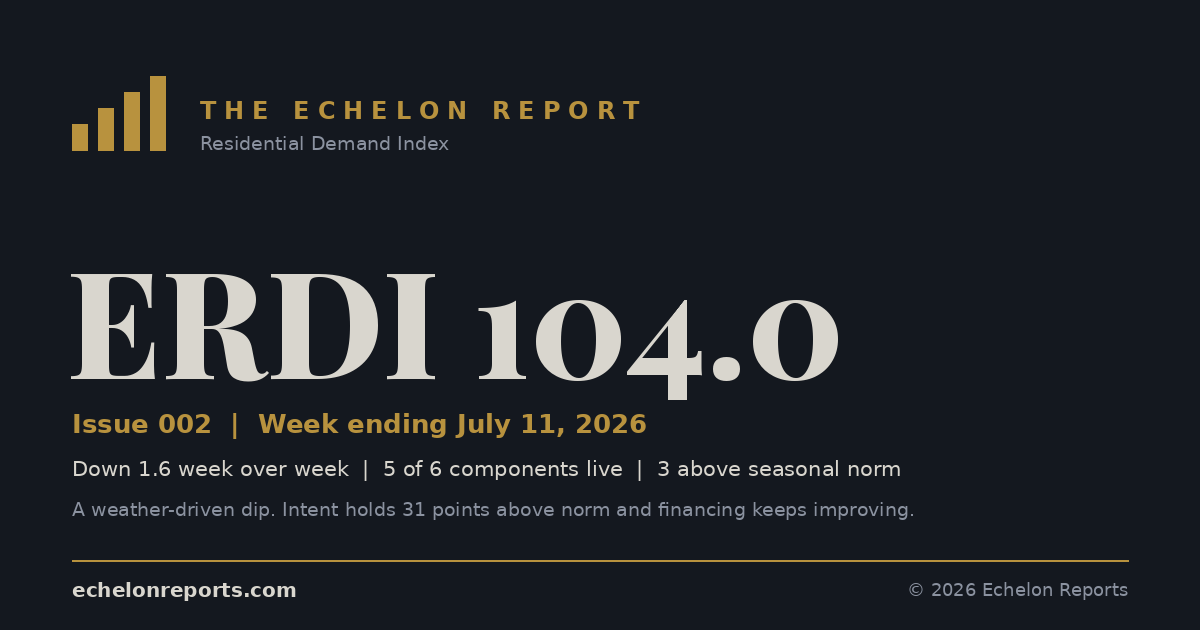
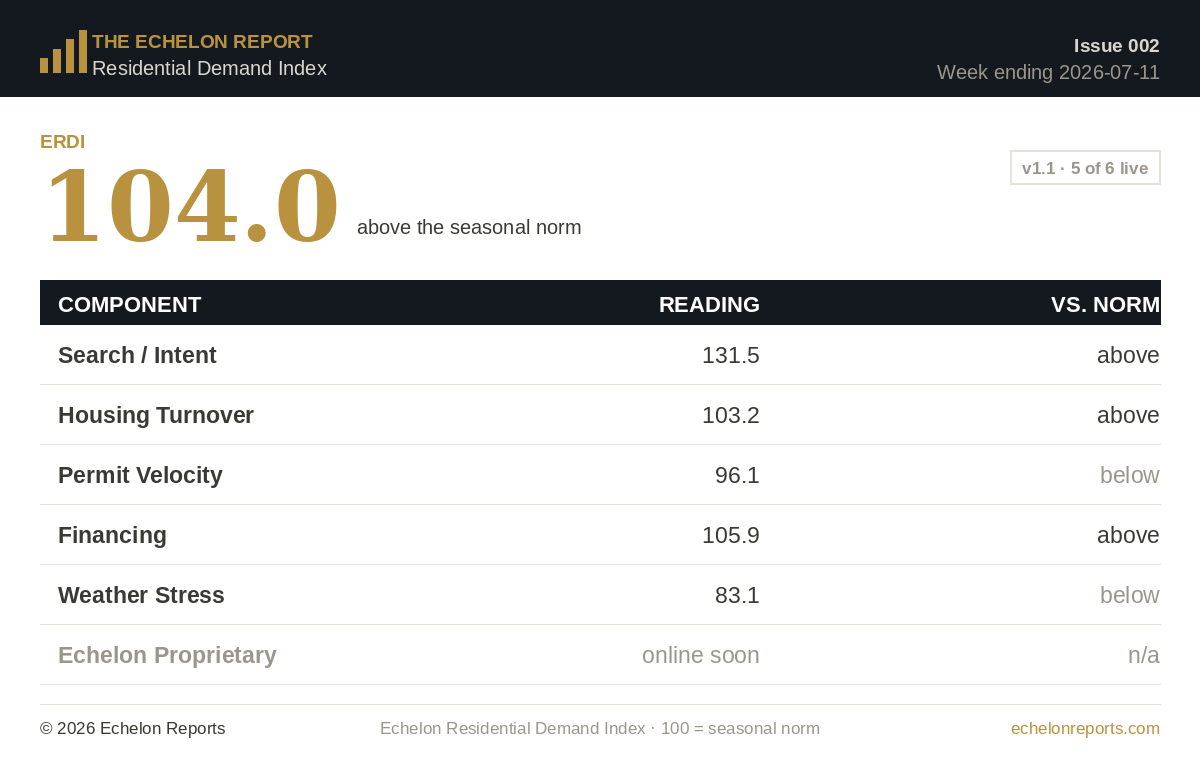
The index stood at 104.0, about 4 percent above its seasonal norm, with three of five live components above baseline. Its first weekly comparison showed a 1.6-point decline from last week’s 105.6, driven chiefly by an 8.2-point drop in the weather-stress component to 83.1 during the milder holiday week. Homeowner search remained at 131.5 despite a small decline, while the financing and housing-turnover components stayed above their seasonal baselines. The two composite readings, 105.6 and 104.0, describe changes in a mix of indicators, not the volume or type of work booked by any shop.
| Component | Reading | Weekly change | Against baseline |
|---|---|---|---|
| Search / Intent | 131.5 | -1.4 | above |
| Housing Turnover | 103.2 | 0.0 | above |
| Permit Velocity | 96.1 | 0.0 | below |
| Financing | 105.9 | +1.4 | above |
| Weather Stress | 83.1 | -8.2 | below |
| Panel review posting | in calibration | Not available | Not available |
Readings are indexed so that 100 equals the seasonal norm. Search and weather are measured against their own recent baselines; financing, turnover, and permits against the same period in prior years.
2 · National Pulse
The holiday week changed the index mix without measuring completed work: weather stress fell below its seasonal norm while homeowner search stayed high. For a contractor, this contrast is a reason to compare local cooling calls with project inquiries and appointments, separating immediate service requests from work customers may schedule later.
Weather stress fell during the holiday week. The component dropped 8.2 points to 83.1, below its seasonal norm, as the interior ran milder than in late June. It uses NOAA station records rather than a forecast to measure the weather load on homes. The lower reading accounts for nearly all of the composite index’s decline; it does not directly count failed cooling systems or emergency calls.
Homeowner searches for trades work stood at 131.5, nearly a third above their recent norm, despite the decline in weather stress. That contrast makes planned projects worth watching: interest did not disappear when the heat eased. The index cannot identify a searcher’s motive or say whether the inquiry became a booked job, so shops should compare it with their own incoming calls.
The tracked 30-year fixed fell from 6.49 to 6.43 percent this week, compared with 6.81 percent a year earlier. Lower rates could change the financing calculation for a household considering a large replacement, but the rate series does not tell us how many households took out a loan or bought a system. The financing component improved to 105.9, up 1.4 index points; an operator still needs its own quotes, approvals and booked projects to assess the effect.
Existing-home turnover held at its strongest level in months while monthly permit data remained below its seasonal norm. That split supports looking for service or replacement opportunities in existing homes rather than assuming a rebound in permitted new construction. It is the second weekly index reading with this distinction, although the permit series itself updates monthly and cannot identify the projects a particular contractor won.
For an operator, the weather and search components point to different scheduling questions. A mild week can reduce the conditions behind urgent cooling calls, while project research continues and may turn into appointments later. Compare calls by trade, bookings and response times with the index before changing staffing or advertising; a national composite cannot describe one shop’s order book.
3 · Regional Spotlight: Midwest-East
OH, IN, MI, KY (regional sub-index online soon)
The Ohio Valley was relatively temperate during the holiday week, which contributed to the lower national weather reading. Meanwhile, the Midwest’s stronger spring home-sales pattern remained a reason to watch resale-related repair and remodeling inquiries. This regional comparison is a lead for checking local calls, not evidence that cooling work vanished or that every home sale produced a project.
The July 5 Ohio roster contains 10,650 distinct credentials in 10,654 company-association rows. The credential counts are 3,512 electrical, 2,761 plumbing, 2,653 HVAC, 884 hydronics, 702 refrigeration and 138 other records. Four credentials have duplicate company-association rows, which explains why the earlier row counts exceeded the distinct total. The company field says ESCROW in 68 rows and is blank in 143; these are 211 association rows, not an additional group of inactive credentials or businesses. License EL.48859 appears with both Rausch Electric LLC and ESCROW in the same file, so that snapshot alone does not establish a dated transition. The named file appears in Echelon Deal Ledger. The separate ownership context is in our owner’s guide to private equity in Ohio HVAC, and the sale process is covered in our guide to selling an electrical business.
4 · The Deal Desk
The Deal Desk examines license and ownership records for possible operator changes. Each signal still needs a company-level check before it supports a transaction claim.
The ownership map connected brands in the Wrench Group, Redwood Services and Trades Holding Company portfolios across the markets covered in this issue. Apex Service Partners, described in the source snapshot as a portfolio of more than 100 names, was planned for later mapping. A candidate map entry requires ownership verification before a brand can be described as having changed hands. The broader acquisition model is discussed in our guide to the trades roll-up.
The Deal Ledger launched in this reporting window. The previous issue examined Sila’s Ohio entry; this issue began tracking the license changes that can prompt further research into a contractor’s ownership or operating position. The Echelon Deal Ledger is a weekly pre-announcement signal brief built from license migrations, escrow events, entries and exits, and platform ownership changes, and Issue 001 opens with a company-association record requiring further verification. Private Deal Ledger coverage monitors five defined markets for $500 per month and begins with an application. Details here.
5 · The Operator’s Edge
Test a furnace offer against July search interest and measure the response.
Furnace-repair search rose 14.8 points to a peak reading in the first week of July, when heating demand would normally be lower. That is an unusual search signal, not evidence that homeowners have already booked furnace replacements. Water heater replacement rose 9.5 points and AC repair 7.5, while window replacement fell 16.2 and kitchen remodel slipped 3.0. An operator can test a furnace offer with existing customers and compare the response before shifting a larger marketing budget toward it. The same caution applies to the other movers: search interest does not by itself establish job volume or margin.
6 · Strategic Lens: Revenue Mix
A shop’s revenue mix matters more to its own planning than a mild week in the national index. Urgent cooling repairs may respond quickly to temperature, while planned replacements often involve estimates and financing over a longer period. At 104.0, the composite combines high search and financing readings with a lower weather measure; that mix suggests comparing the shop’s inquiry types and completion dates rather than treating all demand as interchangeable. Invoices, service agreements and repeat-customer records can then show which work produces durable revenue, something the weekly index cannot determine.
The 104.0 index combines weather, searches, housing and financing, but it cannot distinguish a company’s service revenue from replacement revenue. Operators can compare invoices, booked work and service agreements to see how much of each they actually sold. A buyer assessing the value of recurring service revenue needs those company records, not a premium inferred from this week’s index or an assumed weather-driven increase in value.
7 · The Watch
Watch whether furnace-repair searches rise for a second July week. That would strengthen the case for testing a seasonal offer, but bookings and replacement sales still have to be measured separately.
A broader July heat wave could push the weather component back toward its norm and change the composite again. Local cooling-call logs will show whether that weather shift produces actual work in a given market.
The tracked 30-year rate fell from 6.49 to 6.43 percent this week. The National Association of Realtors identified 6 percent as a possible threshold for more housing transactions; this rate remains above it, and any effect on contractor work would follow later sales and projects.
Check the authority’s dated association history for EL.48859 before treating its Rausch Electric LLC and ESCROW entries as a transfer. The retained roster establishes concurrent rows, not an ownership decision or the outcome of a business transition.
The Echelon Report is Echelon Reports’ weekly residential-trades intelligence brief. It draws on the Echelon Database and the Echelon Residential Demand Index.
See where your own market and competitors stand with an Echelon Intelligence Report, read how ERDI is built, get the weekly deal signals in the Echelon Deal Ledger, or browse every issue of The Echelon Report.
Mike Warner · linkedin.com/in/jmichaelwarner