

The Great Trades Roll-Up
Why Wall Street is buying some trades a shop at a time and walking past others, and what the pattern says about what your business is worth.
The rule everyone gets half-right
Filter one: a harvestable scaled tier
Filter two: demand that comes back
The spectrum, hottest to coldest
What the deal record shows
What it means if you own one of these shops
Frequently asked questions
- Private equity is consolidating the trades selectively, not simply chasing the most fragmented ones.
- Two filters decide it: a harvestable tier of scaled operators, and durable, non-discretionary demand.
- Roofing, HVAC, and electrical clear both. General contracting and remodeling fail the first. Concrete and drywall fail the second.
- Census 2023 shows only 2.4% of residential remodelers have 20 or more employees, against roughly 10 to 12% in the trades capital is targeting.
- For an owner, recurring revenue and operations that run without you are what move the valuation.
There are about 135,000 residential remodeling firms in America. Private equity has bought almost none of them.
There are about 25,000 roofing companies, one fifth as many, and private equity is buying one roughly every two days.
Sit with that for a second, because it breaks the rule everyone repeats. The standard line is that capital chases fragmentation, that wherever a trade is split among thousands of small operators, the roll-up machine moves in. If that were the whole story, the remodelers would be the prize of the decade. They are the most fragmented trade in the country. Instead they are the trade capital ignores. Understanding why is the single most useful thing an operator or a buyer can know right now, because the same logic that explains the gap decides what your business is worth and whether anyone is coming to buy it.
The rule everyone gets half-right
Fragmentation is real and it does matter. The U.S. Census Bureau’s County Business Patterns counts roughly 135,000 residential remodelers, 111,000 combined HVAC and plumbing firms, 83,000 electrical contractors, and 25,000 roofing companies, and in every one of those trades the largest operators hold only a sliver of the market. And those counts only include businesses with employees. Add the sole proprietors and one-truck operators that Census leaves out, and the real universe is larger and more scattered still.
But fragmentation is the price of entry, not the reason for the buyout. If it were enough on its own, the trades would all be consolidating at the same pace, and they are not. The roll-up is selective, and the selection follows two filters, both of which a trade has to pass.
Filter one: a harvestable scaled tier
A roll-up is built by buying an anchor business big enough to run a region, then bolting smaller shops onto it. That requires a supply of operators already large enough to platform. Not the one-truck shop. The business with real management, real systems, and enough volume to survive being absorbed.
Here is where the trades split hard. Measuring the share of establishments with 20 or more employees, Census shows residential remodelers and new-home builders at just 2.4%. Ninety-seven of every hundred are too small to be a platform or even a worthwhile bolt-on. Now compare the trades capital actually targets: roofing at 9.7%, HVAC and plumbing at 11.3%, electrical at 11.9%. Four to five times the density of acquisition-ready operators.
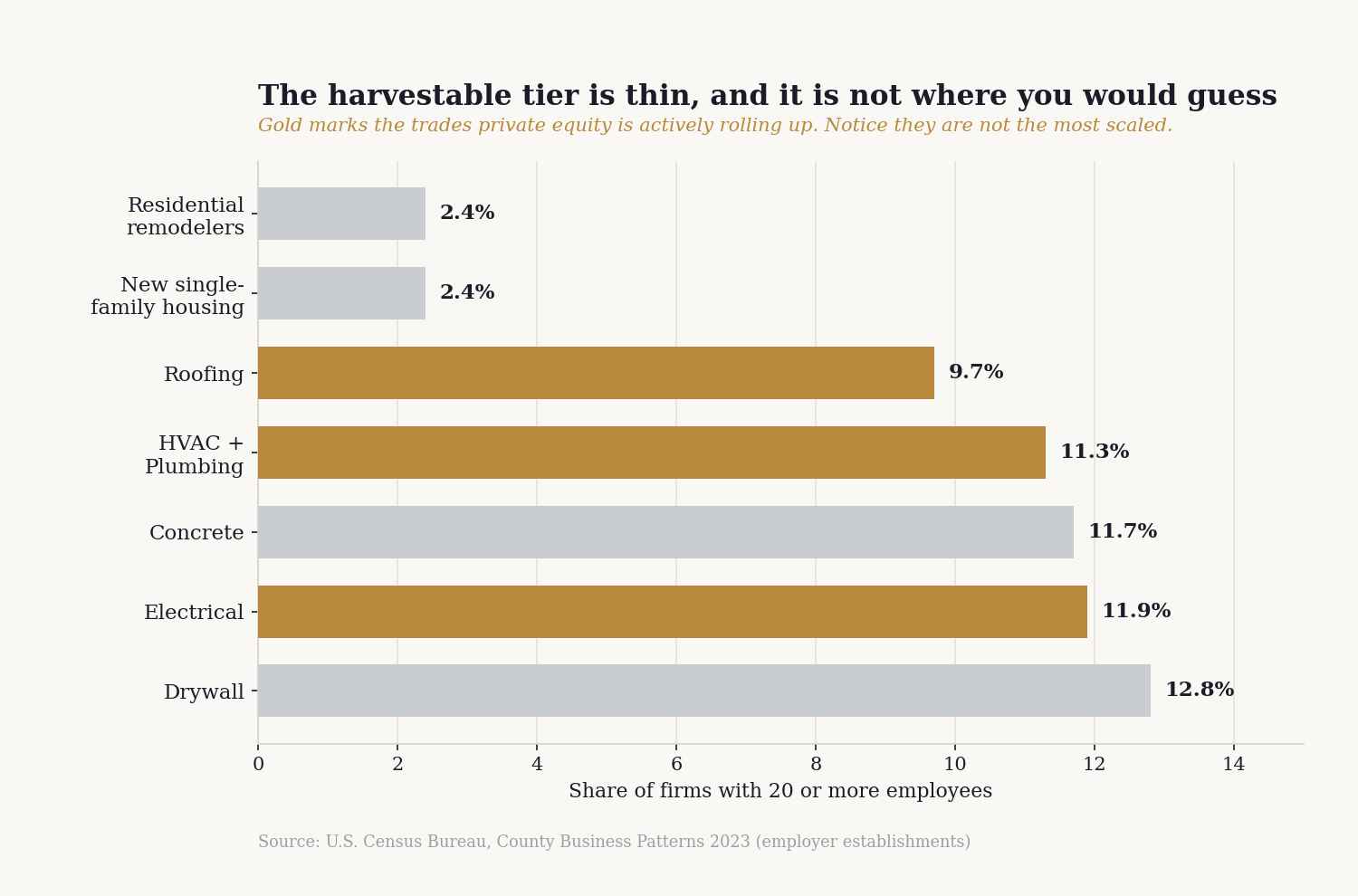
That is why private equity sprints past general contracting despite its enormous fragmentation. There are 135,000 remodelers and only about 3,200 of them are scaled, scattered across every market in the country. The needle-to-haystack ratio is brutal. In roofing, HVAC, and electrical, the scaled tier is dense enough to actually assemble. The fragmentation everyone points to is necessary, but it is the harvestable tier sitting on top that makes the math work. We break down what that means for an owner’s valuation in our piece on the one number that decides what your trades business is worth.
Filter two: demand that comes back whether the economy is good or not
Filter one is not sufficient either, and this is the part almost no one writes. Look at the chart again. Concrete sits at 11.7% scaled and drywall at 12.8%, both denser than roofing. Yet there is no concrete roll-up frenzy, no drywall platform getting recapitalized at twenty times earnings. Scaled tier alone clearly is not the answer.
The difference is the character of the demand. Concrete and drywall are tied to projects and new construction. The work is cyclical, it is bid-driven, and it largely disappears when building slows. Roofing, HVAC, and electrical are different in kind. A roof fails on its own schedule and gets replaced whether or not the homeowner planned for it. A furnace dies in January and cannot wait for a better economy. Electrical demand is being pulled forward for years by electrification and data-center construction. This is replacement, emergency, and service revenue, the kind that returns on its own and often under contract, and it is what an acquirer is really buying. A buyer is not paying a premium for a backlog. They are paying for a stream that refills itself.
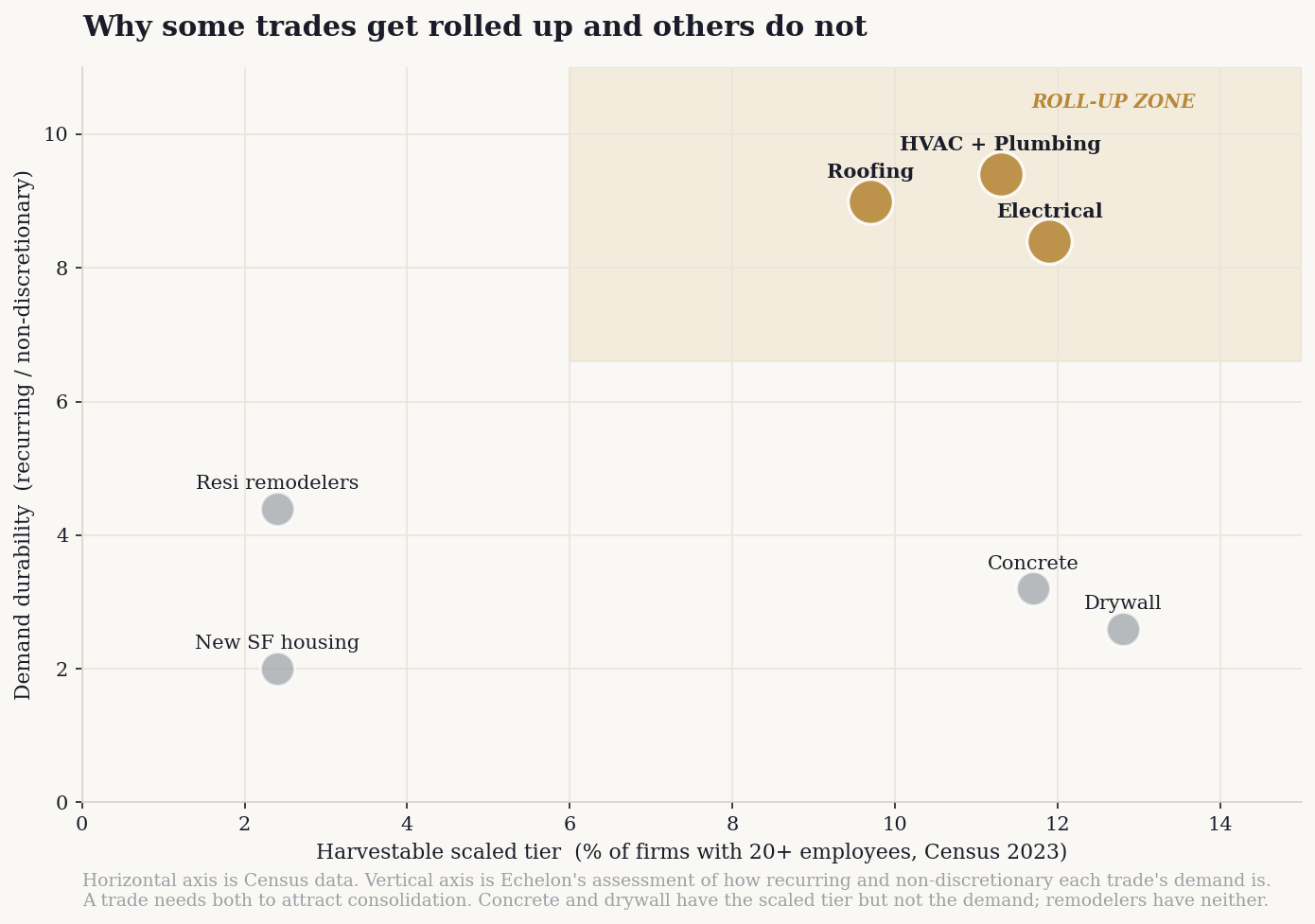
Pass both filters and you are a roll-up target. Fail either one and you are not. That single sentence sorts the entire trades landscape.
The spectrum, hottest to coldest
Roofing is the clearest case, a dense scaled tier on top of non-discretionary replacement demand. It has gone from fragmented backwater to the most actively consolidated trade in home services, with a platform changing hands on roughly a two-day cadence and more than fifty private-equity-backed platforms competing for shops. Full detail in our roofing breakdown.
HVAC and plumbing wrote the playbook. The largest residential platforms bundle them with electrical, and the marquee deal of the cycle, Blackstone’s roughly $2.5 billion purchase of an Orange County platform at about eighteen times earnings, sits here. For how this consolidation is playing out market by market, with the buyers and deals named, see our map of private equity buying HVAC companies in Ohio.
Electrical is the trade to watch, the same thesis arriving a few years later and accelerating fast as data-center and electrification demand pulls capital in. By one count, private equity now drives about three quarters of all electrical contractor M&A. Covered in our electrical breakdown.
Concrete, drywall, and the project trades have the scaled tier but not the recurring demand, so they consolidate slowly and at lower multiples.
General contracting and remodeling are the cold end. The most fragmented trades in the country, and the least consolidated, precisely because the harvestable tier barely exists.
Solar is the cautionary tale, and the most important contrast on this list. Its demand looked durable but was renting from policy and cheap financing, and when California’s net-metering rules changed and interest rates rose, installation volume collapsed and a wave of the biggest names filed for bankruptcy. Solar consolidation today is distressed cleanup, not premium platform building. The full story is in our piece on selling a solar business after the collapse.
Wind is not a trades roll-up at all. Utility-scale wind is energy infrastructure built by independent power producers and large engineering firms, bought and sold by infrastructure funds. It belongs in a different report entirely.
What the deal record shows
The capital behind all of this is not speculative. More than $50 billion has flowed into residential HVAC, plumbing, and electrical roll-ups since 2018, and the pace has climbed every year since. The buyers are the largest names in finance, and the businesses they are assembling now run hundreds of local brands and thousands of trucks. This is a structural consolidation of the trades, not a passing trend, and it is reshaping what an independent operator’s business is worth and who will be competing against it in five years.
What it means if you own one of these shops
Where your trade sits on this spectrum tells you who is coming and roughly what you are worth. But within any trade, the same two filters decide your individual outcome. The scaled-tier filter is about size and systems: a business that runs without the owner, on clean books, is a platform candidate, and one that cannot is a bolt-on at best. The demand filter is about revenue quality: the higher your share of recurring, contracted, service-agreement revenue, the closer you sit to what a buyer actually wants, and the more turns of valuation you command. An owner who understands this is not at the mercy of the first cold call from a private-equity associate. They build the specific business the market pays a premium for, on their own timeline.
A degreed analyst at a megafund can read the fragmentation off a spreadsheet without ever setting foot on a jobsite. What the spreadsheet does not show is which demand comes back on its own and which evaporates when the building stops. An operator who has been on the roof in August and answered the phone at midnight in January knows the difference in his bones, but rarely sees the deal math that turns it into a number. The rare reader who holds both at once is the one who does not oversell and does not get bought cheap.
The roll-up is not random, and it is not simply chasing the most crowded trade. It is hunting the narrow overlap where a harvestable tier of real businesses sits on top of demand that refuses to quit. Find where your trade lands on that map, and you know what is coming.
Frequently asked questions
Why is private equity buying trades businesses?
Because the best of them combine recurring, non-discretionary demand with fragmented ownership, which lets a buyer assemble many small shops into a regional platform and resell it at a much higher multiple. The spread between what a single shop sells for and what an assembled platform is worth is the business model.
Which trades are most likely to be acquired right now?
Roofing, HVAC and plumbing, and electrical. Each has a dense enough tier of scaled operators to consolidate and demand that recurs regardless of the economy. Roofing and HVAC are the most mature, electrical is the fastest-rising.
Why does private equity ignore general contractors when they are so fragmented?
Because fragmentation alone is not enough. Census data shows only about 2.4% of residential remodelers have 20 or more employees, so there are almost no businesses large enough to anchor or meaningfully add to a platform. The targets are too small and too scattered to assemble efficiently.
What makes a trades business attractive to a private equity buyer?
Two things above all: operations that run without the owner, on clean books, and a high share of recurring, contracted service revenue. The first makes the business a platform candidate rather than a bolt-on. The second is the single largest lever on the multiple.
Is solar being consolidated like HVAC and roofing?
No. Solar’s demand depended on policy incentives and cheap financing, and when both tightened the residential market contracted sharply and several large installers went bankrupt. The consolidation happening in solar is distressed, absorbing the customers and obligations of failed companies, not the premium platform-building seen in roofing and HVAC.
What your roofing business is worth, and why it is the fastest roll-up in the trades
Electrical is the next HVAC: what your business is worth before the wave peaks
Is private equity buying HVAC companies in Ohio? A 2026 map for owners
Selling a solar business after the collapse: what every contractor should learn from it
The one number that decides what your trades business is worth
The California paradox: the hardest state to operate in, the best to sell in
Does the business survive the sale or transfer?
The Quality of License Report is the government-records counterpart to a Quality of Earnings: license integrity, qualifier risk, entity standing, liens, litigation, and regulatory record on a single acquisition target.
See the Quality of License ReportSee ERDI in context
ERDI leads every issue of The Echelon Report, the weekly residential-trades intelligence brief. Read the latest issue, or commission a market-level read for your own metro.
Methodology and sources. Establishment counts and employment-size distributions are from the U.S. Census Bureau, County Business Patterns 2023, which covers establishments with paid employees. A second independent dataset, federal PPP loan records held in the Echelon Database, shows the same ordering across trades and is used here to corroborate the Census pattern. Transaction figures and multiples are drawn from public filings, company announcements, and M&A trade press, and are presented as reported. Demand-side reads are labeled as analysis. Echelon takes no position on any law or policy referenced.