
What Is Your Solar Business Worth After the Collapse?
Solar looked like the next great trades roll-up. Then the policy changed. Here is what happened, what a solar business is worth now, and the uncomfortable lesson it holds for every other trade.
The short answer: After the 2023 net-metering changes and the bankruptcies that followed, a solar business built on new residential installations now trades around 3 to 5 times EBITDA, often toward the lower end, while a business with a real, contracted service and maintenance book on an installed base trades higher, commonly 5 to 8 times. What your business is worth depends almost entirely on which of those two you are.
What went wrong
Why solar failed the test
The bankruptcies
What a solar business is worth now
The lesson for every trade
Frequently asked questions
- Solar looked like the next great trades roll-up: fragmented, fast-growing, riding a climate tailwind. It failed for one reason: its demand was renting from policy.
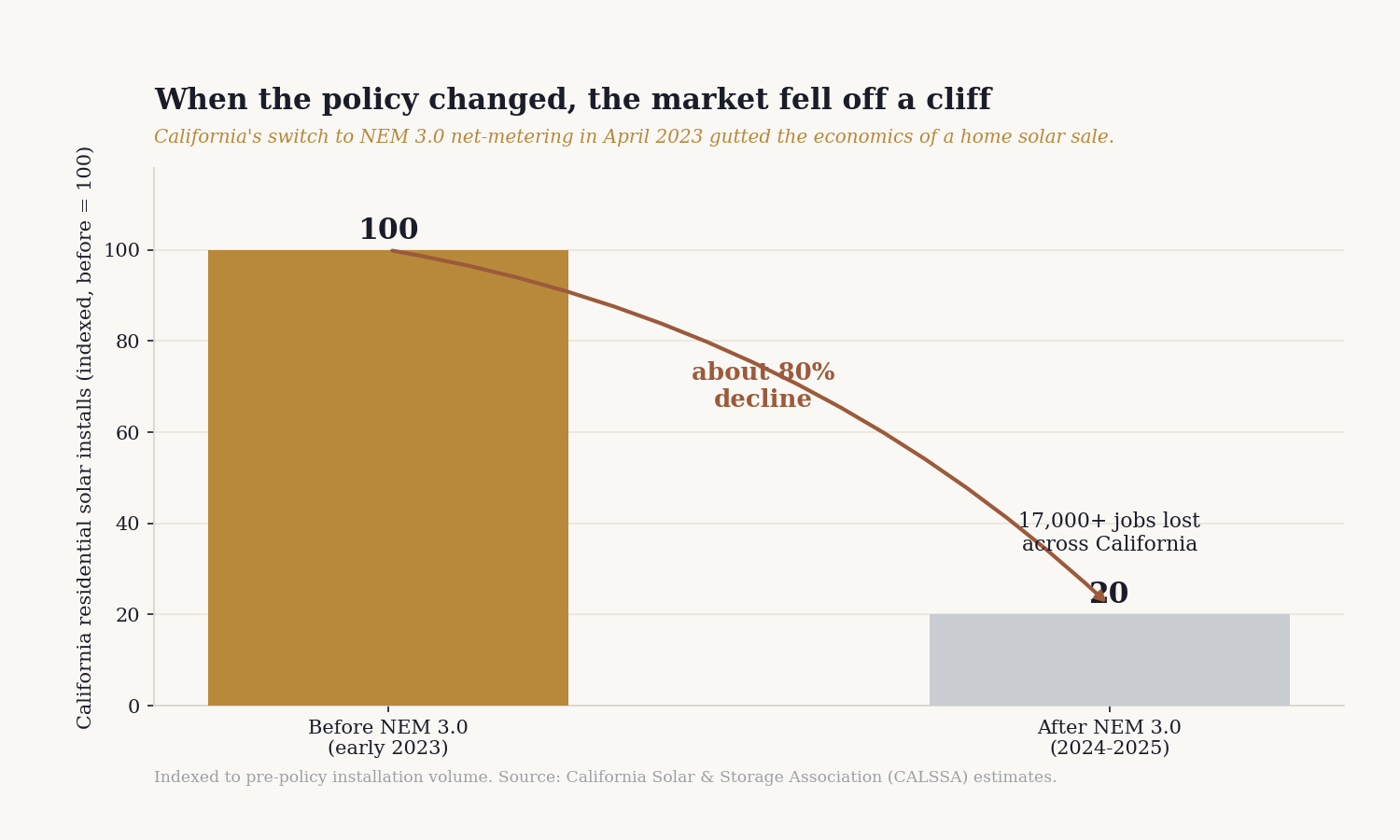
- When California’s NEM 3.0 net-metering change and higher interest rates hit, residential installations fell roughly 80 percent by industry estimates, and more than 17,000 jobs were lost in the state.
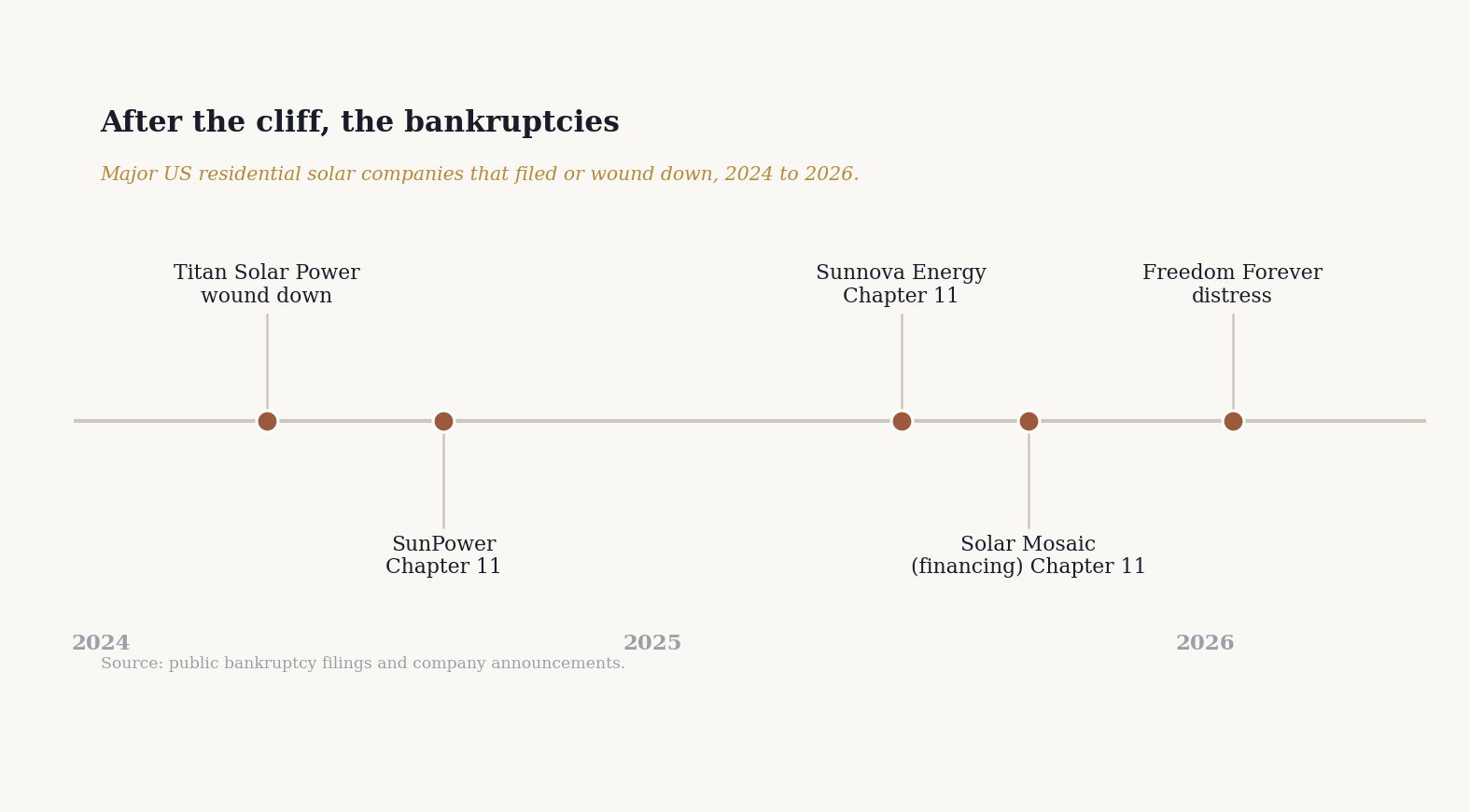
- Major names, SunPower, Sunnova, Titan Solar, and the lender Solar Mosaic, filed for bankruptcy or wound down between 2024 and 2026.
- Consolidation in solar today is distressed cleanup, absorbing the customers and obligations of failed companies, not the premium platform-building seen in roofing and HVAC.
- The lesson for every trade: stress-test your demand. If it depends on a subsidy or incentive, it is fragile. Roofing, HVAC, and electrical demand survives without the subsidy. Solar’s did not.
A few years ago, solar was the hottest trade in home services. Installers were scaling fast, private capital was circling, and the pitch wrote itself: every roof in America is a potential power plant, and the climate tailwind would run for decades. Then California changed one rule, interest rates rose, and the residential solar market fell off a cliff. Companies that had been household names filed for bankruptcy within months of one another. If you own a solar business, you already know this in your bones. This is about what your business is worth now, why the collapse happened, and the lesson it holds for every other trade.
What went wrong
In April 2023, California switched to a new net energy metering regime, NEM 3.0, that cut the credit homeowners earn for exporting power to the grid by roughly 75 percent. That single change gutted the payback math that made a residential solar sale work, in the largest solar market in the country. At the same time, the sharp rise in interest rates made the loans that financed most installations far more expensive, and federal incentive support has since been pared back as well. Three legs of the same stool, the net-metering credit, cheap financing, and subsidy, weakened at once.
The result was not a slowdown. It was a collapse. By some industry estimates, California residential installations fell roughly 80 percent, and the state’s solar association counted more than 17,000 jobs lost.
Why solar failed the test
Solar had the one thing a roll-up needs in abundance: fragmentation, thousands of installers ripe for assembly. What it did not have was the other thing, durable, non-discretionary demand, and that is the entire reason it broke. We laid out the two-factor test in The Great Trades Roll-Up, and solar is its clearest proof.
Think about the difference. A roof replacement or a dead furnace is non-discretionary. The homeowner has no real choice and does not wait for a better economy. A solar installation is discretionary and purely financial: a homeowner buys it to save money, and the instant the savings math breaks, the reason to buy disappears. Solar’s demand looked durable because it rode a genuine climate megatrend, but underneath, it was renting from policy and cheap money. When the landlord raised the rent, the tenant left. Durable-looking demand and genuinely durable demand are not the same thing, and a trade that confuses the two is building on a fault line.
The bankruptcies
Between 2024 and 2026, a roll call of the biggest names in residential solar filed or wound down. SunPower, one of the oldest brands in the industry, filed for Chapter 11 in 2024. Titan Solar Power, among the largest installers in the country, ceased operations the same year. Sunnova Energy, a major financier-installer, filed in 2025, as did Solar Mosaic, one of the sector’s key lenders, with financial distress spreading to others. These were not isolated bad operators. This was the market repricing an entire trade whose unit economics had broken.
What a solar business is worth now
This is where solar differs from every other cluster in this series. Consolidation is happening, but it is distressed consolidation: stronger players and outside buyers absorbing the customers, service obligations, and assets of failed companies, often at distressed prices, rather than the premium platform-building underway in roofing and HVAC. For an owner, that means value now splits sharply by what you actually own.
The multiples make that split concrete. A solar business valued mainly on new residential installations now tends to trade around 3 to 5 times earnings before interest, taxes, depreciation, and amortization (EBITDA), and the post-collapse market pushes a pure-install business toward the bottom of that range, or down to an asset-based number when the forward pipeline is thin. A business built on a real, contracted service and maintenance book trades materially higher, commonly around 5 to 8 times, because that recurring revenue is exactly what a buyer can underwrite with confidence. That gap is the whole argument of this brief in a single number: in solar today, the service book is worth far more per dollar of earnings than the installation business that built it.
A recurring service book has real, durable value. If you hold operations and maintenance, or O&M, contracts on an installed base, monitoring, maintenance, and warranty service on systems already on roofs, that revenue is genuinely non-discretionary. Those systems need servicing regardless of whether anyone is buying new ones. This is the recurring-revenue lever doing exactly what it does in every trade, and in solar it may now be the single most valuable thing you have. We cover it in depth in the one number that decides what your trades business is worth.
A business dependent on new installations is impaired. If your value is a forward pipeline of residential installs, a buyer prices it cautiously, often for the crews, the licenses, and the customer list more than the pipeline itself. And diversification is the survival path. Battery storage, which NEM 3.0 actually favors, and expansion into adjacent trades with durable demand, electrical and roofing, are where the surviving operators are headed. In practice, the solar businesses that make it through are quietly becoming electrical and energy-services businesses. So the honest answer to what your solar business is worth is that it depends almost entirely on how much of your value is the installed-base service book and the diversification, versus pure new-install dependency.
The lesson for every trade
If you are not in solar, this is the part that matters most to you, because solar is the cautionary tale that makes the rest of the framework honest. The test every trades owner should run on their own business is simple: would my demand survive if the subsidy, the incentive, or the cheap financing disappeared?
Roofing, HVAC, and electrical pass that test. Their demand is replacement, emergency, and structural, and it does not depend on a tax credit or a net-metering rule. Solar failed it. Any trade whose demand leans on policy or incentives carries a hidden fragility that does not show up on the income statement until the policy changes, and then it shows up all at once. The most valuable thing a buyer or an owner can understand is the difference between demand that looks durable and demand that actually is. Solar is what it costs to learn that lesson the hard way.
Frequently asked questions
What is my solar business worth after the collapse?
It depends almost entirely on what you own. A business valued mainly on new residential installations now tends to trade around 3 to 5 times EBITDA, toward the lower end or an asset-based number after the collapse. A business with a real, contracted service and maintenance book on an installed base trades higher, commonly around 5 to 8 times, because that recurring revenue is what a buyer can underwrite. Diversification into storage and adjacent trades raises the number further.
Is the residential solar industry recovering?
The residential market remains under heavy pressure from the net-metering changes, higher financing costs, and reduced federal support. Battery storage is a relative bright spot, because the new net-metering rules reward storing power rather than exporting it, but the broad return to the pre-2023 install volumes is not in sight on current policy.
Why did so many solar companies go bankrupt?
Their demand depended on three things that weakened at once: generous net-metering credits, cheap financing, and federal subsidy. When California cut net-metering under NEM 3.0, interest rates rose, and incentive support was pared back, the economics of a residential solar sale broke, install volumes collapsed, and companies built for the old volumes could not survive the new ones.
Does my solar service and maintenance book have value?
Yes, and it may be your most valuable asset right now. Servicing, monitoring, and maintaining systems already installed is non-discretionary, recurring revenue, exactly the kind of predictable stream a buyer pays a premium for. The larger and more contracted your installed-base service book, the more resilient your valuation.
Should I diversify into storage, electrical, or roofing?
It is the clearest survival path. Battery storage aligns with the new net-metering rules, and electrical and roofing carry the durable, non-discretionary demand solar lacks. Many of the solar businesses coming through the downturn are effectively becoming electrical and energy-services companies that also do solar.
What is the lesson of solar for other trades?
Stress-test your demand. If your work depends on a subsidy, an incentive, or cheap financing, it carries a fragility that stays hidden until the policy changes. Demand that looks durable is not the same as demand that is durable. Roofing, HVAC, and electrical survive without the subsidy. Solar did not, and that is the difference a buyer prices most heavily.
Whether you are in solar and weighing your options or in another trade and stress-testing your own demand, your market is its own story: who is consolidating it, which operators are durable, and where your business stands. That market-specific read is exactly what an Echelon Intel Report delivers, built from the same data behind this analysis.
The Great Trades Roll-Up: why Wall Street buys some trades and walks past others
The one number that decides what your trades business is worth
What is your roofing business worth: a trade whose demand passes the test
Methodology and sources. The roughly 80 percent decline in California residential installations and the figure of more than 17,000 jobs lost are estimates from the California Solar & Storage Association (CALSSA). The net-metering change refers to California’s NEM 3.0, effective April 2023. Bankruptcy and wind-down events are drawn from public filings and company announcements; where a company’s status is better described as financial distress than a specific filing, it is labeled that way. Valuation observations are presented as analysis. Echelon takes no position on whether any owner should buy, sell, hold, or diversify.