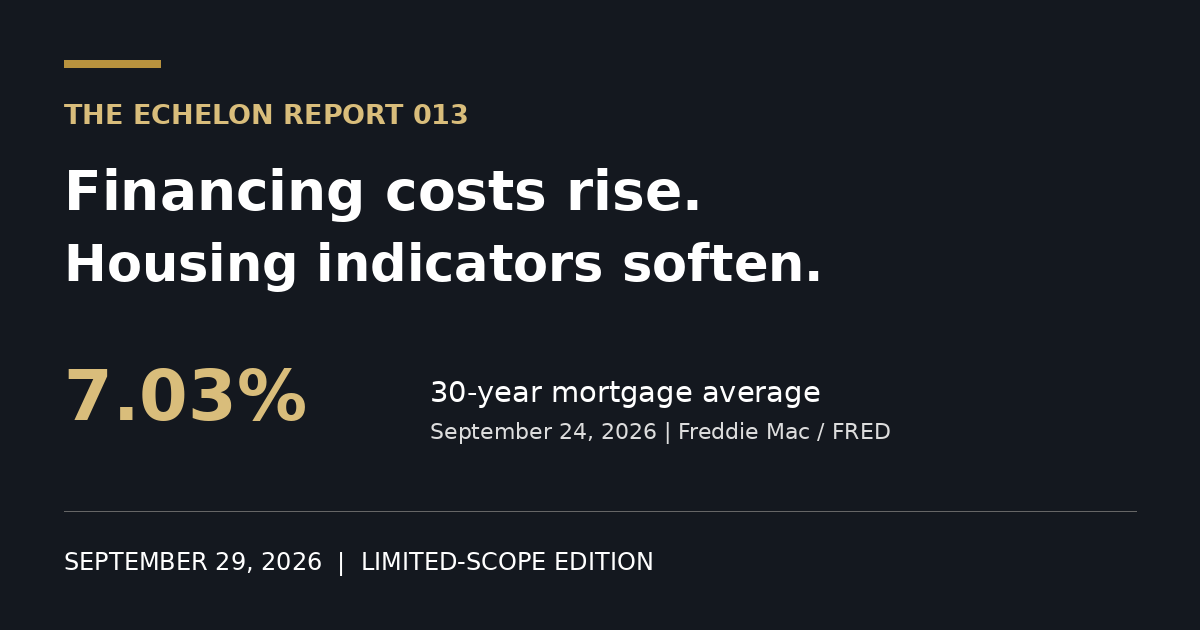
The average 30-year fixed mortgage rate reached 7.03% on September 24, up from 6.95% a week earlier. August housing permits and existing-home sales both fell from July. For contractors planning fall work, these national indicators support a cautious sales plan, not an assumption that cheaper financing will bring customers back.[1][2][3]
Week of September 28, 2026. Published September 29. This limited edition reports three national housing indicators; it does not add an ERDI reading.
What changed
| Indicator | Latest observation | Prior observation | Change |
|---|---|---|---|
| Average 30-year fixed mortgage rate | 7.03%, September 24 | 6.95%, September 17 | Up 0.08 percentage point |
| Housing units authorized by building permits | 1.403 million annualized, August | 1.433 million annualized, July | Down 2.1% |
| Existing-home sales | 3.98 million annualized, August | 4.06 million annualized, July | Down 2.0% |
Sources: Freddie Mac, Census/HUD and the National Association of Realtors, retrieved through FRED on September 29. The mortgage rate is a weekly average. Permits and sales are monthly, seasonally adjusted annual rates. They are not the actual number of permits issued or homes sold during August.[1][2][3]
Financing is getting less favorable
The mortgage average rose from 6.71% on September 3 to 7.03% on September 24, an increase of 0.32 percentage point. The latest weekly increase was 0.08 percentage point, or eight basis points.[1]
A fall forecast that assumes purchase financing will quickly ease has little support from the September 24 national mortgage average. Check the reason a quoted job stalls: price, financing, timing or another contractor.
Permits and transactions point in the same direction
The permit series declined from an annualized 1.433 million housing units in July to 1.403 million in August. That is a 30,000-unit decline in the annualized rate, not 30,000 canceled projects. Permits authorize housing units; they do not measure completed construction or remodeling orders.[2]
Existing-home sales declined from an annualized 4.06 million in July to 3.98 million in August, a rounded 2.0% decrease.[3]
Builders and trades reliant on new housing or move-related projects should compare their own pipeline with the softer national readings. Repair, replacement, accessibility and remodeling work may follow different paths; postponing a move does not guarantee a home-improvement project.
For an acquirer, this is a reason to separate a target’s work by source before accepting a single growth forecast. New-construction work, move-related projects, and service calls can respond differently. Request the target’s actual mix, booked backlog and cancellation history rather than treating a national housing figure as company revenue evidence.
What to check this week
Compare new inquiries, issued estimates and accepted jobs with a comparable period in your own records, using the same counting rules. Record why customers did not proceed.
If discretionary projects weaken, test whether clearer scope or a payment conversation helps before increasing advertising spend. If inquiries hold but accepted work falls, inspect estimates and follow-up.
Scope and methodology
This edition uses three public national series retrieved on September 29, 2026: Freddie Mac’s MORTGAGE30US, Census/HUD’s PERMIT and NAR’s EXHOSLUSM495S. The weekly and monthly observations have different dates and are shown separately. Percentage changes use the displayed prior observation as the denominator and are rounded to one decimal place. Rate changes are percentage-point differences.[1][2][3]
No new ERDI comparison was issued: its historical inputs had not cleared verification. The three national series stand alone, and this edition did not revise the historical index.
Put these signals in your market context
If your inquiry and estimate records show a market-specific problem, Echelon can scope research into the relevant operators and housing context. Agree on evidence, deliverable and price before commissioning work.
Sources
- 1. MORTGAGE30US
- 2. PERMIT
- 3. EXHOSLUSM495S