People oppose data centers over electricity costs, water demand, industrial noise and the use of land near their homes. They also question who receives the jobs and tax revenue, and how much say residents have before a project wins approval. Local petitions, utility proceedings and community reviews show these concerns taking different forms.[3][16][29]
The answer depends on the project. A change in cooling design can address a water concern. A utility tariff can assign capacity costs to the large customer. A community-benefit agreement can fund local programs, but its payment triggers and remedies determine what residents can expect.[5][54]
Start with the concern, then find the document that governs it. The table below pairs actual records with questions a resident can take to a hearing or a contractor can use to assess approval and schedule risk.
From community concern to project record
The dates below describe the underlying records. November 14, 2026 is this table’s review date, not a new permit or operating inspection. Rows labeled “proposed questions” are a worksheet for a specific project, not universal legal requirements.
| Concern | Record, authority and observed date | Supported commitment or limit | Reader next step and construction consequence |
|---|---|---|---|
| Electricity costs | AEP Ohio Schedule DCT, revised effective August 28, 2026; November tariff book.[5] | For new load, the ramp-period billing-demand floor is 85% of load-ramp contract capacity. A different formula applies after the ramp. | Request the applicable tariff and service agreement, including ramp capacity and security. These terms affect the cost of energizing a campus before full use. |
| Cooling water | Pima County board approval of CT2500000087, December 16, 2025; agreement attachment, Section 1.[53][54] | The text specifies closed-loop air cooling and an approved source for domestic and fire-suppression water. | Compare the approved design and water-service records with the agreement. A design change can alter equipment, utility work and approvals. |
| Local jobs | Pima County’s Project Blue update, April 23, 2026.[6] | The memo reports a land-sale requirement for at least 75 employees at a minimum of $75,000 a year, separate from the employment forecast. | Request the governing employment clause, compliance timetable and hiring reports. Ask which qualifications and training routes give local workers access. |
| Public benefits | Project Blue agreement attachment, Section 4, approved December 16, 2025.[53][54] | Contributions follow development and certificates of occupancy; Beale controls distributions after consultation with the county. | Track each phase’s occupancy record and donation agreement. A later phase can change when a promised benefit becomes payable. |
| Renewable energy | Pima County CT2500000087 agreement attachment, Sections 3 and 6(c), approved December 16, 2025.[53][54] | Commercially reasonable matching efforts and annual verification; Section 3 has limited remedies and conditions that can void it. | Request the verification statement after commercial operation and read the exceptions. Matching is different from continuous physical renewable supply. |
| Land-use review | Prince George’s County CR-066-2026, effective July 7, 2026; CB-019-2026, adopted October 27, with a December 11 effective date.[9][10][42] | The planning pause has an early-termination condition. The ordinance changes review rules and retains a vested-rights provision. | Ask planning staff which rule applies to the specific application. Review stage and vested rights affect the project schedule. |
| Money already received | Pima County’s December 29, 2025 memo and attached December 24 settlement.[52] | The settlement separates the land price, relocation consideration, prior release, fees and payment at closing. | Use the settlement for receipts and the budget for spending decisions. Relocation work has its own scope and cost. |
| Noise and nearby land uses | Proposed project-specific questions for the local planning, environmental or code-enforcement office. | Request the applicable noise rule, acoustic study, site plan and enforcement conditions. | Ask where and when sound is measured, which equipment operates during testing, and who handles complaints. Buffers or equipment changes can affect the layout. |
Do data centers create jobs and local income?
Construction work and permanent operations are separate benefits. A large build can support temporary payroll and supplier orders well before an operating staff arrives. The Brightseat Tech Park presentation illustrates the difference: its construction figures cover modeled activity during development, while its operating figures include direct jobs and effects across other businesses and household spending.[41]
| Brightseat forecast, February 9, 2024 developer presentation[41] | Amount and scope |
|---|---|
| Proposed capital investment | $5 billion |
| Construction employment and income | 27,000 “annual construction jobs,” the source’s label; $2.4 billion in construction income; 9,000 annual multiplier-effect jobs in other industries |
| Local taxes from construction-related activity | $53.5 million |
| Operating employment | 1,600 total annual jobs: more than 500 in data processing and utilities, nearly 900 from business-to-business activity and nearly 200 from household spending |
| Operating labor income and local taxes | $123.5 million in annual labor income; $13.7 million in annual local tax revenue |
All figures in this table are developer projections, rather than actual hiring, payroll or tax collections.[41]
The operating total includes jobs outside the campus.[41] The construction label also leaves a practical question for the developer: how many people would work on site in each phase, for how long, and in which trades? A workforce schedule would make that forecast more useful to residents deciding whether the project fits their community.
Project Blue offers a more specific employment test. Pima County’s April 23, 2026 update expected about 180 employees by the third year, at an average annual salary of $64,000. It separately reported a land-sale requirement for at least 75 employees at a minimum of $75,000 a year. The expected average and the contractual minimum describe different populations and obligations.[6]
For local workers, ask about required credentials, paid training, apprenticeship access, hiring dates and travel. For suppliers, ask which packages a local firm can perform and how the buyer qualifies vendors. An order’s gross receipts must cover labor, materials, equipment and overhead before the business earns a profit. Neither the forecast table nor a large capital budget supplies that margin.
A useful public benefits comparison also needs the government’s side: tax incentives, infrastructure spending, service costs and the timing of receipts. Keep those questions beside the jobs forecast instead of assuming every dollar of project investment becomes local income.
For project-specific participation research, see Echelon’s Brightseat contractor-readiness report and data-center construction workforce coverage.
Electricity, water, noise and land
Electricity: who pays when promised demand arrives slowly?
Lawrence Berkeley National Laboratory estimated that U.S. data centers used 176 terawatt-hours of electricity in 2023, about 4.4% of the national total. Its December 2024 report projected 325 to 580 terawatt-hours in 2028, or roughly 6.7% to 12%. The range reflects modeled assumptions about equipment, use and efficiency.[2]
Households need a local answer: who pays for the substation, transmission capacity and other infrastructure built for a large new load? In July 2025, the Public Utilities Commission of Ohio approved an AEP Ohio data-center tariff. Its minimum payments, financial guarantees and exit protections aim to place development risk on the large customer.[3]
The November 2026 tariff book shows why “pay for 85%” needs context. New load can have a ramp period of up to four years. During that period, the floor applies to load-ramp contract capacity. After the ramp, a tiered formula and a historical-demand test apply. For a standalone 100-megawatt contract, the capacity formula yields an 82.5-megawatt minimum. For 200 megawatts, it yields 170 megawatts. Measured demand, the historical test and affiliated-load provisions can raise the billable demand.[5]
These are billing-demand examples, not quantities of electricity purchased.[5] A resident evaluating cost allocation should request the applicable agreement, the utility’s investment assumptions and the security available if development slows. The tariff addresses specified capacity risks; household bills also require a review of the rates and costs assigned to that customer class.
Water: start with the cooling system
Berkeley Lab estimated about 66 billion liters of direct data-center water consumption in 2023 and nearly 800 billion liters of indirect consumption associated with electricity generation. These measure water consumed, rather than all water withdrawn. The indirect estimate uses regional electricity-grid mixes at data-center locations.[2]
For a local proposal, ask for the cooling design, source of water, peak seasonal demand and approved service conditions. Project Blue’s September 17, 2025 county memo described a move to air cooling, reserving water for domestic and fire-protection needs. The later board-approved agreement specifies air cooling with a closed-loop system.[8][54]
That design commitment gives the community something specific to compare with the submitted plans. The remaining water uses still need a supply: Section 1 calls for a source approved by the Arizona Department of Water Resources and compliance with the county’s preliminary integrated water-management plan requirements.[54]
Noise and emissions: ask about operating conditions
In Prichard, Alabama, the Mobile Environmental Justice Action Coalition examined an Edged proposal near Africatown. Its president joined local officials on a May 1, 2026 visit to Edged’s Atlanta campus. MEJAC reported that participants could speak normally beside the cooling equipment. Its account discussed a proposed 6-megawatt Prichard facility and sought commitments on hiring, community benefits and land use.[29]
The visit describes what participants heard at that time. For a proposed site, ask for an acoustic study and the rule the agency will enforce. Useful questions include:
- Where is sound measured: the property line, a nearby home or another location?
- Does the assessment cover nighttime conditions, low-frequency sound and the nearest homes?
- Which cooling units, generators and other equipment operate during a test?
- Who investigates a complaint, what records are public, and what corrective action can the agency require?
These are proposed review questions. The local rule and permit must supply the applicable limits.
Power generation can bring a separate permitting dispute. On April 14, 2026, the NAACP announced a federal lawsuit against xAI and MZX Tech over 27 gas turbines in Southaven, Mississippi. It alleged that the companies operated them without an air permit to power Colossus 2. This describes the organization’s announced allegations, rather than a court finding.[25]
Land: what else could the site become?
The petition concerning the former Landover Mall site calls for a stronger resident voice in its future. It reflects a disagreement over the use of a familiar community property, beyond the campus’s tax forecast.[16]
Ask the planning authority to compare the proposal with feasible alternatives under the site’s zoning and infrastructure constraints. Which uses could support housing, shops, employment or public space? What would each require in roads and utilities? When can residents review the alternatives and comment before the decision? These questions help put fiscal benefits beside the physical changes to a neighborhood.
Landover: organizing and a changing approval process
Taylor Frazier McCollum’s petition opposed a data center at the former Landover Mall site. WJLA reported that a video shared by the Party for Socialism and Liberation helped spread it. McCollum credited the video’s reach and disputed allegations of China-connected outside funding for her work.[16][19]
WAMU’s December 2025 reporting described PSL’s organizing in Prince George’s County. Organizer Isabella Dominique said the local chapter relied on member dues and put a library meeting rental at about $200. That is her account of the chapter’s funding.[17]
The county’s decisions extend beyond the petition. CR-066-2026 became effective July 7, 2026. It pauses applications for preliminary plans of subdivision and detailed site plans containing qualified data-center uses until the earlier of two years after adoption or the effective date of qualifying comprehensive legislation.[9][42]
Executive Order 17-2026, dated September 28, separately extended a hold on accepting, considering and processing qualified data-center permit applications through December 31, 2026. The order allows a further executive order to change that period.[20]
The county adopted CB-019-2026 on October 27. Its 45-calendar-day provision sets a December 11, 2026 effective date. It removes the qualified-data-center exemption from detailed site-plan review and restricts use of the prior zoning ordinance, subject to the text’s vested-rights provision.[10][43]
For a resident or project team, the next question is which application and approval history the county is reviewing. Ask planning staff how CB-019 interacts with CR-066’s early-termination condition, and request the current permit-hold order. Treat the December ordinance date as a scheduled legal change, rather than assuming it automatically resolves every pause.
Project Blue: the agreement behind the benefits
Tucson’s mayor and council voted to end Project Blue discussions and negotiations on August 6, 2025. Pima County had already approved a specific-plan zoning change and land acquisition agreement on June 17 for the site in unincorporated county territory. The county route therefore preceded the city’s decision.[6][7]
The county board approved CT2500000087 on December 16, 2025. The agreement names Humphrey’s Peak Properties LLC, a Beale Infrastructure entity. The available document is the board-approved attachment, not a recovered fully signed counterpart.[53][54]
What the community-benefit text commits to
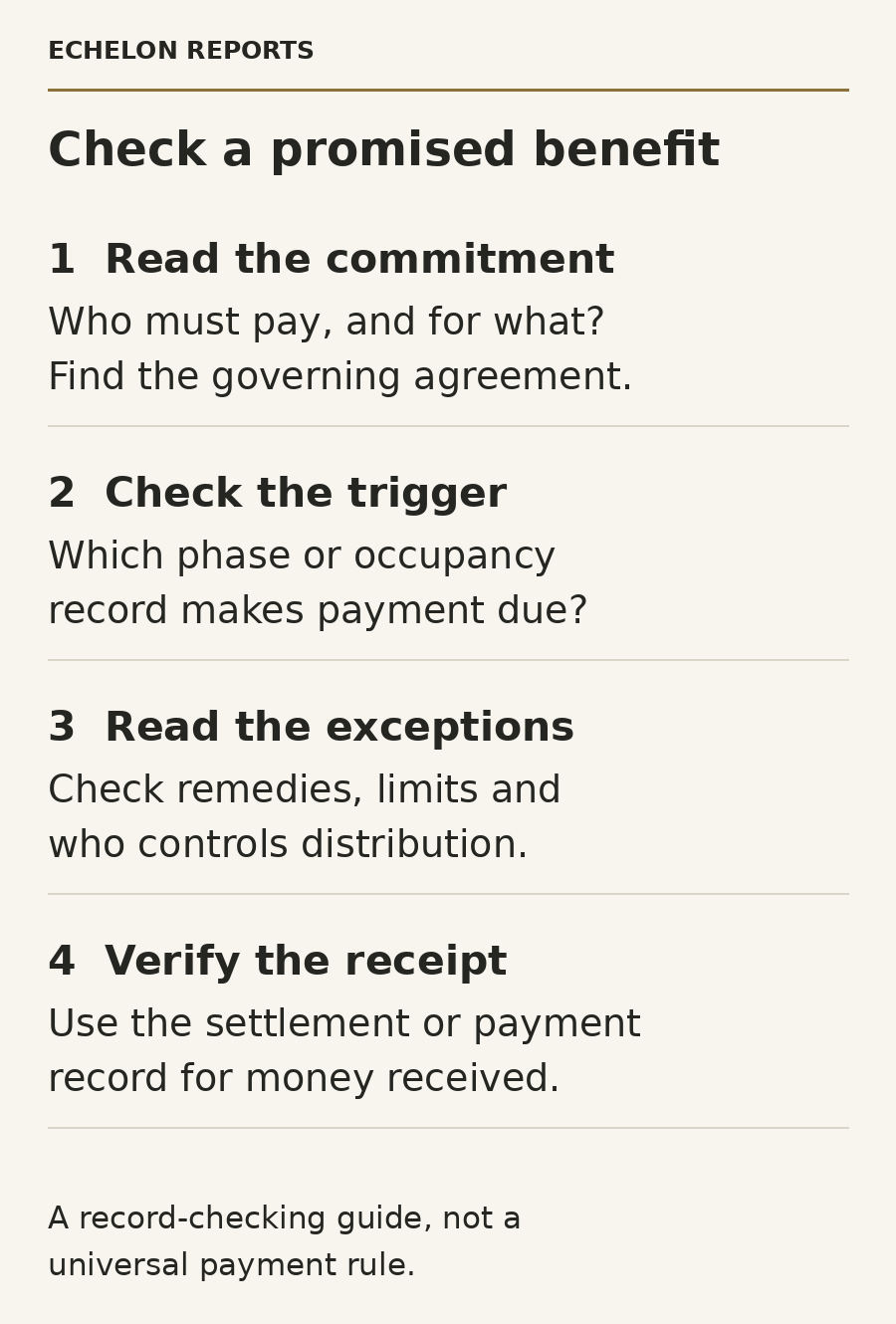
Alongside closed-loop air cooling, Section 4 sets out a $15 million contribution framework: $5 million for the first phase and $10 million for later phases. Payments follow certificates of occupancy for the relevant phase. Undeveloped portions trigger no payment. Beale must consult the county, but distribution decisions remain at Beale’s sole discretion.[54]
The initial donation is intended for STEM scholarships, students and trade schools. The text calls for later donation agreements to identify recipients, uses and payment mechanisms. Residents can ask for those agreements and the occupancy record for each phase to check when a commitment becomes payable.[54]
Section 3 calls for commercially reasonable efforts to match 100% of energy use with renewable energy. Beale must hire an independent, qualified third party to provide a written verification each year. That process starts when commercial operations begin and lasts through the energy supply agreement’s term. Matching does not promise a continuous physical supply of renewable power.[54]
The restrictions are consequential. Section 3 leaves the energy supply agreement and regulatory approval unaffected. It becomes void and is severed if a court or regulator finds it contrary to law or policy, or if it jeopardizes approval of the current or future supply agreements. Tucson Electric Power is not a party to the community-benefit agreement.[54]
For a Section 3 dispute, the text provides meetings, escalation, a corrective-action plan and ultimately nonbinding mediation. It excludes monetary damages, penalties and specific performance as remedies under that section. The broader agreement also bars consequential, incidental, punitive and special damages and compelling specific performance. The renewable provision therefore offers a defined review process with materially restricted enforcement.[54]
What the county received and what it forecast
Project Blue’s December 24, 2025 settlement names Bobcat B1 LLC as the buyer, a different legal entity from the community-benefit agreement’s party. It records a $20.875 million land price and $6.5 million in relocation consideration for the county’s Trap & Skeet Facility. Subtracting $100,000 previously released and $19,151 in seller title and escrow costs leaves $27,255,849 paid to the county at closing.[52]
Pima County’s April 23, 2026 update projected up to $3.6 billion in capital investment across about 10 buildings. Its annual county-tax estimates were $2,794 in 2027, $2,839 in 2028, $1,453,325 in 2029 and $3,674,207 in 2030. Those estimates total $5,133,165 and depend on construction timing and certificates of occupancy.[6]
The same April update listed two issued site-construction permits: P25SC00055 and P25SC00120. P25SC00140 was awaiting corrections. Those are April observations. Check the current permit record next, then the phase’s occupancy status and the contribution documents tied to it.[6][54]
The settlement, jobs clause and community-benefit agreement give residents distinct checks on this project: money received, an employment floor and phase-dependent commitments. They also identify different work for contractors, including the campus itself and relocation of an existing county facility.[6][52][54]
Who organizes data-center opposition?
Local campaigns and national organizations pursue different decisions. A neighbor can seek a larger buffer or a different use for one site. A national campaign can seek a construction moratorium. Labor groups can support a campus while seeking union work and community protections.[16][24][26]
Food & Water Watch reported on June 11, 2026 that more than 500 groups from 47 states had joined its call for a nationwide AI data-center moratorium. That is the organizer’s coalition count. Indiana’s Citizens Action Coalition approaches the issue through consumer advocacy and utility concerns.[24][30]
Local politics can cross party lines. WFYI’s October 2025 reporting followed Republican campaign volunteer Alec Willis and the Coalition to Protect Morgan County. Willis described a campaign bringing people with different politics together over water, corporate power and local authority.[27]
AI-safety organizations approach the issue through the technology it enables. The Future of Life Institute’s March 2023 letter called for a pause of at least six months in training systems more powerful than GPT-4. Labor leaders interviewed by WGLT on November 13, 2026 instead supported data centers built with union labor and community-minded regulation.[26][36]
Ask what each group wants the decision-maker to do. A site-plan amendment, a utility-cost safeguard and a national AI pause require different evidence and different negotiating terms.
Echelon Reports · Relationship explorer
Follow a relationship to its source
Explore selected documented relationships. Choose a case view, then select a circle or arrow to read the record behind it. Each arrow describes one dated action. Equal-size circles identify organizations, people, documents and projects.
All source records
Arrow direction follows the named action. “Reported” identifies a filing; “recommended” preserves the grant page’s wording. Dates refer to the event, tax year or publication shown in the source details.
Open a relationship below to read its source.
Relationship records
No matching relationships. Change a filter or reset the map.
-
Cash grant reported: $4,250,000
Lightcone Foundation (EIN 92-0636259) → Future of Life Institute (EIN 47-1052538)
The 2023 return reports a cash grant for charitable work in support of the Future of Life Foundation’s mission.
Lightcone Foundation, 2023 Schedule I
47-1052538
501(C)(3)
4,250,000
0CHARITABLE WORK IN SUPPORT OF THE FUTURE OF LIFE FOUNDATION’S MISSION
-
Grant recommended: $250,000
Future of Life Institute (EIN 47-1052538) → Encode
FLI labels the amount “Amount recommended” and the purpose “General Support.”
FLI 2024 grant recommendations
Project titleEncode
Amount recommended
$250,000.00Details
Project Summary
General Support. Encode are young people mobilizing policymakers and the public for a future where human-centered artificial intelligence fulfills its transformative potential.
-
Director before and after transfers
Max Tegmark → Lightcone Foundation (EIN 92-0636259)
FLI’s 2022 filing identifies Max Tegmark among the directors of Lightcone Foundation before and after the reported transfers.
Future of Life Institute, 2022 Schedule N
EXPLANATION OF INVOLVEMENT: MAX TEGMARK, ANTHONY AGUIRRE, MEIA CHITA-TEGMARK, AND JAAN TALLINN WERE DIRECTORS OF THE FUTURE OF LIFE FOUNDATION, THE FUTURE OF LIFE INSTITUTE EUROPE, AND THE LIGHTCONE FOUNDATION, BOTH PRIOR TO AND AFTER THE TRANSFERS DESCRIBED HEREIN.
-
Published AI-pause advocacy
Future of Life Institute (EIN 47-1052538) → Pause Giant AI Experiments: An Open Letter
The letter asks AI labs to pause training systems more powerful than GPT-4 for at least six months.
Pause Giant AI Experiments: An Open Letter
We call on all AI labs to immediately pause for at least 6 months the training of AI systems more powerful than GPT-4.
22 March, 2023
-
Bill findings quote letter
S. 4214, introduced March 25, 2026 (119th Congress, S. 4214 (IS)) → Pause Giant AI Experiments: An Open Letter
The introduced bill quotes the letter in its findings. The edge records textual uptake in a federal proposal.
(E) more than 1,000 business leaders in the Big
Tech industry, prominent scientists, and artificial
intelligence researchers and academics, including Elon
Musk, Steve Wozniak (co-founder of Apple), and Evan
Sharp (co-founder of Pinterest), who, in March 2023,
cosigned an open letter entitled “Pause Giant AI
Experiments” which stated the following: “We must ask
ourselves: Should we let machines flood our information
channels with propaganda and untruth? Should we
automate away all the jobs, including the fulfilling
ones? Should we develop nonhuman minds that might
eventually outnumber, outsmart, obsolete and replace
us? Should we risk loss of control of our civilization?
Such decisions must not be delegated to unelected tech
leaders. . .Therefore, we call on all AI labs to
immediately pause for at least 6 months the training of
AI systems more powerful than GPT-4. This pause should
be public and verifiable, and include all key actors.
If such a pause cannot be enacted quickly, governments
should step in and institute a moratorium.”; and
(F) artificial intelligence pioneers Geoffrey
Hinton and Yoshua Bengio and other technology leaders,
who have called for “a prohibition on the development
of superintelligence, not lifted before there is broad
scientific consensus that it will be done safely and
controllably, and strong public buy-in”. -
Facilitated coalition letter
Food & Water Watch → June 11, 2026 national data-center moratorium letter
Food & Water Watch describes its role in facilitating the June 11 letter to Congress.
Food & Water Watch, coalition launch
The letter was facilitated by the environmental advocacy group Food & Water Watch; other signers include Greenpeace, Friends of the Earth, Americans for Financial Reform, Popular Democracy, People’s Action Institute, Good Jobs First and Honor the Earth.
-
Listed coalition signatory
Greenpeace (name in launch statement) → June 11, 2026 national data-center moratorium letter
The organizer’s launch statement names Greenpeace among the letter’s signers. The source uses the Greenpeace name without an affiliate identifier.
Food & Water Watch, coalition launch
The letter was facilitated by the environmental advocacy group Food & Water Watch; other signers include Greenpeace, Friends of the Earth, Americans for Financial Reform, Popular Democracy, People’s Action Institute, Good Jobs First and Honor the Earth.
-
Organized construction protest
No Desert Data Center Coalition → Project Blue
Tucson Spotlight reports an April protest against Project Blue. This record describes organizing activity.
Tucson Spotlight, Project Blue protest
The No Desert Data Center Coalition organized last week’s protest in response to the recent start of construction.
Members of the No Desert Data Center Coalition gathered near the Pima County Fairgrounds Friday to protest the start of construction on Project Blue, the controversial data center approved despite community opposition.
Use the records for your next decision
For a hearing, choose the concern most relevant to your household and request the governing record from the responsible office. Ask for the clause, observation date and next action. For construction planning, pair that record with the application’s status, utility milestones and phase schedule.
Echelon’s Brightseat report follows the project from a contractor-readiness perspective. If your question spans several projects or a market, request a scoped research discussion about custom market intelligence. Bring the project names, geography and decision you need to make.
Deeper investigation: funding and influence
This optional section examines selected funding relationships raised by the Bitcoin Policy Institute, followed by a documented foreign-messaging operation. BPI is a Bitcoin-focused policy organization; its reports argue for greater scrutiny of foreign influence and AI opposition. The records below distinguish nonprofit resources, local organizing and platform-attributed covert activity.[31][32][34]
People’s Support Foundation and the Justice and Education Fund
Thoughtworks founder Neville Roy Singham figures prominently in BPI’s account. On August 23, 2017, longtime Thoughtworks employee Martin Fowler wrote that Singham had decided to sell the company to Apax Funds and was spending more time on activism. The dated account describes the decision to sell.[32][50]
People’s Support Foundation Limited’s initial Form 990-PF covers April 4 through December 31, 2017. Schedule B identifies Mutod, LLC as contributing $160.2 million and Likewise Conceptions, LLC as contributing $3.5 million. Together, the named companies account for $163.7 million, matching the return’s contributions line. The legal donors are the LLCs; their beneficial ownership requires separate records.[48]
The return lists Jodie Evans as president/director, Jason Pfetcher as treasurer/director and Jo Anderson-Figueroa as secretary/director. Chad Wathington is listed as treasurer/director through October 9, 2017. Thoughtworks’ undated alumni profile says Pfetcher’s service as general counsel began in 2011.[48][49]
The foundation’s 2024 return again lists Evans, Pfetcher and Anderson-Figueroa in those roles, alongside directors Carolyn Baker and Layan Fuleihan. These are roles reported for that tax year.[21]
| Reporting year | Reported grant relationship | Amount and identity |
|---|---|---|
| 2024 | People’s Support Foundation Limited to Justice and Education Fund | Two grants paid, $2.9 million and $2.47 million; total $5.37 million.[21] |
| 2024 | People’s Support Foundation Limited to The People’s Forum | $5 million paid.[21] |
| 2024 | Justice and Education Fund to Break Through Media | $977,000 cash grant; recipient EIN 84-5071181.[15] |
BreakThrough News’ donation page identifies “BreakThrough / BT Media Inc.” and EIN 84-5071181. The shared EIN connects the brand’s donation recipient to the grantee named in the filing.[15][22]
These annual schedules identify separate nonprofit grants and broad charitable purposes. The local accounts describe a different form of support: amplification of McCollum’s petition and organizing funded through member dues, according to the participants quoted above.[15][17][19]
FLI: a large gift and sustained policy work
The Future of Life Institute’s 2021 Form 990 reports $665,882,523 in noncash contributions and identifies Shiba Inu cryptocurrency in Schedule M. FLI describes Vitalik Buterin’s gift as unconditional and says part serves as an endowment. The reported noncash value and later spending measure different stages of that funding.[11][13]
| Date or reporting period | Financial record | Amount and category |
|---|---|---|
| December 11, 2022 | FLI to Future of Life Foundation | $25,025,000 cash asset disposition.[12] |
| December 15, 2022 | FLI to Lightcone Foundation | $162,587,667 in cash and publicly traded securities.[12] |
| December 30, 2022 | FLI to Future of Life Institute Europe | $180,297,079 in cash and financial assets.[12] |
| 2023 tax year | Lightcone Foundation to FLI, EIN 47-1052538 | $4.25 million cash grant; the filing was submitted May 5, 2026.[47] |
| 2024 grant page | FLI recommendation for Encode | $250,000, labeled “Amount recommended.”[38] |
| 2024 grant page | FLI recommendation for Federation of American Scientists | $1.5 million, labeled “Amount recommended.”[38] |
The three 2022 dispositions total $367,909,746. Schedule N describes shared directors and Max Tegmark’s role before and after the transfers. The later Lightcone grant is an affiliate return flow, rather than new outside financing to add to the original gift.[12][47]
FLI reports $46.192 million in 2025 expenditure, including $26.724 million in charitable grants, $5.019 million in personnel costs and $5.795 million in media and outreach. It says these figures come from audited financial statements and that endowment funds covered the difference between income and expenditure.[13]
Buterin offered his account on March 13, 2026. He said he had expected the tokens to produce about $10 million to $25 million and described eventual proceeds of roughly $500 million. He favored open-source defensive technology and said FLI had moved toward cultural and political action, while also praising its Pro-Human AI Declaration and work on concentration of power. Those proceeds estimates and judgments are his.[37]
FLI says its teams and five-member board set policy independently of Buterin. Its finance page names Jaan Tallinn as a director and says its funding policy excludes governments and companies seeking to build artificial general intelligence. These are the organization’s stated governance arrangements and funding policy.[13]
The link to construction policy appears in a public legislative text. Senator Bernie Sanders introduced S. 4214, the Artificial Intelligence Data Center Moratorium Act, on March 25, 2026. Its findings quote FLI’s 2023 pause letter. The introduced bill proposes a moratorium on construction and upgrades of covered AI data centers until Congress enacts specified protections.[14][36]
That is a documented use of an advocacy argument in a legislative proposal. It identifies the policy connection without treating a donor, grant recipient or quoted organization as the bill’s author.[14]
Foreign messaging about an American cost debate
OpenAI’s June 2026 threat report describes a cluster called “Data Center Bandwagon.” It assessed the cluster as likely originating in China. The operators were likely part of a private Chinese technology company’s social-media team working for provincial-government clients, OpenAI said. They requested posts in English and Chinese that posed as Americans. Some blamed data-center growth for higher electricity prices.[40]
The operators drew on legitimate regional reporting about power-grid capacity-auction prices. OpenAI described content appearing on X through likely inauthentic accounts, alongside real news links. It also documented requests for work reports about credible personas, coordinated interactions, backup accounts and avoiding platform detection.[40]
OpenAI assessed the observed operation as having limited reach beyond its own activity. Its findings describe a sector-level messaging effort involving the accounts its investigators examined. OpenAI also has a commercial stake in AI development; the attribution and reach assessments remain the company’s.[40]
The report documents an attempt to exploit a genuine cost debate through concealed identities.[40] The local tariff, permit and budget records remain the way to evaluate the underlying project concerns.
About this report
Echelon Reports combined official energy research, utility tariffs, local decisions, county memoranda, nonprofit filings and attributed reporting. Record dates appear beside the findings. The permit observations describe April 2026; the executive-order account follows the September 28 text retained in our archive. Current applications require the agencies’ latest records. Financial tables retain the reporting entity, period and category. The funding section examines selected relationships.
For a correction or to supply additional information, email Echelon Reports with the original record, issuing organization, date and relevant project or legal entity. Contributions are subject to source verification.
Sources
[2] Lawrence Berkeley National Laboratory: 2024 United States Data Center Energy Usage Report. https://eta-publications.lbl.gov/sites/default/files/2024-12/lbnl-2024-united-states-data-center-energy-usage-report_1.pdf (research file reviewed November 14, 2026).
[3] Public Utilities Commission of Ohio: Data-center tariff approval, July 2025. https://content.govdelivery.com/accounts/OHPUC/bulletins/3e8bb79 (research file reviewed November 14, 2026).
[5] Ohio Power Company: November 2026 tariff book, Schedule DCT. https://www.aepohio.com/lib/docs/ratesandtariffs/Ohio/November_2026_Ohio_Power_Tariff_Book.pdf (research file reviewed November 14, 2026).
[6] Pima County: Progress Update on Project Blue Development, April 23, 2026. https://content.civicplus.com/api/assets/32428b1b-4a81-444a-92a4-72b1fa039655 (research file reviewed November 14, 2026).
[7] City of Tucson: Motions adopted, August 6, 2025. https://www.tucsonaz.gov/files/sharedassets/public/v/1/government/city-manager-office/documents/motions-adopted-under-aug-6.pdf (research file reviewed November 14, 2026).
[8] Pima County: Update on Project Blue, September 17, 2025. https://content.civicplus.com/api/assets/2192e865-fe7e-48f4-8a0c-7c1c8b5cd32c (research file reviewed November 14, 2026).
[9] Prince George’s County: CR-066-2026 adopted text. https://princegeorgescountymd.legistar.com/View.ashx?M=F&ID=15744494&GUID=6CACA2E8-84B4-4990-B7AE-41220CBFFA7C (research file reviewed November 14, 2026).
[10] Prince George’s County: CB-019-2026 text, adopted October 27, 2026. https://princegeorgescountymd.legistar.com/View.ashx?M=F&ID=15870146&GUID=435101F1-C1CA-4F4A-AF97-36B343CBEEFF (research file reviewed November 14, 2026).
[11] Future of Life Institute: 2021 Form 990, Schedule M and financial statements. https://pdf.guidestar.org/PDF_Images/2021/471/052/2021-471052538-202400669349300240-9.pdf (research file reviewed November 14, 2026).
[12] Future of Life Institute: 2022 Form 990 Schedule N. https://projects.propublica.org/nonprofits/full_text/202510309349301606/IRS990ScheduleN (research file reviewed November 14, 2026).
[13] Future of Life Institute: Finances, including 2025 expenditures. https://futureoflife.org/about-us/finances/ (research file reviewed November 14, 2026).
[14] U.S. Government Publishing Office: S. 4214, introduced March 25, 2026. https://www.govinfo.gov/content/pkg/BILLS-119s4214is/html/BILLS-119s4214is.htm (research file reviewed November 14, 2026).
[15] Justice and Education Fund: 2024 Form 990 Schedule I. https://projects.propublica.org/nonprofits/full_text/202533109349300428/IRS990ScheduleI (research file reviewed November 14, 2026).
[16] Change.org: Stop Data Center at Former Landover Mall Site. https://www.change.org/p/stop-data-center-at-former-landover-mall-site (research file reviewed November 14, 2026).
[17] WAMU: PSL organizing against data centers in Prince George’s County, December 3, 2025. https://wamu.org/story/25/12/03/this-socialist-party-is-leading-the-fight-against-data-centers-in-prince-georges-county/ (research file reviewed November 14, 2026).
[19] WJLA: Landover petition, PSL amplification and McCollum response. https://wjla.com/news/local/landover-mall-maryland-prince-georges-county-data-center-taylor-frazier-mccollum-petition-party-for-socialism-and-liberation-neville-roy-singham-chinese-communist-jonas-du-pirate-wires-moratorium-zoning (research file reviewed November 14, 2026).
[20] Prince George’s County: Executive Order 17-2026. https://www.princegeorgescountymd.gov/sites/default/files/media-document/EO%2017-2026%20In%20Support%20of%20Recommendations%20Forthcoming%20from%20the%20Qualified%20Data%20Centers%20Task%20Force%2C%20Temporary%20Hold%20on%20Accepting%2C%20Considering%20and%20Processing.pdf (research file reviewed November 14, 2026).
[21] People’s Support Foundation Limited: 2024 Form 990-PF. https://projects.propublica.org/nonprofits/full_text/202503149349103280/IRS990PF (research file reviewed November 14, 2026).
[22] BreakThrough News: Donation page and legal entity identification. https://breakthroughnews.org/donate/ (research file reviewed November 14, 2026).
[24] Food & Water Watch: 500 groups from 47 states call for moratorium, June 11, 2026. https://www.foodandwaterwatch.org/2026/06/11/500-groups-from-47-states-call-for-nationwide-ai-data-center-moratorium (research file reviewed November 14, 2026).
[25] NAACP: Announcement of xAI air-pollution lawsuit. https://naacp.org/articles/naacp-sues-xai-illegal-pollution-data-center-power-plant (research file reviewed November 14, 2026).
[26] WGLT: Labor leaders support regulated, union-built data centers, November 13, 2026. https://www.wglt.org/local-news/2026-11-13/b-n-labor-leaders-support-data-centers-built-with-community-minded-regulation-union-labor (research file reviewed November 14, 2026).
[27] WFYI: Indiana communities organize against data centers, October 28, 2025. https://www.wfyi.org/wfyi-news/2025-10-28/indiana-data-centers-google-communities-fight-back-winning (research file reviewed November 14, 2026).
[29] MEJAC: Lessons from the Prichard/Africatown proposal, May 26, 2026. https://www.mejacoalition.org/2026/05/26/africatown-data-center (research file reviewed November 14, 2026).
[30] Citizens Action Coalition: AI Data Centers. https://www.citact.org/ai-data-centers (research file reviewed November 14, 2026).
[31] Bitcoin Policy Institute: Foreign Influence in the Campaign Against American AI, Part I. https://www.btcpolicy.org/articles/foreign-influence-in-the-campaign-against-american-ai (research file reviewed November 14, 2026).
[32] Bitcoin Policy Institute: Part II, Singham’s Ground Game. https://www.btcpolicy.org/articles/foreign-influence-campaign-against-american-ai-part-ii-singham-ground-game (research file reviewed November 14, 2026).
[34] Bitcoin Policy Institute: Who We Are. https://www.btcpolicy.org/who-we-are (research file reviewed November 14, 2026).
[36] Future of Life Institute: Pause Giant AI Experiments, March 2023. https://futureoflife.org/open-letter/pause-giant-ai-experiments/ (research file reviewed November 14, 2026).
[37] Vitalik Buterin: Public account of FLI donation and policy differences, March 13, 2026. https://x.com/VitalikButerin/status/2032296498181128441 (research file reviewed November 14, 2026).
[38] Future of Life Institute: 2024 Grants. https://futureoflife.org/grant-program/2024-grants/ (research file reviewed November 14, 2026).
[40] OpenAI: June 2026 Threat Report. https://cdn.openai.com/pdf/96b559fa-c165-4575-805d-e636909e2f78/June-2026-Threat-Report.pdf (research file reviewed November 14, 2026).
[41] Brightseat Tech Park: February 9, 2024 presentation, slides 16 and 17. https://cms7files1.revize.com/cityofglenarden/Documents/News/2023/Brightseat%20Data%20Center/Brightseat%20Tech%20Park%20Presentation%20Booklet.pdf (research file reviewed November 14, 2026).
[42] Prince George’s County: CR-066-2026 legislative history. https://princegeorgescountymd.legistar.com/LegislationDetail.aspx?ID=8122087&GUID=4DA0E757-A8B6-4BFD-A7E5-E83AD62A0B1F (research file reviewed November 14, 2026).
[43] Prince George’s County: CB-019-2026 legislative history. https://princegeorgescountymd.legistar.com/LegislationDetail.aspx?GUID=DE711CE9-7E27-4B7D-93E3-A2BE6BA41A98&ID=7948722 (research file reviewed November 14, 2026).
[47] Lightcone Foundation: 2023 Form 990 Schedule I. https://projects.propublica.org/nonprofits/full_text/202621259349303312/IRS990ScheduleI (research file reviewed November 14, 2026).
[48] People’s Support Foundation Limited: 2017 Form 990-PF, initial return. https://990s.foundationcenter.org/990pf_pdf_archive/821/821202926/821202926_201712_990PF.pdf (research file reviewed November 14, 2026).
[49] Thoughtworks: Jason Pfetcher alumni profile. https://www.thoughtworks.com/profiles/j/jason-pfetcher (research file reviewed November 14, 2026).
[50] Martin Fowler: Roy sells Thoughtworks, August 23, 2017. https://martinfowler.com/articles/201708-tw-sale.html (research file reviewed November 14, 2026).
[52] Pima County: December 29, 2025 closing memorandum and December 24 final settlement. https://content.civicplus.com/api/assets/93418380-b75f-4118-a254-04d7511f4a74 (research file reviewed November 14, 2026).
[53] Pima County: CT2500000087 board approval, December 16, 2025. https://pima.legistar.com/LegislationDetail.aspx?ID=7782142&GUID=4BF7B795-D4DA-40F5-9F8E-80D480F23058&Options=&Search= (research file reviewed November 14, 2026).
[54] Pima County: CT2500000087 board-approved agreement attachment. https://pima.legistar.com/View.ashx?M=F&ID=15028222&GUID=0971B1C5-6857-4D43-B80D-3EDE758CEFB1 (research file reviewed November 14, 2026).