Brightseat Tech Park in Landover is a project to monitor. We are watching for bid opportunities and hiring announcements. Contractors can start by asking who will handle procurement for their trade and which packages are being planned.
Source review: November 12, 2026. Wording updated November 12, 2026. Historical plans and forecasts retain their original dates.
The proposed Landover data center would occupy the former Landover Mall site at 2101 Brightseat Road in Prince George’s County, Maryland. Brightseat Associates, LLC is the applicant named in the 2024 planning resolution. The county economic-development corporation describes the developer as an affiliate of Lerner Enterprises and The Tower Companies. [1] [2]
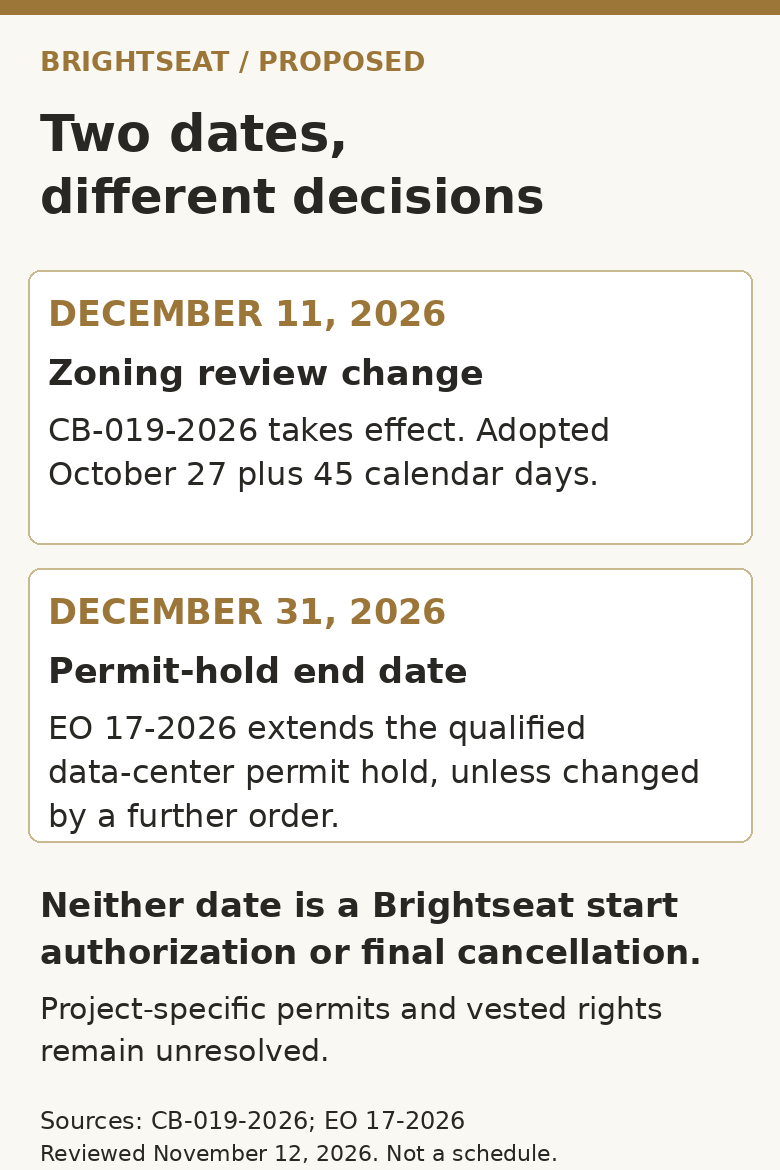
Two dates matter now. Executive Order 17-2026 extends the county’s hold on qualified data-center permit applications to December 31, 2026, unless changed by a further order. Separately, the October 27 zoning bill takes effect December 11, 2026. It removes the detailed-site-plan exemption and changes use of the prior zoning ordinance, with a vested-rights qualification. How the county applies these measures to Brightseat remains unresolved. [16] [3]
Use the checklist below to prepare a procurement inquiry and assess a package when it becomes available. Workers can go directly to the regional training routes. We have not been able to verify, as of yet, specific hiring for this project.
What Lerner proposed at the former Landover Mall
The planning resolution names Brightseat Associates, LLC as the landowner and applicant. Its 86.62-acre property sits near Brightseat Road, Landover Road and the Capital Beltway. The county economic-development corporation names the partners and attributes the $5 billion investment estimate to Lerner. [1] [2]
| Item | What the sources establish |
|---|---|
| Site | 86.62 acres in the planning resolution. The former Landover Mall address is 2101 Brightseat Road. [1] [2] |
| Buildings | The developer presentation shows five buildings, each with 826,500 square feet, totaling 4,132,500 square feet. These are the proposed master-plan dimensions. [4] |
| Power | The presentation labels 820 MW as total site capacity and shows a planned substation area. The power section below explains the capacity labels and service questions. [4] |
| Capital | $5 billion is the developer’s projected investment. Financing, spending to date and awarded construction value remain unconfirmed in the November 12 source review. [1] [4] |
| Delivery | The November 12 source review leaves the tenant, general contractor and current start date open. A building schedule would show the sequence and timing of work. [2] [4] |
Sources: planning resolution, developer presentation, pages 4 and 16, and county economic-development summary. [1] [2] [4]
When a building schedule is announced, we will post it here. NPR reported an earlier 2026–2027 groundbreaking target, then described the project as on hold in its November 7 story. [5]
Brightseat readiness checklist: questions for your first inquiry
Use this Echelon checklist to organize an early inquiry, then assess the documents as they become available. Start with the questions that affect your trade. Record the issuer and date of each answer so you can distinguish a preliminary discussion from a package ready to price.
| Gate | Who to ask | Record needed and current evidence | Contractor or worker action |
|---|---|---|---|
| Permit processing | County DPIE; developer supplies the exact application identifiers. | EO 17-2026 extends the hold to December 31, 2026. Obtain the current written permit disposition and any later order. [16] | Confirm authorization for your scope with the county before mobilizing; the hold’s end date alone does not authorize construction. |
| Planning and vested rights | County planning authorities; developer and its land-use counsel. | CB-019-2026 takes effect December 11. Obtain the county’s project-specific treatment, relevant decision and any appeal or court order. [2] [3] [7] | Ask how the earlier subdivision approval and the new review requirements apply to the specific application. |
| Electric service and phase | Developer and serving utility; the package buyer must confirm work boundaries. | The plan labels 820 MW total site capacity. Request the service commitment, energization milestones and utility/developer scope split for the phase. [2] [4] | Use phase-specific scope and dates for pricing; flag assumptions in preliminary estimates. |
| Water, civil work and cooling | Developer’s design team and WSSC, with the actual civil-package buyer. | The 2024 resolution calls for system-integrity review and upgrades as necessary. Obtain accepted drawings, easement decisions and a design-specific water-demand basis. [2] | Identify site constraints early, then refine quantities and equipment allowances as the design develops. |
| Buyer, package and payment | Developer first; then the confirmed purchasing entity or prime. | Ask when packages will be released and who will buy them. Request the legal buyer, package number, drawings, deadline, qualification requirements and contract terms. [10] | Explore qualification requirements now. For a formal bid, confirm the submission route and review insurance, bonds, retainage, payment and cancellation terms. |
| Crew assignment or job offer | The named employer or the relevant hiring hall. | For an assignment, obtain the employer, site, start date, referral rules, pay, overtime and travel terms in writing. [4] | Base travel or relocation plans on a confirmed assignment. Regional training offers a separate route into the trades. |
For a first inquiry, use Lerner’s general contact page and ask who handles Brightseat procurement for your trade. Identify 2101 Brightseat Road and request the current package contact. This is a general inquiry form. Ask for the appropriate submission route before sending pricing. [10]
Did the petition stop the Landover data center?
NPR reported that Taylor Frazier McCollum’s petition drew more than 25,000 signatures and helped build the campaign against Brightseat. Its November 7 story describes the project as on hold. The organizing matters to the project’s political prospects, but the permit and planning records determine the legal steps. [5]
Separate government actions govern different stages. The Planning Board approved preliminary subdivision plan 4-23024 on March 14, 2024. It adopted the resolution on April 4. In July 2026, the council paused specified planning applications. In October, it adopted a change to the review process for qualified data centers. These actions affect different stages of development. [2] [3] [7]
- Subdivision approval, 2024. The Planning Board approved three parcels with conditions. Building permits are a separate approval stage.
- Planning moratorium, July 7, 2026. CR-066-2026 pauses preliminary subdivision and detailed-site-plan applications for up to two years, subject to earlier comprehensive legislation. [7]
- Permit hold, September 28, 2026. Executive Order 17-2026 extends the hold to December 31, unless changed by a further order.
- Review change, effective December 11, 2026. Adopted October 27, CB-019-2026 removes the detailed-site-plan exemption and changes use of the prior zoning ordinance, with a vested-rights qualification.
- Construction and utility delivery. The next records to watch are project-specific permit decisions, utility commitments and authorization to start work.
Echelon graphic based on the planning resolution and county legislation. It follows the approval stages outlined above. [2] [3] [16]
The July moratorium covers specified planning applications
The county’s official record lists July 7, 2026 as the adoption and effective date of CR-066-2026. Its operative text pauses applications for preliminary plans of subdivision and detailed site plans. Nature Forward’s July account identified the central problem for opponents: Brightseat already had preliminary subdivision approval and qualified data centers then had a detailed-site-plan exemption. [7] [8]
The separate executive permit hold runs to December 31
Executive Order 17-2026, issued September 28 and effective immediately, extends the temporary hold on accepting, considering and processing qualified data-center permit applications from September 30 to December 31, 2026. It directs county permitting staff to discontinue accepting, considering, processing or reviewing those applications, as determined by county staff. The order terminates December 31 unless changed by a further executive order. [16]
The September order extends the earlier countywide hold. For Brightseat, the county’s written disposition of the individual permit files is still needed to establish their status, including any treatment of issued permits or vested rights.
The October law targets the review exemption
When effective, CB-019-2026 will make qualified data centers subject to detailed site plan approval. It also changes the ability to proceed under the prior zoning ordinance, while retaining language concerning vested rights under Maryland law. The bill was adopted October 27 and takes effect 45 calendar days later, December 11, 2026. That effective date falls after this report’s November 12 review. [3]
WTOP reported that Council Member Shayla Adams Stafford expected the law to bring Brightseat back through review and effectively stop it given the opposition. That assessment describes the council member’s expected outcome. A final project-specific ruling, including any vested-rights determination or court decision, remains unverified. [9]
Brightseat faces a harder approval path and organized opposition. We are watching for the county’s project-specific decisions and any owner announcement about the plan.
What the 820 MW power plan shows
The developer’s master plan labels 820 MW “total site capacity” and reserves 191,664 square feet for a substation. The same slide separately describes about 100 MW of IT capacity per data center, dependent on design. The two labels describe different aspects of the design; the presentation leaves their relationship unexplained. They are planning figures, not contracted or energized IT load. [4]
The 2024 planning resolution says on page 36 that no letters from public utilities had been received. It says utility connections would be reviewed at the permit stage. That is the historical 2024 record. As of the November 12 source review, a later signed power-service agreement, agreed connection scope and energization date remain unverified. [2]
Water mains, easements and cooling design
The resolution places the property in Water and Sewer Category 3 and describes active water and sewer mains around and within the site. It says WSSC would require a system-integrity review and upgrades as necessary. It also addresses conflicts between dry-utility easements and a WSSC easement near Brightseat Road and Evarts Street. Those are concrete infrastructure issues for future design and civil work. [2]
The next design questions are the campus water demand, cooling-system selection, water allocation and discharge approval. Those details remain unverified, as do generator counts, emissions and operating limits. Civil and mechanical firms can ask which design documents are available for early review.
Residents have raised concerns about noise, air quality, power bills and water. NPR reports on the campaign. Nature Forward explains the concerns from an advocacy position. Those accounts help explain local opposition. The county records document the approvals discussed here. [5] [8]
Construction scopes to discuss with the project team
The November 12 source review leaves the general contractor, trade awards and public bid packages unconfirmed. Contractors can use Lerner’s corporate contact page to ask about procurement contacts, planned packages and qualification requirements. [10]
The planning conditions and master plan point to the scopes below. Use them to explain your capabilities in an early inquiry and evaluate future notices. The table combines documented site requirements with construction-scope analysis; package details await released designs and procurement notices.
| Trade or package | Evidence and boundary |
|---|---|
| Civil, excavation and utilities | Planning conditions address easements, stormwater and site improvements. WSSC review can require main upgrades. Ask for civil drawings and quantities as the package develops. |
| Concrete, reinforcing and structural steel | The five-building concept implies major foundations and structures. Foundation design, framing system and building sequence need issued drawings. |
| Electrical and substation | A substation area appears on the master plan. Ask where utility-owned work ends and developer-owned work begins, and how switchgear procurement fits the schedule. |
| Mechanical, pipefitting and plumbing | Cooling and building services would require design-specific packages. Ask for the cooling selection and water-demand schedule to develop quantities. |
| Sheet metal, insulation and controls | These are common data-center building-service trades. Equipment schedules and controls specifications would define the Brightseat packages. |
| Fire protection and life safety | Sprinkler, alarm and associated testing scopes depend on approved design. Ask how installation and acceptance testing will be packaged. |
| Low-voltage, security and commissioning | These packages normally follow tenant and systems requirements. Ask which tenant requirements and commissioning responsibilities will govern these packages. |
| Operators, laborers, roofing and envelope | Site preparation, material handling and building enclosure would span several trades. Discuss equipment needs, labor requirements and the enclosure sequence as plans develop. |
Project-specific anchors: resolution and developer master plan. Other trade descriptions are construction-scope analysis for future package review. [2] [4]
Early conversations can establish trade fit and qualification requirements. As a package develops, use the buyer’s drawings, scope boundaries and schedule to refine an estimate. For comparison with projects that have named builders or procurement routes, use Echelon’s data-center project and contractor reports.
For other approval-stage comparisons, read the Antelope permit and contractor report and Project Jupiter’s separate campus and power workstreams. Each report follows its own project’s decisions and work routes.
What Brightseat could mean in paychecks, business income and taxes
The developer forecasts $2.4 billion in construction income and $450 million in income across other industries during construction, followed by $123.5 million in annual operating labor income to county residents and businesses.[4] They remain developer forecasts: the February 2024 presentation does not supply the underlying model, define how construction income divides between wages and other compensation, or show how much reaches county households.
The project-specific dollar forecast
| Developer forecast | Construction phase | Annual operations |
|---|---|---|
| Construction income | $2.4 billion | Separate operating measure below |
| Income across other industries | $450 million | Not separately reported |
| Operating labor income to county residents and businesses | Separate construction measures above | $123.5 million |
| Local tax revenue | $53.5 million | $13.7 million |
| State tax revenue | $88.6 million | $16.3 million |
| Federal tax revenue | $416.7 million | $15.3 million |
Source: developer presentation, slides 16–17.[4] The construction dollar figures have no stated duration; the operating column is explicitly annual. The presentation gives no price year for either set of dollar forecasts. The deck calls the construction employment figures annual, but does not define their time denominator. The presentation does not break local taxes out by taxing body.
The developer’s construction model lists 27,000 annual construction jobs and 9,000 annual multiplier-effect jobs. Its operating model lists 1,600 total annual jobs, including more than 500 in data processing and utilities, nearly 900 from business-to-business activity and nearly 200 from household spending.[4] The operating categories are parts of the 1,600 total. These impact-model categories do not establish unique workers, concurrent onsite crews or open positions.
How much income could stay in the county?
Every 1 percentage point of the developer’s $2.4 billion construction-income forecast equals $24 million. The following retention cases show the scale of different outcomes if that forecast were realized. The percentages are chosen for illustration, not measured local hiring or likely outcomes.
| Assumed share reaching county residents or businesses | Illustrative construction income retained |
|---|---|
| 10% | $240 million |
| 25% | $600 million |
| 40% | $960 million |
Here, retained income means the chosen share of the developer’s construction-income category attributed to county residents or businesses. It is not take-home pay, local retail spending or a new estimate to add to the developer’s forecast. County hiring, locally owned subcontractors and purchasing arrangements would help determine the actual share. Commuting and traveling workers could take earnings back to other communities as well.
What an individual trade assignment could pay
Regional wage evidence gives workers a separate way to value an assignment. BLS May 2025 estimates for the Washington-Arlington-Alexandria metro cover occupations across industries, not data centers alone.[19] They measure straight-time gross cash pay and exclude overtime and employer benefits.[20] The table applies those hourly means to 2,000 regular paid hours in a worker-year: 50 weeks at 40 hours. Its overtime case adds 400 hours at time-and-a-half; an 18-month assignment would instead use 3,000 regular hours. These are constant-2025-wage examples, not announced Brightseat pay rates.
| Trade | Metro mean hourly cash wage | Year at 2,000 hours | Year with 400 overtime hours |
|---|---|---|---|
| Construction and extraction supervisors | $43.78 | $87,560 | $113,828 |
| Carpenters | $32.11 | $64,220 | $83,486 |
| Cement masons and concrete finishers | $28.00 | $56,000 | $72,800 |
| Construction laborers | $23.88 | $47,760 | $62,088 |
| Construction equipment operators | $31.18 | $62,360 | $81,068 |
| Electricians | $38.29 | $76,580 | $99,554 |
| Plumbers, pipefitters and steamfitters | $36.10 | $72,200 | $93,860 |
| Sheet metal workers | $30.29 | $60,580 | $78,754 |
| Structural iron and steel workers | $32.44 | $64,880 | $84,344 |
| HVAC mechanics and installers | $35.45 | $70,900 | $92,170 |
Hourly rates: BLS; earnings: Echelon calculations.[19] At 3,000 regular hours over 18 months, the electrician example becomes $114,870 and the concrete-finisher example $84,000. Actual rates, paid hours, benefits and travel terms would come from the hiring employer.
How pay reaches nearby businesses and home communities
Start with $1 million in gross cash wages and assume workers keep 75% after taxes and deductions, leaving $750,000. The table assumes equal average pay across three worker groups. Every residence and spending percentage is a chosen illustration, not a measured Brightseat hiring or spending pattern.
| Worker group and assumed payroll share | Share of take-home spent in host county / outside home community | Host-county purchases | Outside-home purchases |
|---|---|---|---|
| County residents: 25% | 60% / 0% | $112,500 | $0 |
| Outside commuters: 50% | 10% / 50% | $37,500 | $187,500 |
| Traveling workers: 25% | 25% / 35% | $46,875 | $65,625 |
That puts $196,875 into Prince George’s County businesses and $253,125 into workers’ home communities outside the county. The remaining $300,000 covers saving, debt principal and purchases elsewhere. Residents’ home purchases are already in the county column. Employer-paid reimbursements are outside this example.
For an individual commuter, the same assumed 75% take-home rate and 10% host/50% home spending shares turn the electrician’s $76,580 annual gross wages into about $5,744 in host-county purchases and $28,718 in purchases back home. The concrete finisher’s $56,000 becomes $4,200 near the project and $21,000 back home. These are hypothetical spending choices applied to the wage examples, not forecasts of workers’ behavior.
Lodging, meals and other purchases can support businesses near the project while earnings taken home support other communities. These purchases are uses of wages, not extra benefits to add to payroll or the developer’s modeled income. Purchases at a local business also differ from income retained by local owners and employees.
What the dollars mean for contractors and residents
At the regular-hour schedule, a 20-person electrical crew would earn $1,531,600 in annual gross wages. A contractor’s receipts must also cover benefits, employer payroll costs, materials, equipment, supervision, financing and overhead before producing profit. Successive paid packages could support crew continuity and supplier orders. The developer’s $5 billion capital-investment headline does not disclose a construction-only contract budget, so assigning a percentage of it to electrical or concrete contracts would require a cost breakdown.[4]
The community’s net gain depends on local participation, alternative work and land uses, and who pays for roads, utility upgrades, services and incentives. The forecasts show the gross opportunity; those costs and alternatives determine how much better off residents would be.
Local hiring, apprenticeship places, accessible work packages and prompt payment would help households and firms participate. Published award values, crew schedules and tax terms would turn these dollar scenarios into a clearer account of what Brightseat could deliver if built.
Regional training and trade application routes
Workers can pursue the regional training and application routes below while following Brightseat. These programs have their own admission and referral processes; they are separate from employment on this project.
- Electrical and technology services: The Electrical Alliance’s Local 26 training page describes a five-year inside-electrical route and a separate technology-services option. It explains account creation, application steps, testing and selection. Review the current fees and documents on the official page before applying. [11]
- Plumbing and gasfitting: Plumbers Local 5 says online applications are being accepted for the 2027/2028 school year. The application process is year-round, but testing occurs on specific dates and admission is limited. Applicants must be at least 17 when applying and 18 when assigned to work after acceptance. [12]
- Steamfitting and pipefitting: Steamfitters Local 602’s training site lists its Landover location and displays an applications-open notice. The linked application page did not expose a usable form in this review. Confirm intake directly with the training center before relying on that notice or making a trip. [13]
- Sheet metal: SMART Local 100 lists a five-year program and its Washington/Baltimore training center in Suitland. It publishes online application instructions and says applicants are notified of test dates. [14]
- Ironwork: Ironworkers Local 5 lists in-person applications at 7 a.m. on the second Monday of each month in Largo, with a written exam and physical-ability test. Confirm the session and required documents before attending. This is a different union from Plumbers Local 5. [15]
Experienced operators, laborers, sprinkler fitters, insulators and other trades can ask their own hiring halls or employers about referral requirements and regional work.
What would change the project assessment?
A revised status should rest on a new record: an extension or termination of the executive permit hold; the county’s treatment of Brightseat under CB-019-2026; a project-specific permit decision; an owner’s withdrawal or revised plan; a utility-service commitment; or a named construction award. A procurement notice should identify the buyer and package. A hiring notice should identify the employer and job location.
For now, an early inquiry can help a contractor learn the procurement process and prepare for relevant work. We will update this report when announcements or public records clarify the next stage.
Questions about the Landover data center
Who owns the proposed Brightseat Tech Park site?
The 2024 planning resolution names Brightseat Associates, LLC as owner and applicant. The county economic-development corporation describes the developer as an affiliate of Lerner Enterprises and The Tower Companies. [1] [2]
Is the Landover data center canceled?
NPR’s November 7 report describes Brightseat as on hold. As of the November 12 source review, an owner cancellation or final cancellation order remains unverified. The executive permit hold runs to December 31 unless changed, while the new zoning law takes effect December 11. Project-specific permit and vested-rights treatment remain unresolved. [3] [5] [16]
Has the developer secured 820 MW?
The master plan labels 820 MW as total site capacity, a planning figure. As of the November 12 source review, a signed power-service commitment and energization date remain unverified. [4]
Can a contractor bid or a worker apply to Brightseat now?
Contractors can make an early procurement inquiry through Lerner’s general contact page. A project-specific public bid invitation remains unverified in the November 12 source review. We have not been able to verify, as of yet, specific hiring for this project. Workers can explore the separate regional training routes listed above.
Sources, updates and corrections
For a correction or to supply additional information, email Echelon Reports with the record, issuing organization, date and project address. A permit decision, procurement notice or named contractor award would help resolve the gaps in this report.
This report separates government decisions, developer forecasts, journalism and advocacy. The source review and competitive revision took place November 12, 2026. The 2024 plans describe that historical record, not current utility or construction commitments. Image-based pages were read with OCR and visually checked for consequential dates and figures. The September 28 executive order was included in that source review. The economics section adds a November 12 review of the original dollar forecasts and BLS May 2025 wage examples. Other project observations retain their existing evidence dates. December 11 is calculated from the enacted bill’s October 27 adoption and 45-calendar-day clause; the legislative landing page leaves its effective-date field blank.
The checklist is Echelon’s practical guidance for contractor inquiries. Project-specific legal conclusions require the county’s decisions and qualified legal advice. The report draws on the linked records; it does not represent contact with the developer, a submitted bid or a job application.
Sources
- Prince George’s County Economic Development Corporation, development-project summary, October 30, 2024. Developer affiliation, address and Lerner-attributed investment estimate.
- Planning Board resolution 2024-016, preliminary plan 4-23024, adopted April 4, 2024. See pages 1–5 for approval and conditions, 23–24 for water and utility easements, 36 for WSSC and utility comments, and 38 for action dates.
- County legislative record, CB-019-2026, adopted October 27, 2026; DR-2 text, including the vested-rights qualification and 45-day effective-date clause.
- Brightseat Tech Park developer presentation, hosted by the City of Glenarden, February 9, 2024 (cover date). Page 4: master plan; pages 16–17: economic-impact projections. These are developer forecasts; their price year and underlying model are not supplied.
- Jenny Abamu, NPR/WAMU, “An unexpected activist emerged to help block a $5 billion data center in Maryland”, November 7, 2026.
- County legislative record, CR-066-2026, adopted and effective July 7, 2026; DR-2 text. Its scope is specified planning applications, not a blanket cancellation.
- Nature Forward, Brightseat Tech Park environmental-justice account, July 30, 2026. Advocacy source. Its account flags the existing-approval gap; the county record controls the July adoption date.
- WTOP, “Prince George’s Co. bill may pull the plug on data center at former Landover Mall site”, October 2026. Reports the council member’s assessment of the new law.
- Lerner corporate contact page. General inquiry, not a verified Brightseat solicitation.
- Electrical Alliance, Inside Electrical Track. Regional Local 26/NECA training and application instructions.
- Plumbers Local 5, apprenticeship applications. Published 2027/2028 intake information.
- Steamfitters Local 602 training center. Regional training contact and application notice; linked form availability was not confirmed.
- SMART Local 100, apprenticeships. Washington/Baltimore program and Suitland training route.
- Ironworkers Local 5, About Apprenticeship. Largo application process and requirements.
- Executive Order 17-2026, September 28, 2026, pages 1–2. Extends the qualified data-center permit-application hold to December 31, 2026, unless changed by a further executive order.
- BLS May 2025 Washington metro wages. Washington-Arlington-Alexandria, DC-VA-MD-WV; cross-industry hourly mean wages, May 2025. Table checked November 12, 2026. Earnings examples use separately assumed hours.
- BLS May 2025 OEWS technical notes. Straight-time gross wages exclude overtime premiums and supplementary employer benefits; BLS annual estimates use 2,080 hours, unlike the 2,000-hour examples here.