Sewer rehabilitation jobs cover camera inspection, pipe cleaning, cured-in-place pipe (CIPP) lining and temporary pumping during repairs.[2][3][6] In the employer listings reviewed here, Twin D’s Utah operator-assistant role starts at $20–$22 an hour, while SAK’s Tennessee laborer role advertises up to $35 an hour with CDL and CIPP experience.[1][5] Those are different jobs with different entry requirements, not the endpoints of a national pay range.
Use this guide to choose a role that matches your experience, compare travel and training terms, and apply through the employer. The six selected US listings were checked on October 30, 2026. Their descriptions provide application leads, not confirmation that each position remains unfilled.
Start with your qualifications. A commercial driver’s license (CDL), outdoor construction experience and CIPP experience are separate requirements. A role that prefers one can still require another.[2][3][4] Compare the specific listing before paying for a course or arranging travel.
Compare jobs and application linksWhich sewer job fits your experience?
These starting points narrow the search; they do not establish eligibility on their own. Read the full description for physical demands, screening, driving requirements and other conditions.
- No prior sewer experience: Start with Twin D’s Layton operator-assistant description. Construction or field-labor experience is highly preferred rather than mandatory, but a valid driver’s license and clean motor vehicle report are required.[1]
- Class A or B CDL: Compare Guildner’s Commerce City jet-vac role, which prefers heavy-equipment experience. Baltimore’s CCTV role also requires construction and CIPP experience; a CDL alone does not meet its listed qualifications.[2][3]
- Outdoor construction experience: Cerritos requires at least two years and prefers CIPP or water/sewer utility experience. Its CDL is preferred, not required. SAK’s Chattanooga laborer role requires a CDL as well as outdoor construction experience.[4][5]
- Mechanical and crew-leadership experience: Sunbelt’s North Chesterfield foreman role covers pump and power projects, including bypass pumping. It is a supervisory support role, not a sewer-only laborer opening.[6]
Compare six employer listings: pay, requirements and travel
The location is the listing’s stated base, not a promise of local-only work. Pay and travel terms belong to the individual role. Several listings are within the Azuria group, so six listings should not be read as six independent corporate owners.[1][2][3]
| Employer and role | Location and published pay | Requirements and travel | Employer listing |
|---|---|---|---|
| Twin D: construction laborer / operator assistant | Layton, Utah. Starting pay $20–$22 per hour, depending on experience. | Construction or field-labor experience highly preferred. Valid driver’s license and clean motor vehicle report required. Travel at least once a month when needed; daily per diem and individual hotel room covered while traveling. | Supports truck and CCTV operators on sewer and stormwater work. Listing 27786098.[1] Read role and apply |
| Insituform Technologies LLC: CCTV operator | Baltimore, Maryland. No numerical pay rate shown. | Class A or B CDL; 1–2 years of outdoor construction experience with CIPP experience; OSHA certifications required but not specified. Travel as much as 75%. | Remote camera inspection and robotic tap-cutting work. Requisition R-7816.[2] Read role and apply |
| Guildner Pipeline Maintenance: jet vac truck operator | Commerce City, Colorado. No numerical pay rate shown. | Class A or B CDL required. Previous heavy-equipment experience preferred. Out-of-town work when needed. | Jet-vac cleaning and hydro excavation, including city and storm sewers. Requisition R-7999.[3] Read role and apply |
| Insituform Technologies LLC: installation technician | Cerritos, California. Starting at $20 per hour. | At least two years of outdoor construction experience, preferably CIPP or water/sewer utilities. Class A or B CDL preferred. As much as 70% overnight travel, with local, regional or interstate assignments. | Sewer and stormwater rehabilitation, site setup and installation support. Requisition R-7978.[4] Read role and apply |
| SAK Construction: construction laborer (CDL) | Chattanooga, Tennessee. Up to $35 per hour with CDL and CIPP experience. | Class A or B CDL and outdoor construction experience required. Travel based on operational needs; listing states expenses paid plus per diem. | CIPP rehabilitation and repair of sewer and stormwater pipes. Listing 1747.[5] Read role and apply |
| Sunbelt Rentals: pump solutions foreman | North Chesterfield, Virginia. Displayed range $27.07–$37.21; pay interval not stated. | Construction background, strong mechanical knowledge and demonstrated leadership. Occasional travel, including several consecutive nights away. | Setup and teardown leadership for pump/power projects, including bypass pumping. Listing 2026-14718.[6] Read role and apply |

SAK’s $35 figure is a qualified upper rate, not the starting wage for every applicant.[5] Sunbelt’s displayed range cannot be compared with hourly offers until the employer confirms its pay interval.[6] Layton and SAK state per diem arrangements but do not publish the amount in these descriptions.[1][5] Missing terms are questions for the recruiter, not evidence that an employer offers no allowance.
Contractor names and the employing business
Insituform and Guildner identify themselves as Azuria businesses.[2][3] The Layton description names Twin D even though the careers portal groups that role under Insituform Technologies.[1] Confirm the employing business when applying. These listings describe employer roles; they do not establish which contractor holds a particular municipal rehabilitation contract.
What sewer inspection, cleaning, lining and bypass crews do
CIPP is a resin-saturated tube installed inside an existing pipe and cured in place.[7] NASSCO describes heat and light-based curing systems among the methods used.[7] Sewer rehabilitation also includes other linings, grouting and pipe replacement techniques; CIPP is one part of the field.[7]
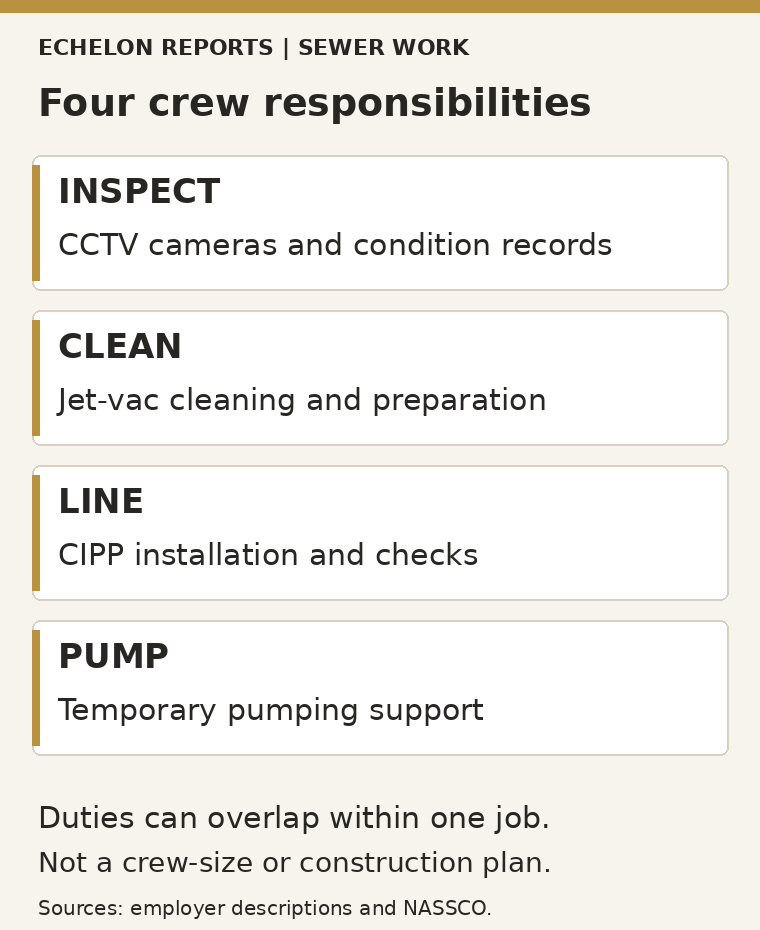
Inspect and document
Closed-circuit television (CCTV) operators record pipe conditions.[2] Some roles include robotic cutting to reopen service connections after rehabilitation.[2]
Clean and prepare
Jet-vac operators use high-pressure water and vacuum equipment.[3] Guildner’s role combines sewer cleaning with hydro-excavation duties.[3]
Support pumping
Pump crews install and remove temporary equipment.[6] Sunbelt’s foreman role includes bypass pumping among several pump and power project types.[6]
Install and check
Lining crews rehabilitate the pipe.[7] Insituform’s technician duties include site setup and review of pre-installation and post-installation videos.[4]
This map describes responsibilities, not a fixed crew size, construction sequence or promotion ladder. Employers can combine tasks: Baltimore’s CCTV role includes inspection and cutting, while Twin D’s assistant supports truck and camera operators.[1][2] The selected descriptions do not establish a standard number of people needed for a rehabilitation crew.
Entry routes, PACP and employer training
Twin D’s Layton assistant is the clearest sewer-work entry route in this sample for someone without required prior sewer experience.[1] It prefers construction or field-labor experience and provides training on products, safety procedures and equipment.[1] Preferred experience does not guarantee acceptance; answer the application’s experience questions accurately.
Training offers also have limits. Baltimore offers robotic tap-cutting training for someone with transferable skills, but its description still requires a CDL, construction experience and CIPP experience.[2] Do not interpret one training offer as a waiver of the other requirements.
PACP means Pipeline Assessment Certification Program.[8] NASSCO uses it for consistent coding of pipeline conditions, with related programs for laterals and manholes.[8] Certification remains valid for three years, and NASSCO links to scheduled classes and trainers.[8] PACP concerns inspection and reporting; it does not replace a CDL or the safety training required for a particular assignment.[2][8][9]
Before buying a credential, ask which course is required before hiring, which training the employer provides, and who pays for the course, travel and renewal. Baltimore names OSHA certifications without specifying which ones.[2] Ask the recruiter to identify them rather than assuming a particular course will qualify you.
Confined-space duties require separate authorization and training
OSHA identifies pipelines, manholes and wet wells among the confined spaces workers can encounter in sewer work.[9] Employers must train workers involved in permit-required confined-space operations, and workers must not enter without authorization.[9] A camera-assessment credential does not authorize entry.[8][9]
Ask whether the role involves entry, who assigns safety responsibilities and how the employer handles rescue arrangements. OSHA warns that rescue attempts by untrained personnel can lead to multiple deaths.[9] This is employment guidance, not an entry or rescue procedure.
A sewer-job comparison worksheet
Copy these fields into a note for each offer. Record what the employer confirms and leave unresolved terms marked “not confirmed.” A higher advertised rate tells you little about the money and time you will commit if the hours, travel arrangements and expenses remain unclear.
| Record for each offer | Get a specific answer |
|---|---|
| Employer, role and requisition | Who employs you, which listing are you discussing, and is it still accepting applicants? |
| Work and equipment | Inspection, cleaning, mainline lining, lateral work or pump support? Which equipment must you operate without training? |
| Base pay and hours | Starting rate and pay interval; expected weekly hours; overtime terms; paid travel time; any project-specific wage terms. |
| Reporting location and travel | Reporting yard, territory, nights away, rotation, dispatch notice and arrangements for trips home. |
| Expenses | Per diem amount and qualifying days; hotel booking or reimbursement; room arrangements; transport and payment timing. |
| Credentials and training | Required CDL class and endorsements; exact inspection or safety courses; employer-paid training and renewal terms. |
| Safety, supervision and start | Entry duties, training and rescue arrangements; supervisor; anticipated start date and next hiring step. |
Travel percentages are not interchangeable with a rotation schedule. Baltimore lists as much as 75% travel; Cerritos lists as much as 70% overnight travel.[2][4] Ask how that translates into nights away and trips home. Obtain the terms in writing before committing to relocation or training costs.
Prepare an application that shows the relevant experience
Describe work you have actually performed: equipment operated, installation or inspection tasks, credentials held and time spent in each role. Separate tasks you can perform independently from those requiring training. For these listings, that distinction matters because Guildner prefers equipment experience, Cerritos requires construction experience and Baltimore requires CIPP experience.[2][3][4] State your travel limits before accepting an assignment.
Tell Echelon what sewer work fits you
Apply to a specific role through its employer. For other opportunities, you can register your experience, preferred locations and travel limits with Echelon. Your worker-interest profile stays private, and sharing it requires separate permission naming the employer or recruiting partner.[10] The form is not an employer application or a promise of placement.
Create a private worker-interest profileHiring a crew? Submit a free job for review, with the work location, pay, required skills and travel terms. See the privacy and listing terms before submitting.[10]
For water-main and service-line construction, use the separate water distribution jobs and employer guide. The Water & Underground Infrastructure series covers the wider specialties. You can also browse Echelon Trades Jobs.
Questions about sewer rehabilitation jobs
Can I apply without sewer construction experience?
Twin D’s Layton assistant listing prefers construction or field-labor experience rather than stating it as mandatory.[1] It requires a valid driver’s license and clean motor vehicle report.[1] Guildner requires a CDL but only prefers prior heavy-equipment experience.[3] Both employers evaluate applicants against their full requirements.
Do all sewer rehabilitation jobs require a CDL?
No. Baltimore’s CCTV, Guildner’s jet-vac and SAK’s Chattanooga laborer listings require a Class A or B CDL.[2][3][5] Cerritos prefers one, while Layton requires a valid driver’s license without listing a CDL as mandatory.[1][4] Requirements belong to the specific role, not the industry as a whole.
What is the difference between CCTV inspection and CIPP lining?
CCTV operators use cameras to inspect pipes; some positions also include robotic cutting.[2] CIPP lining installs and cures a resin-saturated tube inside an existing pipe.[7] Inspection and lining can be part of the same assignment, but they are different tasks.
Is PACP the same as confined-space training?
No. PACP concerns pipeline condition assessment and coding.[8] OSHA’s confined-space requirements address workplace hazards, authorization and safe performance of assigned duties.[9] One does not replace the other.
What do sewer rehabilitation jobs pay?
The selected listings show starting pay of $20–$22 per hour for Twin D’s Layton assistant and $20 per hour for Insituform’s Cerritos technician.[1][4] SAK’s Chattanooga laborer lists up to $35 per hour with CDL and CIPP experience.[5] These are employer-specific terms, not a national wage estimate. Confirm the starting offer, hours and expenses with the employer.
Sources and method
Echelon Reports reviewed the employer descriptions and application routes on October 30, 2026, and compared their published requirements, pay and travel terms. The sample covers six selected US listings, not a national vacancy census. No employer interviews, application submissions or project-assignment confirmations were conducted. Listings can close or change after the observation date.
NASSCO supplies the rehabilitation-method and inspection-certification references.[7][8] OSHA’s sewer confined-space fact sheet supplies the safety background.[9] The role comparison and offer worksheet are Echelon’s synthesis, not an employer-endorsed career ladder or a crew-staffing standard. Check the employer’s current description before applying.
Sources
- Twin D: construction laborer / operator assistant, Layton, Utah
- CCTV Operator | Baltimore, MD | R-7816
- Jet Vac Truck Operator | ITI Commerce City CO | R-7999
- Installation Technician | ITI Cerritos CA | R-7978
- SAK Construction: construction laborer (CDL), Chattanooga, ID1747
- Sunbelt Rentals: pump solutions foreman, North Chesterfield, ID2026-14718
- NASSCO: pipe rehabilitation
- PACP | LACP | MACP | NASSCO
- Confined Spaces in Construction: Sewer Systems
- Echelon Trades Jobs: employer listings and private worker interest