
What Is Your Electrical Business Worth in 2026?
Electrical is the next HVAC, and the wave has not peaked. Here is what your business is worth today, and what decides whether you ride the wave or get bought at the bottom of it.
Why electrical, and why now
How hot, exactly
What electrical businesses actually sell for
How a buyer reads your business: assets, liabilities, and booked work
The timing question
Frequently asked questions
- Electrical is the next HVAC. The capital that consolidated HVAC and plumbing is now buying electrical, pulled by data centers, electrification, and the grid.
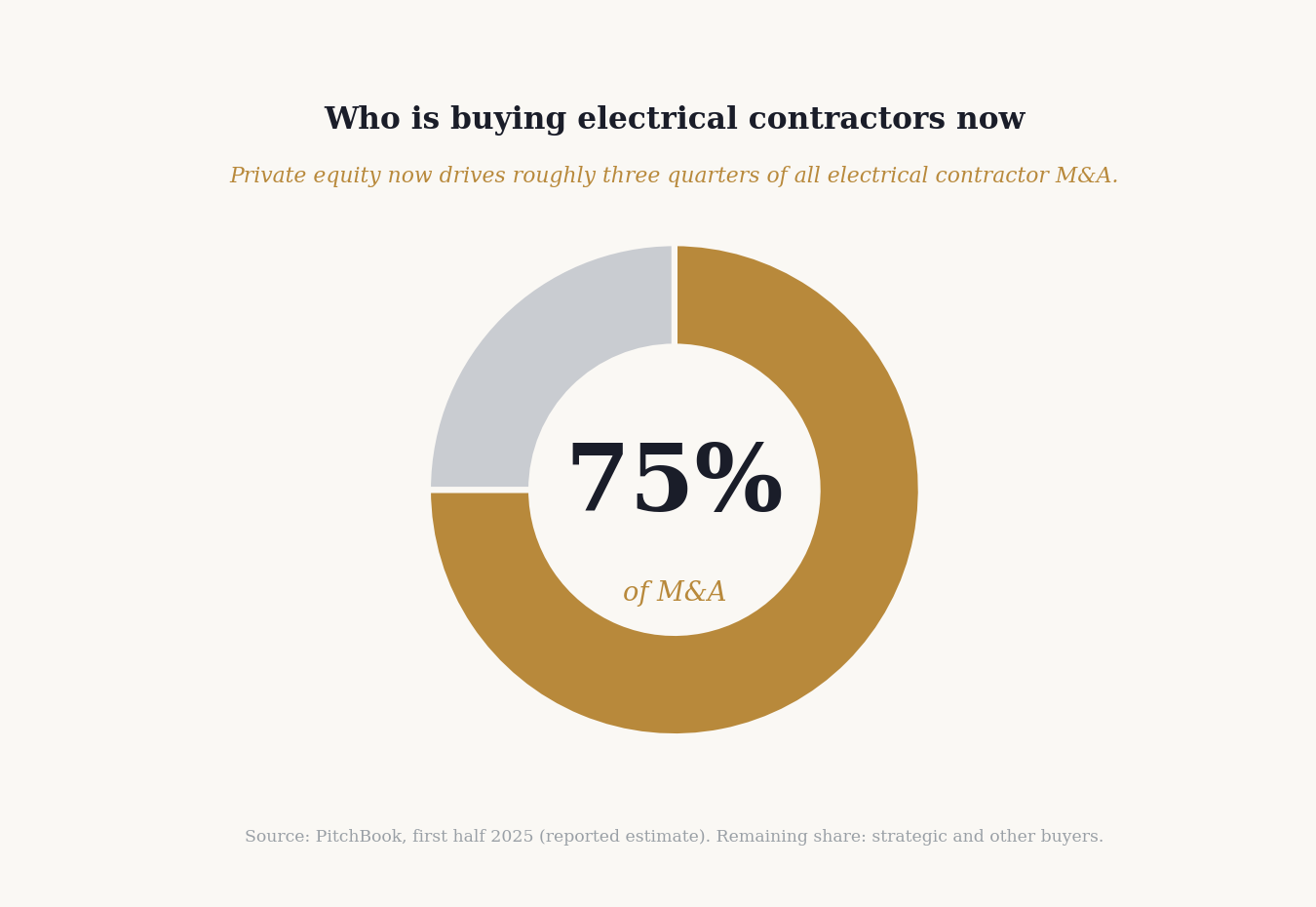
- Private equity now drives roughly 75 percent of electrical contractor M&A, and the wave is still building rather than cresting.
- In all but a couple of the 20 largest metros, Echelon found the most-reviewed “electrician” is actually a bundled plumbing, HVAC, and electrical platform, the same operators that consolidated those trades now leading electrical.
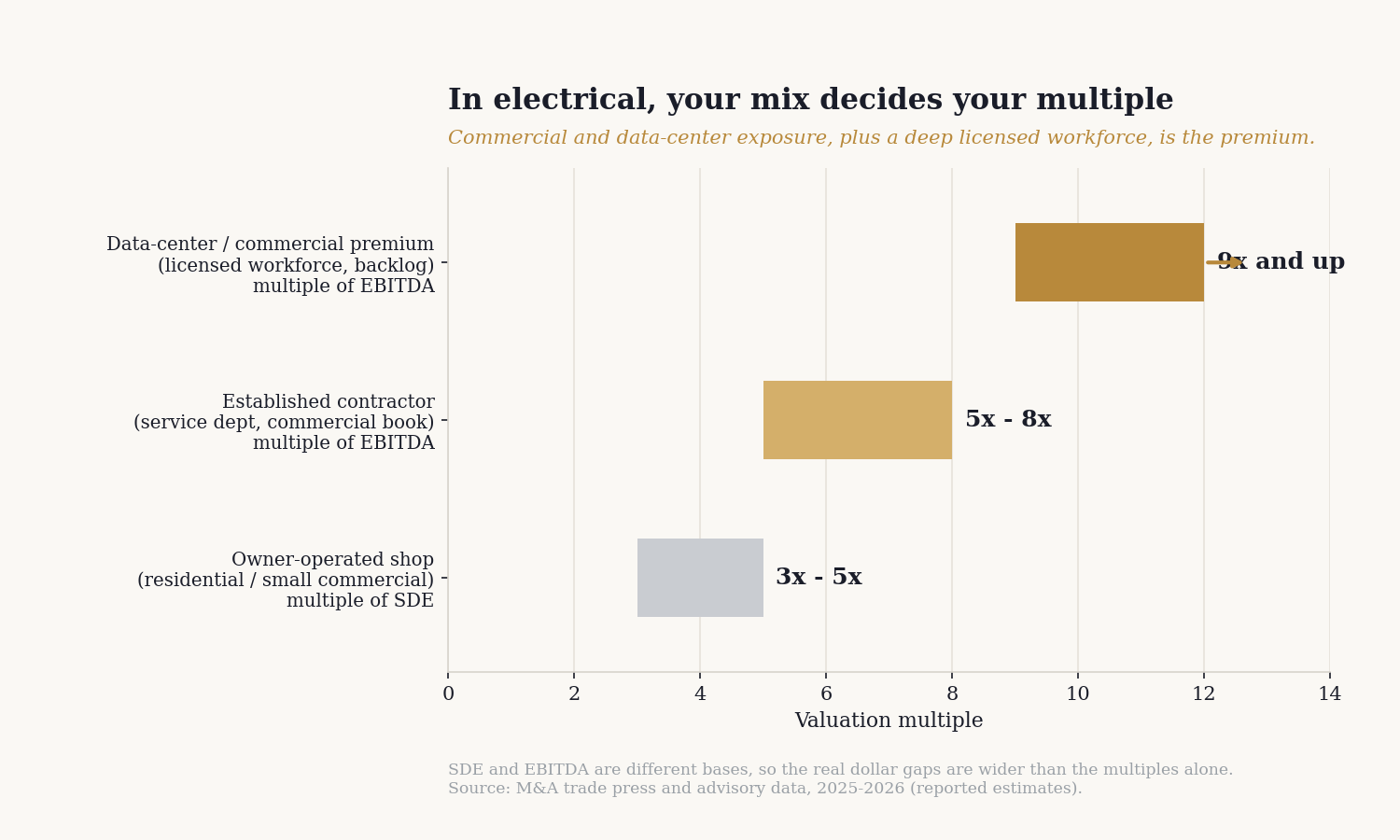
- Your mix decides your multiple: owner-operated shops trade around 3 to 5 times SDE, established contractors around 5 to 8 times EBITDA, and data-center or commercially weighted operations at 9 times and up.
- Electrical’s premium asset is the licensed workforce. Master and journeyman headcount is now valued on its own, because a buyer cannot quickly replicate it.
- Most of what drags value down is fixable, but on a timeline of a year or two, not the week a buyer calls.
The capital that spent the last decade buying up HVAC and plumbing companies is now calling electrical contractors. Same playbook, same buyers, a few years later. If you own an electrical contracting business and the cold calls and LinkedIn messages from people who say “search fund” or “platform” have picked up, that is not random. It is the front edge of a consolidation wave that is still building, and it has already started to move what your business is worth.
This is a straight read on where electrical sits: why the money is flowing in now, what electrical companies are actually selling for, and the specific things, some of them unique to this trade, that decide whether you command a premium or get treated as a bolt-on. We are not here to push you toward an exit. The goal is to show you what the ground actually looks like so you can decide on your own terms, and read your own business the way a buyer will.
Why electrical, and why now
Electrical clears both filters that decide whether a trade gets consolidated, which we mapped across all the trades in The Great Trades Roll-Up. It has a harvestable tier of operators large enough to build on, and it has demand that is not only durable but accelerating.
The demand story is the reason electrical is the trade to watch rather than just another roll-up. Three forces are pulling at once. Data-center construction for artificial intelligence is consuming electrical capacity at a scale the industry has never seen. Electrification, the shift of heating, vehicles, and appliances onto the grid, is generating panel upgrades and service work across both homes and commercial buildings. And reshoring, grid modernization, and the federal money behind the CHIPS Act and the energy legislation are funding a build-out of industrial and infrastructure electrical work that runs for years. A buyer is not betting on this quarter. They are betting on a decade of structural tailwind, and they are willing to pay for a seat.
The fragmentation gives them room to build. Census counts roughly 83,000 electrical firms with employees, and only about one in eight has 20 or more people. The scaled tier is real but thin, which is exactly the condition that draws capital: enough platform-grade businesses to assemble, far from enough to be picked over.
How hot, exactly
The buyers have arrived in force. By PitchBook’s read, private equity now drives roughly three quarters of all electrical contractor M&A, and private-equity deal flow in the first half of 2025 already exceeded the full-year total for 2024. The same institutional capital that built the big HVAC and plumbing platforms is now underwriting electrical on the identical thesis, and the multi-trade mechanical platforms are bolting electrical capability onto what they already own.
One number looks like cooling but is not. Total electrical deal count actually eased from about 140 in 2024 to 99 in 2025, by Cascade Partners’ count. That is not demand pulling back. It is the market normalizing off a peak and shifting from a flurry of small bolt-ons toward larger platform and strategic deals, a pattern the same analysis expects to continue or grow into 2026. The clearest signal of where this is heading is a single public deal: MYR Group’s roughly $328 million acquisition of Valley Electric and Comet Electric in October 2025, made explicitly to capture data-center and electrification demand.
You can see the consolidation in the data, by name. Echelon pulled the single most-reviewed electrical operator in each of the 20 largest US metros. Read the list.
| Metro | Most-reviewed “electrical” operator | Google reviews |
|---|---|---|
| Charlotte, NC | Morris-Jenkins | 35,404 |
| Phoenix, AZ | Parker & Sons | 34,080 |
| Chicago, IL | Four Seasons Heating, Air Conditioning, Plumbing, Sewer & Electric | 29,439 |
| Dallas, TX | Baker Brothers Plumbing, Air & Electric | 24,544 |
| Columbus, OH | Eco Plumbers, Electricians, and HVAC Technicians | 20,475 |
| Kansas City, MO | Anthony Plumbing, Heating, Cooling & Electric | 19,470 |
| Houston, TX | John Moore Services | 19,276 |
| Minneapolis, MN | Hero: Plumbing, Heating, Cooling, Drains, Ducts & Electrical | 18,897 |
| Denver, CO | Applewood Plumbing Heating & Electric | 17,318 |
| San Antonio, TX | Jon Wayne Service Company | 16,950 |
| Cincinnati, OH | Apollo Home | 15,939 |
| Orlando, FL | Frank Gay Services | 14,627 |
| Atlanta, GA | TE Certified, Electrical, Plumbing, Heating & Cooling | 12,476 |
| Philadelphia, PA | Harris Plumbing, Heating, Air & Electrical | 12,313 |
| Tampa, FL | And Services | 10,945 |
| Indianapolis, IN | Peterman Brothers Heating Cooling Plumbing | 10,783 |
| Nashville, TN | Hiller Plumbing, Heating, Cooling & Electrical | 9,791 |
| New York, NY | Service Professionals | 6,620 |
| Miami, FL | Paradise Plumbing, Air & Electric | 5,431 |
| Los Angeles, CA | Powell Electric | 4,074 |
In all but a couple of these markets, the most-reviewed “electrician” is not an electrician at all. It is a bundled plumbing, heating, cooling, and electrical home-services brand: Parker & Sons in Phoenix, Morris-Jenkins in Charlotte, Baker Brothers in Dallas, Eco Plumbers in Columbus, names carrying tens of thousands of reviews and a service van for every trade. That is the roll-up made visible. The platforms that spent the last decade consolidating plumbing and HVAC have folded electrical into the same brand, the same trucks, and the same call center, and they now sit at the top of the residential electrical market in metro after metro. When we say the capital that built the HVAC platforms is moving into electrical, this is what it looks like on the ground.
For an independent electrical contractor, the read is twofold. These platforms are your most active acquirers, and they are also your most organized competitors for residential work. Both facts raise the value of being the kind of business they want to buy rather than the kind they want to outrun.
What electrical businesses actually sell for
Electrical has a wider valuation spread than most trades, and where you land depends almost entirely on your mix of work.
At the owner-operated end, a residential or small commercial shop where the owner runs everything tends to trade on a multiple of seller’s discretionary earnings (SDE), commonly in the range of about 3 to 5 times. These are bolt-ons. The systems are thin and the owner is the business.
Established contractors with a service department, management depth, and a real commercial or industrial book trade on earnings before interest, taxes, depreciation, and amortization (EBITDA), commonly reported in the range of about 5 to 8 times. And the premium tier is specific to this trade: operations weighted toward commercial, industrial, and especially data-center work, with the licensed workforce and backlog to support it, regularly clear 9 times and move higher at platform scale, where construction deals done by private equity have averaged well above what strategic buyers pay.
The reason for the spread is the nature of the work. Residential electrical, particularly new-construction and light renovation, is episodic and sensitive to the housing cycle. Commercial and industrial work, the office fit-outs, the data centers, the healthcare and multi-family projects, runs on longer lead times, larger tickets, and relationships that repeat. A buyer pays for the predictable stream, not the lumpy one, which is why two electrical businesses with the same revenue can be worth very different numbers.
Echelon’s own data shows why this matters, in a way that is easy to miss. Across the 20 largest metros, only about 8 percent of electrical operators have crossed 100 Google reviews, proportionally fewer than in roofing, even though the federal employment data says electrical has a larger share of scaled, 20-plus-employee firms than roofing does. That gap is the tell. Reviews come from homeowners, and the most valuable electrical work, the commercial fit-outs, the industrial plants, the data centers, never generates a single homeowner review. A pure commercial electrical contractor can be one of the largest and most valuable operators in its market and remain nearly invisible to a review count. The lesson for an owner is the one a buyer already knows: the commercial book is the hidden value in electrical, worth the most precisely because it does not show up where everyone else is looking.
How a buyer reads your business: assets, liabilities, and booked work
A buyer does not pay for revenue. They pay for a defensible stream of future cash flow, and they reach their number by weighing what adds durable value against what drags it down, then judging how much of the future is already spoken for. The most useful thing you can do before anyone calls is look at your own business the same way.
The assets that actually move the number in electrical start with something no other trade weighs as heavily: your licensed workforce. The density of master and journeyman electricians on your payroll is now valued on its own, separately from the revenue they generate, because a buyer cannot conjure licensed tradespeople out of thin air in a market this short on them. A stable, credentialed crew with a low experience-modification rating (EMR), the workers’ comp safety multiplier, is a genuine asset. So is bonding capacity, which gates the size of work you can win. Beyond the workforce, the things that lift value are a book of commercial and industrial relationships, recurring service and maintenance agreements, and your digital footprint on the residential side, where a business that generates its own work through its website, reviews, and ranking owns a real, transferable asset, while one that rents every lead from a platform it does not control owns nothing it can hand over.
The liabilities that get priced in are often the ones no accountant booked. Owner-dependence is the big one: if you are the top estimator, the relationship that wins the bids, and the person who keeps the crews together, a buyer is looking at a job to fill rather than an asset to absorb, and prices it as a bolt-on. Customer concentration above roughly fifteen percent reads as risk, and in electrical that often means over-reliance on one or two general contractors. A high EMR, thin bonding, working-capital strain from project-heavy work, and an entirely residential book exposed to the housing cycle are all drags a buyer will quantify and subtract.
Booked work counts, but a buyer underwrites it rather than trusting it. Backlog matters more in electrical than in most trades, and it gets scrutinized hard. A buyer will ask for signed contracts and executed purchase orders, analyze the margin on each project, assess the credit quality of the general contractors and owners you are working for, and stress-test the timeline against whether your crews can actually deliver. Backlog is worth the most when it is contracted, profitable, backed by creditworthy customers, and executable without you on site. And hold the distinction between backlog and recurring revenue clearly in mind, because they are valued very differently. A fat project backlog proves demand but runs out. A book of recurring service and maintenance contracts repeats, and a buyer weights it far more heavily because it is the closest thing a project-based trade has to predictable income.
The timing question
Electrical is earlier in its consolidation than roofing or HVAC, and that cuts two ways. The wave has not peaked, so the buyers are not yet picked over and the runway is longer. But “the next HVAC” also means today’s pricing may look like a floor in a couple of years rather than a ceiling, which tempts owners to simply wait. The trap is that the premium does not go to whoever waits longest. It goes to whoever is ready when they engage. A buyer in 2027 will pay up for the same things they pay up for now: a deep licensed workforce, a commercial or data-center book, recurring service revenue, clean books, and a business that runs without the owner. The defensible move is not to time the wave. It is to spend the runway building the version of your business that commands the premium tier, so that whenever you choose to act, you are negotiating from strength rather than taking the first offer that clears.
That is the whole point. The wave is real, the buyers are real, and electrical has more room left in it than most trades. What you do with that depends entirely on which version of your business shows up to the table.
Frequently asked questions
What is my electrical business worth in 2026?
It depends heavily on your mix of work. Owner-operated residential and small commercial shops commonly trade around 3 to 5 times SDE. Established contractors with a service department and management depth trade on EBITDA, commonly around 5 to 8 times, and operations weighted toward commercial, industrial, or data-center work with the workforce to support it regularly reach 9 times or more. Your commercial mix and licensed headcount matter as much as your revenue.
Are electrical companies in demand from buyers right now?
Yes, and rising. Private equity now drives roughly three quarters of electrical contractor M&A, and the same capital that consolidated HVAC and plumbing is moving into electrical on the same thesis, pulled by data-center, electrification, and grid demand.
Does commercial or residential electrical sell for more?
Commercial and industrial work generally sells for more, because it carries larger tickets, longer lead times, and repeat relationships, while residential new-construction work is episodic and tied to the housing cycle. Data-center exposure commands the highest premium of all.
How do I get a higher multiple for my electrical business?
Build your commercial and industrial mix, grow recurring service and maintenance revenue, deepen and retain your licensed workforce, keep your EMR low and your bonding capacity strong, make the business run without you, and keep accrual-basis books with job-level profitability. Licensed headcount and a commercial book are the levers specific to this trade.
What makes an electrical business especially attractive to buyers?
Exposure to the structural tailwinds, meaning data-center, electrification, and infrastructure work, combined with a deep licensed workforce a buyer cannot quickly replicate. Those two things together are what turn an electrical contractor into a premium target rather than a bolt-on.
What hurts an electrical business’s valuation?
Owner-dependence, heavy reliance on one or two general contractors, an entirely residential book exposed to the housing cycle, a high EMR, thin bonding, and weak or sloppy financials. Most are fixable, but on a timeline of a year or two, not the week a buyer calls.
This is the national picture. Your market is its own story: how many scaled electrical operators actually compete in your metro, which platforms are already buying there, where the data-center and electrification demand is concentrated, and where your business stands in that field. That market-specific read is exactly what an Echelon Intel Report delivers, built from the same data behind this analysis.
The Great Trades Roll-Up: why Wall Street buys some trades and walks past others
The one number that decides what your trades business is worth
What is your roofing business worth: the trade furthest along in the same consolidation
Methodology and sources. Establishment counts and the scaled-tier share are from U.S. Census County Business Patterns 2023. Private-equity share, deal counts, and valuation multiples are aggregated from PitchBook, Cascade Partners, GF Data, and M&A trade press and advisory data, and are presented as reported estimates, not audited figures. Transaction values are from public announcements. The named-operator and review data is Echelon’s own pull from Google business listings across the 20 largest US metros, within a 40 km radius of each metro center; counts of operators above 100 reviews are exact, and because the business category captures any firm that performs electrical work, the most-reviewed result is frequently a multi-trade home-services brand rather than a pure electrical contractor, which is itself the finding. Echelon takes no position on whether any owner should buy, sell, or hold.