

The California Paradox
It is the most punishing state in the country to run a residential trades business. It is also where the biggest checks are being written. Both are true at once, and the space between them decides what your California trades business is worth and whether you should operate it or sell it.
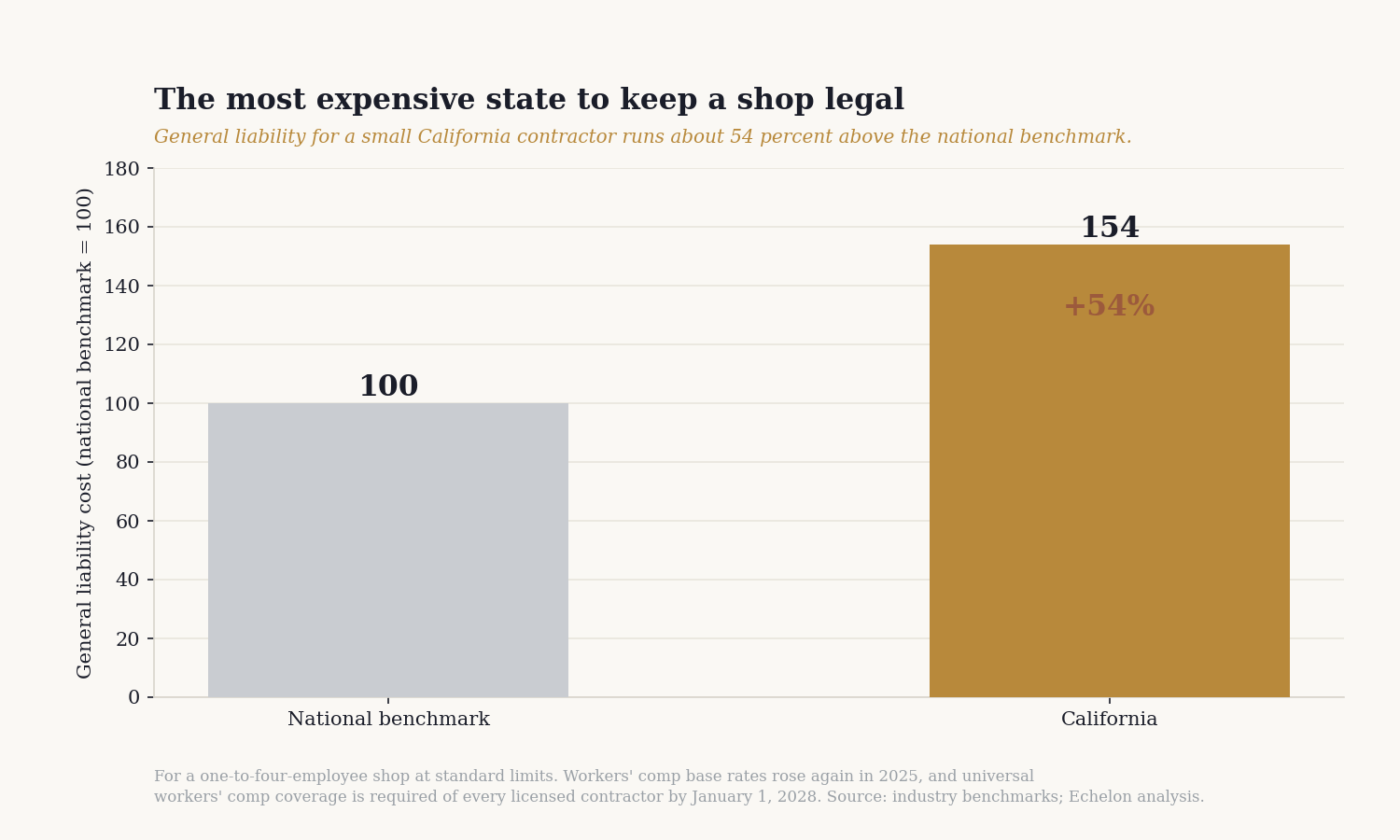
The short answer: California is the most expensive state in the country to operate a licensed trades business. General liability runs about 54 percent above the national benchmark, and every licensed contractor must carry workers’ compensation by January 1, 2028. It is also where the largest trades deals are done, with platforms recapitalizing at 17 to 20 times earnings. For a shop above the buyer’s size floor with real recurring revenue, California’s demand and exit economics currently more than offset its cost load. For a sub-floor shop with no recurring base, the cost wins.
What it costs to keep the lights on
Why anyone pays 18 times earnings for this
The math behind the checks
The equation, stated plainly
What to watch, and one thing to ignore
Frequently asked questions
- California carries the heaviest operating load of any state for a licensed trades shop: general liability runs roughly 54 percent above the national benchmark, and the workers’ comp base rate rose again in 2025.
- A compliance cliff is coming. By January 1, 2028, essentially every licensed California contractor must carry workers’ compensation, even with zero employees, with an exemption-verification process beginning in 2027.
- The same state sits at the center of the hottest trades M&A market in history. The largest residential trades deal of the cycle was a California platform.
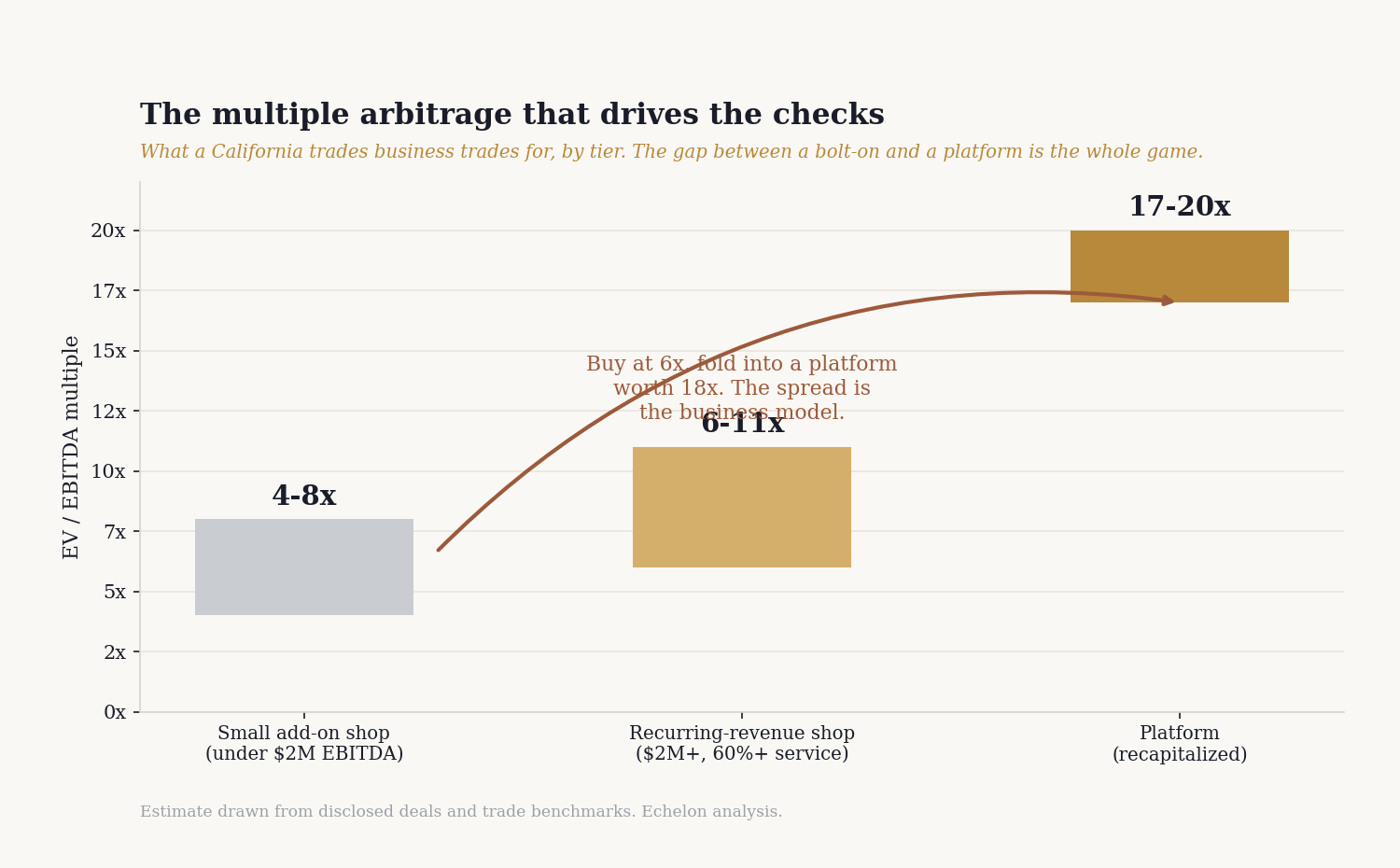
- The deal engine is a multiple arbitrage: small shops change hands at 4 to 8 times earnings, recurring-revenue shops at 6 to 11, and the platforms they roll into at 17 to 20.
- For businesses above the buyer’s size floor with real recurring revenue, the current math says California’s demand and exit economics more than offset its cost load.
In February 2026, Blackstone agreed to pay about $2.5 billion for a heating and air-conditioning company. Not a software company. Not a bank. An HVAC, plumbing, and electrical business headquartered in Orange County, California. The reported price worked out to roughly 18.5 times earnings on about $140 million of EBITDA, a multiple that would make plenty of tech founders jealous.
Here is the part that should stop you. That same company operates in the single most expensive state in the country to keep a trades shop legal and insured. The firm that wrote the check knows this. They wrote it anyway. That is the paradox worth sitting with. California punishes the operator and rewards the owner, sometimes in the same building on the same day. If you run one of these shops, or you are thinking about buying one, the gap between those two facts is where your real decisions live. Let us walk both sides of it.
What it costs to keep the lights on
Start with the load, because it is heavier here than anywhere else. General liability insurance for a small California contractor runs near the top of the national range, roughly 54 percent above the national benchmark for a one-to-four-employee shop at standard limits. Carriers point to wildfire exposure, construction-defect litigation, and broad claims inflation, and they are not bluffing. The workers’ compensation advisory pure premium rate climbed another 8.7 percent effective September 2025. Anyone who has sat through a comp audit true-up knows the renewal quote is the optimistic number. The real bill shows up thirteen months later when the auditor reconciles your payroll and reclassifies the uninsured sub you forgot to collect a certificate from.
Then there is the cliff on the calendar. Under SB 216, as amended by SB 1455, the requirement to carry workers’ compensation is expanding to every licensed contractor in the state, regardless of whether they employ a single person, with the universal deadline set for January 1, 2028. The high-risk classifications already live under that rule with no employee threshold, C-8 concrete, C-20 HVAC, C-22 asbestos abatement, C-39 roofing, and D-49 tree service. Solo operators in other trades can still file an exemption today, but a formal exemption-verification process begins in 2027, and the License Board is already tightening its review. For an owner, that is a known future cost. For a buyer, it is a line item that belongs in every target’s model right now, not in 2028.
The friction does not stop at insurance. LLC-licensed contractors must carry at least a million dollars per occurrence in general liability under the Business and Professions Code, plus a separate worker bond, and the License Board enforces with field checks and license-status matching that can stop a job over a name mismatch on a policy. New rules effective January 2026 cap retention at 5 percent of progress payments and force those terms to flow down to subcontractors, which tightens cash timing across the whole chain.
None of this is fatal. The aggressive enforcement actually thins the unlicensed competition for the operators who play it straight. But the fully loaded cost of staying compliant in California is real, it is rising, and most owners have never put the whole number on one page. That blind spot is exactly what gets exploited at the negotiating table.
Why anyone pays 18 times earnings for this
Because the demand on the other side of the ledger is just as extreme as the cost. California is the largest contracting market in the country, full stop. Heat volatility drives non-deferrable HVAC replacement and repair, and emergency replacement work is the most margin-rich, least price-sensitive revenue a residential shop ever sees. State energy policy keeps pushing heat-pump conversions and electrical panel upgrades, which, whatever you think of the policy, translates on the ground into a multi-year retrofit tailwind for the HVAC and electrical trades. Above all of it, the data-center buildout is pulling commercial cooling demand to levels the industry has never recorded, lifting the top tier of mechanical contractors and dragging the skilled-technician wage floor up with it.
That is the answer to the paradox. The buyer is not paying a premium in spite of California. They are paying it because California’s revenue base is large, recurring, and structurally supported by climate and code in a way few other states can match. The cost stack is real, but it is a known, modelable drag against a demand engine that keeps running.
The math behind the checks
The deal market has gone fully institutional, and the mechanics are worth understanding even if you never plan to sell. Private equity has poured more than $50 billion into residential HVAC, plumbing, and electrical roll-ups since 2018. Financial buyers now account for roughly half of HVAC service transactions, up from about a third a year earlier, and add-on activity rose sharply through 2025. In May 2026, Apollo committed roughly $2 billion to Apex Service Partners at a reported $10 billion valuation. Apex alone runs more than a hundred local brands, around $1.3 billion in revenue, and over 8,000 tradespeople.
The engine driving all of it is a multiple arbitrage. As an estimate drawn from disclosed deals and trade benchmarks, small add-on shops below $2 million of earnings change hands in the 4-to-8-times range, shops above $2 million with strong recurring revenue go for 6 to 11 times, and the platforms those shops get rolled into recapitalize at 17 to 20 times. Buy a shop at six, fold it into a platform worth eighteen, and the spread is the business model. That is why every operator above a certain size now has a private-equity business-development rep in their inbox.
The single largest lever a seller controls is recurring revenue. A business with 60 percent or more of its revenue under service agreements routinely trades one to two full turns higher than a project-heavy shop of the same size, a relationship we cover in depth in the one number that decides what your trades business is worth. The buyer’s floor for serious platform interest sits around $3 million in revenue, half a million in earnings, a fleet near ten trucks, and at least a fifth of revenue on maintenance plans. Below that, you are talking to a sub-platform, not the sponsor.
One counterpoint that rarely makes the consolidation-is-evil narrative: at least one major sponsor reports an average 20 percent technician pay increase in the first year after acquisition, driven by higher base, bonuses, and commissions. Whatever else you make of the roll-up wave, it is not uniformly bad for the people holding the tools.
The equation, stated plainly
Put the two sides together and the operate-versus-acquire question resolves into something you can actually act on. If you operate, the California cost stack compresses your margin from the top, but the demand engine and the exit market reward the shop that builds the right asset. The move is not to flee the cost. It is to build the specific things that convert that cost into a premium when you sell: service-agreement revenue above 30 percent, clean accrual-basis books with job-level profitability, a manager who can run the place without you, and no single customer above 15 percent of revenue. Each of those moves the multiple, and in a high-multiple market every turn is worth more in California than in a cheaper, thinner state. The cost you resent today is the reason the asset you build commands a premium tomorrow.
If you buy, the cost stack is not a reason to avoid California. It is a set of inputs to price. The buyers who fail to model the 2028 comp cliff, the insurance trajectory, and the retention-timing rules will overpay and find the drag in year two. The ones who model them honestly keep discovering that California’s scale and demand durability support the premium more often than the headlines about the state’s business climate would suggest.
The net read, and we label it an estimate rather than a verdict: for businesses above the buyer’s floor with real recurring revenue, California’s demand and exit economics currently more than offset its cost load. For sub-floor shops with no recurring base, the cost wins and the calculus gets hard. The whole game is knowing which side of that line your business sits on, and what it would take to move it.
What to watch, and one thing to ignore
A few forward inputs matter more than the rest. The January 2028 workers’ comp universalization is the most concrete cost change on the calendar and belongs in every operator’s plan and every buyer’s model. Whether the insurance market keeps hardening or finally softens will swing a meaningful slice of operating cost over the next two years. And the pace of electrification mandates is the largest single swing factor on the demand side.
One item will get more headlines than it deserves in this context: the billionaire wealth tax on the November 2026 California ballot, a one-time 5 percent levy on individual net worth above a billion dollars, hitting an estimated 200 to 250 residents, with real estate and retirement accounts excluded. It does not reach operators, and it does not reach all but a handful of the people buying trades businesses. Its only relevance here is as a faint signal of regulatory direction that some out-of-state capital allocators track. The merits are contested, and this is not the place to argue them. For the purpose of running or buying a trades shop, it is noise, not cost. Treat it that way.
A degreed analyst at a megafund can model the earnings from a spreadsheet without ever setting foot on a jobsite. An operator who has been on the roof in August knows exactly what the cost stack feels like at seven on a Friday but rarely sees the deal math that decides what the business is worth. The rare reader who holds both pictures at once is the one who does not overpay as a buyer and does not undersell as an owner. California makes that double vision harder than any state in the country, and more valuable. The cost is loud. The opportunity is quiet. Learn to hear both.
Frequently asked questions
Is California a good state to own a trades business?
It is the most expensive state to operate one and among the most lucrative to own and eventually sell. For a shop above the buyer’s size floor, roughly $3 million in revenue with real recurring service revenue, California’s large, durable demand and high exit multiples currently more than offset its heavy cost load. For a small, project-dependent shop with no recurring base, the cost load is harder to justify. Which side of that line you sit on is the whole question.
Do all California contractors need workers’ compensation by 2028?
Yes. Under SB 216, as amended by SB 1455, essentially every licensed California contractor must carry workers’ compensation by January 1, 2028, even with zero employees, unless they hold a verified exemption. High-risk classifications, including C-8 concrete, C-20 HVAC, C-22 asbestos abatement, C-39 roofing, and D-49 tree service, already require it regardless of employee count, and a formal exemption-verification process begins in 2027. For both owners and buyers, it is a known, datable cost that belongs in the plan now.
What is a California HVAC or trades business worth right now?
It depends almost entirely on size and recurring revenue. Small owner-operated shops change hands roughly in the 4-to-8-times earnings range, shops above about $2 million in earnings with strong recurring revenue trade around 6 to 11 times, and the platforms those shops roll into recapitalize at 17 to 20 times. A business with 60 percent or more of revenue under service agreements typically trades one to two full turns higher than a project-heavy shop the same size.
Why are private equity firms paying so much for California trades businesses despite the high costs?
Because California’s revenue base is large, recurring, and structurally supported by climate and energy code in a way few states match, and because the buyers are running a multiple arbitrage: buy small shops at single-digit multiples, fold them into a platform that recapitalizes near 18 to 20 times. The largest residential trades deal of the cycle, a roughly $2.5 billion Orange County platform purchase, was a California business. The cost stack is real, but to an institutional buyer it is a modelable drag against a durable demand engine.
How much does it cost to run a trades business in California?
More than anywhere else. General liability for a small contractor runs about 54 percent above the national benchmark, the workers’ comp advisory rate rose another 8.7 percent in 2025, LLC contractors must carry at least a million dollars in general liability per occurrence, and new 2026 rules cap progress-payment retention at 5 percent and force those terms down the subcontractor chain. Most owners have never totaled the fully loaded number, which is exactly what gets exploited at the negotiating table.
Should I sell my California trades business now or keep operating it?
That is your decision, and it turns on which side of the buyer’s floor you sit on and what your business would be worth after a year or two of preparation. The premium does not go to whoever sells first or waits longest. It goes to the shop built the way a buyer wants: recurring service revenue, clean books, a manager running daily operations, and no single customer above 15 percent. Building those is what converts California’s high cost into a high exit, whenever you choose to engage.
California is one state with one cost-and-demand profile. Your specific market is its own story: who is consolidating it, how the established operators are built, what the demand signals say, and where your business stands against the buyer’s floor. That market-specific read is exactly what an Echelon Intel Report delivers, built from the same data behind this analysis.
The Great Trades Roll-Up: why Wall Street buys some trades and walks past others
The one number that decides what your trades business is worth
What is your electrical business worth in 2026?
Methodology and sources. Insurance and compliance figures, including the roughly 54 percent general-liability premium and the 8.7 percent workers’ compensation advisory increase effective September 2025, are drawn from industry insurance benchmarks and WCIRB filings and are presented as reported estimates. The workers’ compensation expansion refers to California SB 216 as amended by SB 1455, with the universal deadline of January 1, 2028 and an exemption-verification process beginning in 2027. Transaction values and platform figures are from public announcements and M&A trade press. Valuation multiples are an estimate drawn from disclosed deals and trade benchmarks, not audited figures. The operate-versus-acquire read is labeled as analysis. Echelon takes no position on the merits of any law, policy, or ballot measure referenced.