
What Is Your Roofing Business Worth in 2026?
Roofing has become the fastest roll-up in the trades. Here is what that means for your number, and what separates a premium exit from getting bought cheap.
Why roofing, and why now
How hot, exactly
What roofing businesses actually sell for
How a buyer reads your business: assets, liabilities, and booked work
The timing question
Frequently asked questions
- Roofing is the fastest roll-up in the trades because it clears both filters: a harvestable tier of scaled operators and demand that does not care about the economy.
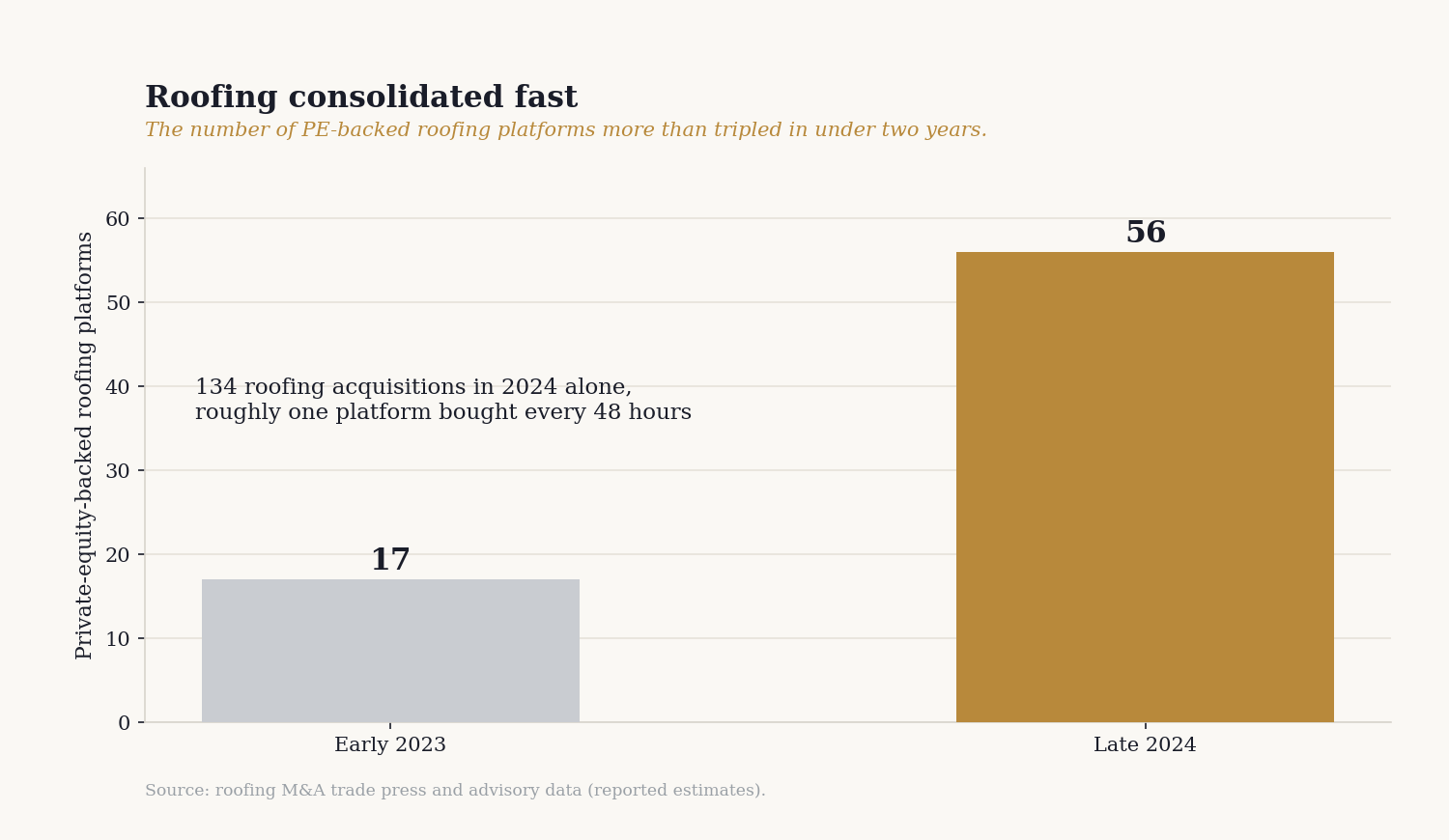
- Private-equity-backed roofing platforms grew from about 17 in early 2023 to 56 by late 2024, with roughly one platform acquired every 48 hours.
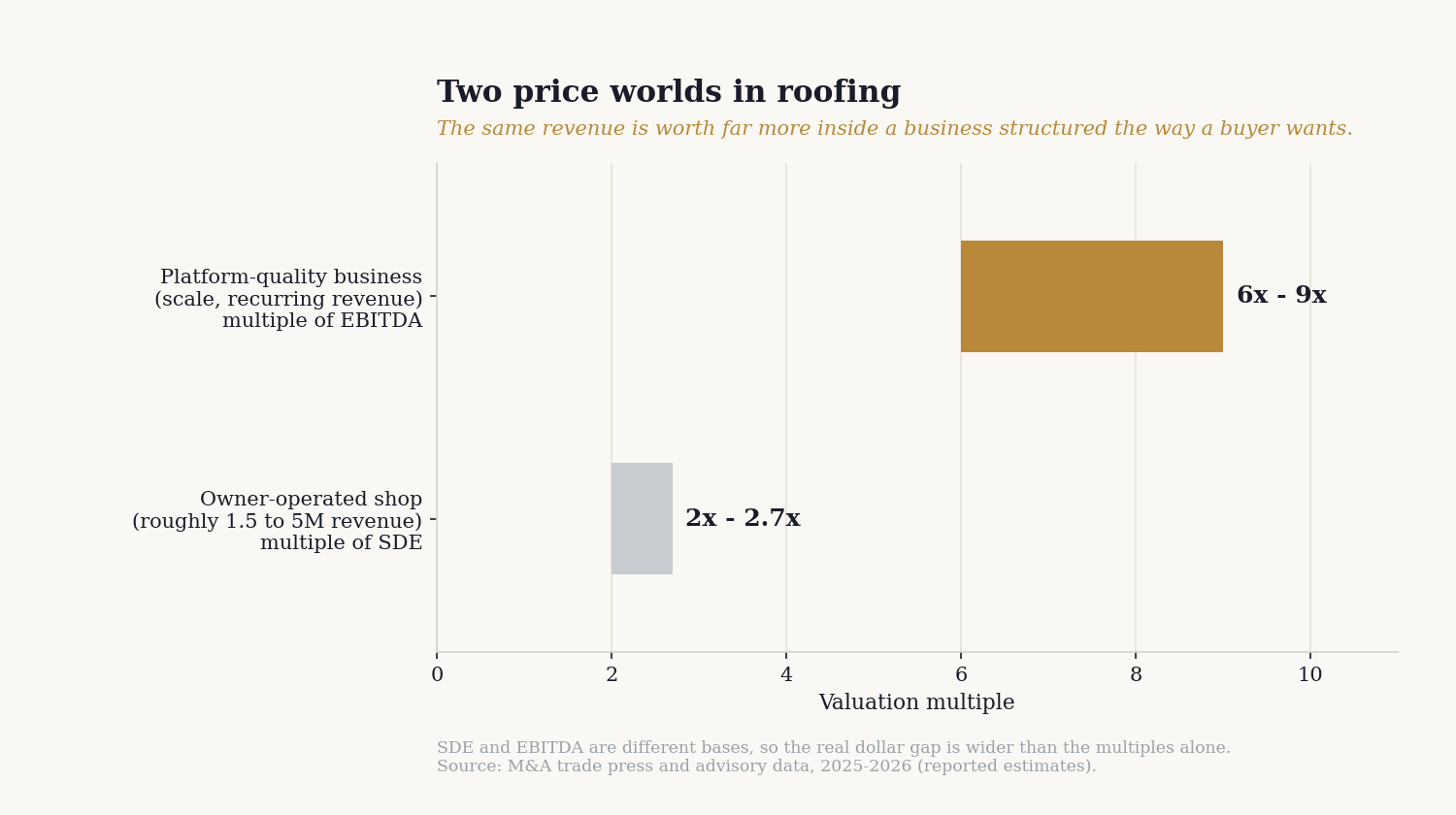
- Two price worlds: small owner-operated shops trade around 2.0 to 2.7 times SDE, while platform-quality businesses trade around 6 to 9 times EBITDA.
- The gap between those worlds is mostly within your control. Recurring revenue, a commercial mix, operations that run without you, clean books, and a self-generating lead engine all move the number.
- Most of what drags value down is fixable, but on a timeline of a year or two, not the week a buyer calls.
Five years ago, the most likely buyer for a roofing company was a slightly larger competitor down the road. Today you would field calls from a dozen private-equity-backed platforms before you finished cleaning up your books. The phone calls are not a fluke. They are the sound of the most aggressive consolidation in the home-services trades, and it has quietly changed what your business is worth. Most roofing owners have no idea by how much, in either direction.
This is a plain read on where the money actually is: how hot the market really is, what roofing companies are selling for, and the specific things that decide whether your shop commands a premium or gets treated as a cleanup job. We are not here to push you toward an exit. The goal is to show you what the ground actually looks like so you can decide on your own terms, and read your own business the way a buyer will.
Why roofing, and why now
Roofing sits in the narrow sweet spot that draws institutional capital, which we mapped across all the trades in The Great Trades Roll-Up. It clears both filters that decide whether a trade gets consolidated. It has a harvestable tier of operators large enough to build on, and it has demand that does not care about the economy.
That second part is the engine. A roof does not fail on a schedule a homeowner chooses. Roughly four out of five roofing dollars are non-discretionary replacement and repair, driven by weather and an aging housing stock whose median age now sits around four decades. When a roof goes, it gets replaced whether or not the owner planned for it, and largely regardless of where the broader economy is. That is exactly the kind of revenue a buyer will pay up for, because it refills itself.
The fragmentation does the rest. Roofing is a market estimated at $50 to $100 billion where, by KPMG’s read, the two largest operators combined hold only about 4 to 6 percent. Census counts roughly 25,500 roofing firms with employees, and fewer than one in ten has 20 or more people. That thin scaled tier is small enough to be assembled and valuable enough to be worth assembling. The result is a buying spree.
How hot, exactly
The numbers are not subtle. By industry counts, the number of private-equity-backed roofing platforms grew from about 17 in early 2023 to 56 by the end of 2024, with roughly 134 roofing acquisitions in that year alone. By several tallies, a platform has been changing hands at a cadence of about one every 48 hours, and announced deal volume has more than doubled since 2021. The capital is institutional and it is not shy: the buyers include the largest names in finance, and the consolidation has run all the way up the chain, with QXO’s roughly $11 billion acquisition of the distributor Beacon putting an exclamation point on it.
For a seller, the practical effect is leverage you did not have a few years ago. On many deals there are now a dozen or more credible buyers competing, which is the condition that drives a price up rather than down. But leverage only helps the operator who knows what tier their business actually falls into.
What roofing businesses actually sell for
Two very different price worlds exist in roofing, and the gap between them is enormous.
At the smaller end, owner-operated shops in the rough range of $1.5 to $5 million in revenue tend to trade on a multiple of seller’s discretionary earnings, commonly cited in the range of about 2.0 to 2.7 times SDE. These are the businesses a buyer treats as a bolt-on. The owner is the business, the systems are thin, and the price reflects it.
At the larger and cleaner end, businesses with real management depth, recurring revenue, and the scale to anchor or meaningfully expand a platform trade on EBITDA, and the range commonly reported through 2025 and into 2026 is roughly 6 to 9 times for quality operators, down from peaks nearer 8 to 11 times. The same revenue dollar is worth dramatically more inside a business structured the way a buyer wants than inside one that is not.
Closing that gap is the entire game, and it is mostly within an owner’s control. We cover the single biggest lever in depth in the one number that decides what your trades business is worth.
How a buyer reads your business: assets, liabilities, and booked work
A buyer does not pay for revenue. They pay for a defensible stream of future cash flow, and they reach their number by weighing what adds durable value against what drags it down, then judging how much of the future is already spoken for. The most useful thing you can do before anyone calls is look at your own business the same way.
The assets that actually move the number are rarely the ones owners list first. Fleet and equipment get counted but seldom swing the price. What swings it is what is hard to replicate. A stable, credentialed crew in a trade starved for labor is an asset a buyer cannot quickly rebuild, and it is increasingly valued on its own. Manufacturer designations, licenses, and a clean safety record transfer with the business. A book of commercial accounts and service agreements is gold, because it is the closest thing roofing has to predictable, repeating income, and a high share of that contracted revenue can lift the multiple by a full turn or more. And then there is your digital footprint, which owners chronically undervalue. A roofing business that generates its own work through its website, its reviews, and its ranking owns a real, transferable asset that keeps producing after the sale. One that rents every lead from a third-party platform it does not control owns nothing it can hand over. Whether or not you think of it this way, your online presence is a line on the balance sheet a buyer is building in their head.
The liabilities that get priced in are often the ones no accountant booked. Debt and leases are the easy part. The expensive entries are softer. Owner-dependence is the big one: if you are the top salesperson, the estimator, and the glue holding the crews together, a buyer is looking at a job to fill rather than an asset to absorb, and prices it as a bolt-on. Customer concentration above roughly fifteen percent of revenue reads as risk. So does warranty and workmanship exposure, which in roofing carries a real tail, along with a poor safety record or open litigation. And lead fragility, where all your work traces to one referral source or one paid channel you do not own, is a liability even though nothing on the books names it.
Booked work counts, but a buyer underwrites it rather than trusting it. Signed contracts and a full pipeline have value, but the questions come fast: are the contracts signed or merely promised, what is the margin, how creditworthy are the customers, and can your crew deliver the work on the promised timeline without you on the roof. Backlog is worth the most when it is contracted, profitable, and executable without the owner. And it pays to hold the distinction between backlog and recurring revenue clearly in mind, because owners blur them. Backlog is finite. It smooths the handoff and proves demand exists, but it runs out. Recurring service and maintenance revenue repeats, which is why a buyer weights it far more heavily. A fat storm-season backlog is a nice-to-have. A steady book of commercial service contracts is worth more per dollar, every time, and the market has paid for that distinction directly: TopBuild’s roughly $810 million purchase of Progressive Roofing was a bet on commercial focus, and the largest commercial roofing platform in the country now spans more than a hundred locations.
The timing question
Here is the part owners get wrong in both directions. Some take the first call and sell at a bolt-on multiple a stronger business would have beaten by a wide margin. Others wait indefinitely, assuming the buyers will always be there at today’s prices. Neither is sound. Consolidation waves do not run forever, and roofing multiples have already eased off their peak, which tells you the frothiest pricing is behind us even as activity stays high. The defensible move is not to time the market. It is to build the specific business the market pays a premium for, so that whenever you do choose to engage, you are negotiating from the platform tier rather than the bolt-on tier.
That is the whole point. The roll-up is real, the buyers are real, and the leverage is real. What you do with it depends entirely on which version of your business shows up to the table.
Frequently asked questions
What is my roofing business worth in 2026?
It depends almost entirely on which tier you fall into. Smaller owner-operated shops, roughly $1.5 to $5 million in revenue, commonly trade around 2.0 to 2.7 times seller’s discretionary earnings. Larger, well-run businesses with recurring revenue and management depth trade on EBITDA, commonly in the range of about 6 to 9 times for quality operators. The structure of your business matters as much as the revenue.
Are roofing companies actually in demand right now?
Yes, intensely. The number of private-equity-backed roofing platforms grew from roughly 17 in early 2023 to 56 by the end of 2024, and by several counts a platform has been acquired about every two days. On many deals there are a dozen or more competing buyers.
How do I get a higher multiple for my roofing business?
Build recurring and service-agreement revenue, develop a commercial or low-slope mix, make the business run without you by putting trained managers over the crews and office, keep accrual-basis books with job-level profitability, and stabilize your crew. Recurring revenue is the single largest lever.
Should I sell my roofing business to private equity?
That is your call, and it depends on your goals, your timeline, and whether you want to fully exit or roll equity and stay in. What matters before any conversation is knowing your tier, because that determines your leverage. Going in unprepared is how owners get bolt-on pricing for a platform-quality business.
What hurts a roofing business’s valuation?
The biggest drags are owner-dependence, where the business cannot run without you, heavy customer concentration, weak or sloppy books, warranty, safety, or litigation exposure, and lead fragility, where all your work comes from a single source you do not control. Most are fixable, but on a timeline of a year or two, not the week a buyer calls.
Does commercial or residential roofing sell for more?
Commercial and low-slope work generally commands a premium, because it carries longer relationships, predictable re-roof cycles, and service contracts. A healthy commercial mix widens your buyer pool and tends to lift your valuation.
This is the national picture. Your market is its own story: how many scaled roofing operators actually compete in your metro, which platforms are already buying there, what the demand signals say, and where your business stands in that field. That market-specific read is exactly what an Echelon Intel Report delivers, built from the same data behind this analysis.
The Great Trades Roll-Up: why Wall Street buys some trades and walks past others
The one number that decides what your trades business is worth
Electrical is the next HVAC: what your business is worth before the wave peaks
Methodology and sources. Establishment counts and the scaled-tier share are from U.S. Census County Business Patterns 2023. Market-size and concentration figures are from KPMG Corporate Finance. Platform counts, deal cadence, and valuation multiples are aggregated from M&A trade press and advisory data and are presented as reported estimates, not audited figures. Transaction values are from public announcements. Echelon takes no position on whether any owner should buy, sell, or hold.