
Research updated October 16, 2026. Original publication: August 22, 2026. Local license snapshot: August 29, 2026.
ECHELON INFRASTRUCTURE PROJECT FILE 01 · PIKETON, OHIO
PORTS-Pike: Piketon data center contractors, jobs and permits
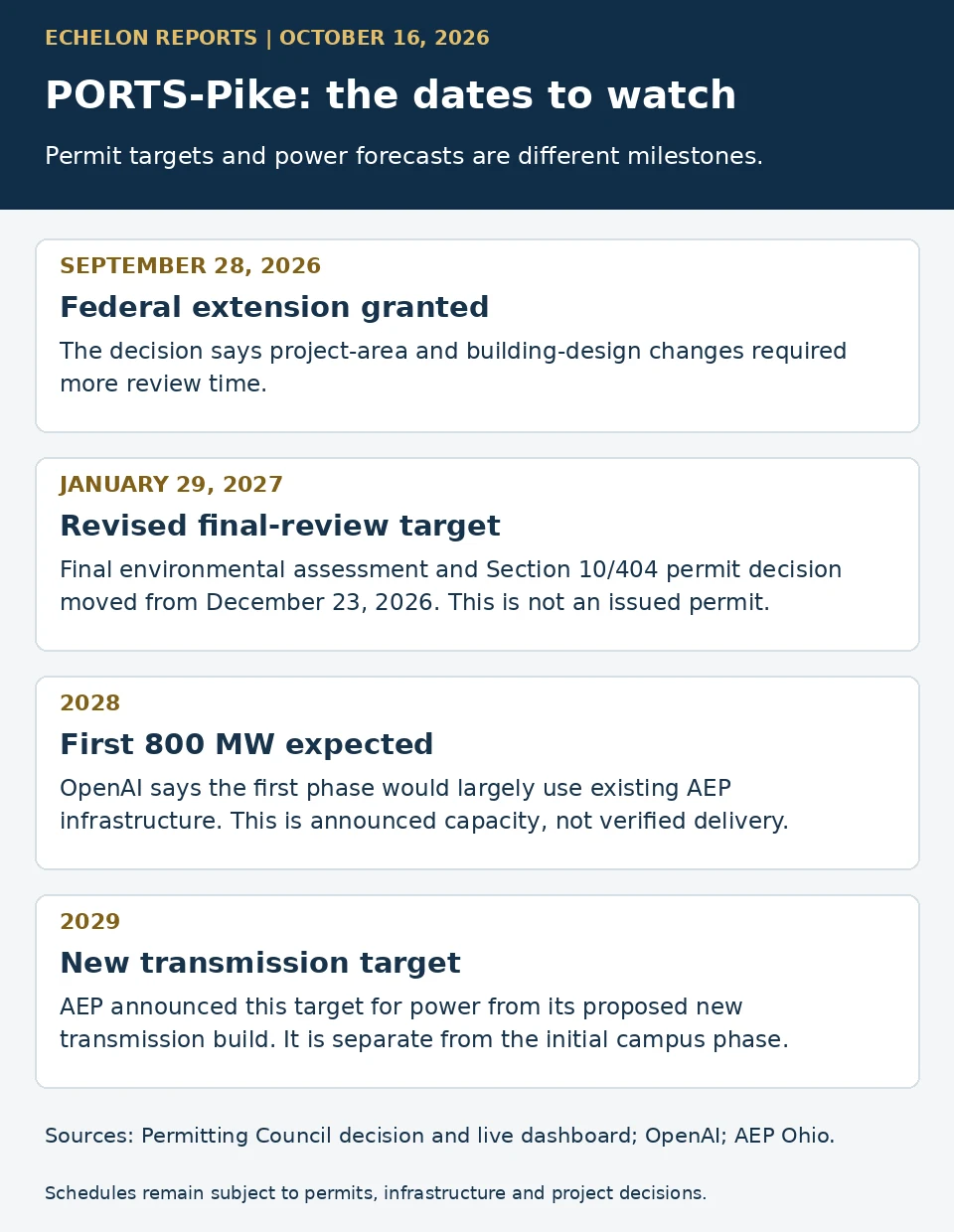
PORTS-Pike has a revised federal permitting timetable and active owner-side recruiting. On September 28, the Permitting Council approved a 37-day extension. The final environmental assessment and Section 10/404 permit decision had been due December 23, 2026. Both now target January 29, 2027. SB Energy changed the project area to avoid a cultural site. The decision says those changes required more time to update the application and building designs.[26]
Contractors can start with Bechtel, Kiewit and AEP supplier channels. SB Energy lists local project-management and engineering roles. We did not verify an open public PORTS-Pike trade bid package or a current project-specific craft referral in the routes reviewed. Supplier registration, an advertised job and an awarded subcontract are different things.[15][29][31]
Choose your next step
The project is SB Energy’s planned campus in Pike County, Ohio, with an approximately 8 IT-GW OpenAI commitment within a broader 10 GW data-center plan. The first phase is approximately 800 MW. New generation, transmission and site infrastructure have separate delivery paths.[1][21][41]
This report belongs to our data center construction project index. It does not cover Google’s separate Project Dazzler in Franklin Furnace.
October update: federal review now targets January 2027
The live federal dashboard showed environmental review and permitting in progress on October 16, with two of four listed processes complete. Its overall estimated completion date was January 29, 2027. Completed consultation steps do not mean the final construction-related permit has been issued.[25]
The September 28 determination says the sponsor reduced the project area to avoid a cultural site and revised the associated building design. Updated maps, mitigation calculations and other application materials required more review. The decision also identifies Ohio EPA’s Section 401 water-quality certification as a dependency for the Corps authorization.[26]
| Milestone | Revised target or forecast | What it means |
|---|---|---|
| Section 10/404 provisional notification | November 30, 2026 | Intermediate milestone in the September 28 decision, not final permit issuance. |
| Ohio water-quality certification | Anticipated on or before December 25, 2026 | Expectation recorded in the federal decision, not a verified state approval. |
| Final environmental assessment and federal permit decision | January 29, 2027 | Revised from December 23, 2026. Approval is not guaranteed. |
| First approximately 800 MW | Expected in 2028 | OpenAI says this phase would largely use existing AEP infrastructure. |
| New AEP transmission service | Announced 2029 target | A separate infrastructure milestone, not the first-phase start date. |
Sources: the September 28 federal determination, OpenAI’s August 17 announcement and AEP’s March 20 announcement.[26][21][6]
The sponsor asked the Corps to advance the January decision milestone day for day if Ohio’s certification arrived earlier. That request is not proof that an earlier date has been adopted. The federal extension changes the permit timetable; it does not by itself establish a revised 2028 first-capacity target.[26]
SB Energy’s FAQ still says early civil work has begun and describes full construction starting in 2026. It projects nearly 4,000 construction jobs and 300 to 400 operating jobs for the first phase, with investment of $30 billion to $40 billion. These are developer statements and forecasts, not a current site headcount or confirmation that every phase is cleared to proceed.[41]
On October 16, the developer’s homepage and FAQ both stated $5.1 billion for grid investment. AEP’s March announcement states $4.2 billion. The owner’s newer figure is higher, but neither source explains the change in cost or scope. Confirm the applicable budget with the buyer.[1][41][6]
Where contractors can pursue PORTS-Pike work
The sources name Bechtel with the data-center portion and Kiewit with generation. AEP handles a separate transmission program. The Boilermakers account supports those builder roles, but it does not supply contract values or a complete subcontract package list.[13][6]
| Company and workstream | Practical entry route | Limit to keep in mind |
|---|---|---|
| Bechtel: data-center work | Supplier registration and portal. Use the linked new-supplier form, then complete the company profile and relevant service categories. | Bechtel’s September guide says requests for quotations are invitation-only. Registration is not a PORTS-Pike bid invitation. |
| Kiewit: generation | Business With Us. Follow the invitation/contact route and ask specifically about PORTS-Pike generation procurement. | The general vendor-participation page does not identify a public PORTS-Pike package or release calendar. |
| AEP: transmission and substations | AEP supplier resources. Follow supplier registration or the Supply Chain question route. | Utility onboarding is separate from campus and generation bidding. |
| SB Energy: owner and development team | Official campus contact form. Select Vendor Inquiries for a business approach or Job Notifications for employment updates. | These are inquiry and notification choices, not an open bid or job application. We inspected the form but did not submit it. |
Bechtel, Kiewit and AEP have separate supplier processes.[15][29][30] The owner’s current contact form adds Vendor Inquiries and Job Notifications choices; its FAQ says local job fairs are planned but gives no date.[42][41]
Bechtel’s public Project Opportunity List, last updated October 7, did not contain a Piketon, PORTS-Pike, Portsmouth or Ohio entry. Its guide explains that requests for quotations arrive by direct invitation. The absence of a public listing does not prove that private procurement is inactive.[28][27]
Before estimating, ask the buyer to confirm the project name, legal contracting entity, package scope, qualification process and bid date. Request the current drawings and permit assumptions. Settle bonding, insurance, payment timing, retainage and responsibility for design changes before committing crews or purchasing materials.
PORTS-Pike jobs: owner recruiting and craft routes
SB Energy’s employer board listed these roles on October 16. Most are management and engineering jobs. They are not electrician, pipefitter or equipment-operator vacancies. Use the listing ID to find the exact posting if a title changes.[31][32]
| Employer role and application | Listed location | Project connection |
|---|---|---|
| Project Manager, Site Development – Power Generation Listing 6148535004 |
Piketon, OH | Description explicitly names PORTS-Pike generation work.[35] |
| Development Project Manager – Data Center Listing 6220106004 |
Piketon, OH | Description names PORTS-Pike gas generation despite the data-center title. Ask the employer to clarify the assignment.[36] |
| Project Engineer – Data Center Power Listing 6199621004 |
Pike County, Ohio | Local owner-side lead; inspected description does not explicitly name PORTS-Pike.[37] |
| Electrical Engineer – Data Center Power Generation Listing 6209014004 |
Pike County, Ohio | Local owner-side lead; inspected description does not explicitly name PORTS-Pike.[38] |
| Instrumentation and Controls Engineer, Data Center Power Generation Listing 6209010004 |
Pike County, Ohio | Local owner-side lead; inspected description does not explicitly name PORTS-Pike.[39] |
| High Voltage Project Manager/Senior Project Manager – Data Center Power Listing 6205687004 |
Pike County, Ohio | Local owner-side lead; inspected description does not explicitly name PORTS-Pike.[40] |
A listing is an application route, not employer confirmation that the position is still unfilled. Verify the assignment, start date and employment terms before making plans. SB Energy’s site warns about fraudulent recruiting messages; use the employer-linked application rather than an unsolicited offer.[31]
Where tradespeople should look
Search Bechtel careers and Kiewit careers for the exact Ohio location and craft. Our review did not establish a current PORTS-Pike-specific craft requisition on either board. A Portsmouth result can refer to another state; confirm the site before applying.[33][34]
- IBEW Local 575: regional electrical referral and training contact.
- UA Local 577: plumbing, pipefitting, welding and mechanical-service training and contractor information.
- Boilermakers Local 105 project account: the local describes plans involving members, travelers and recruits.
These are regional contact and training routes, not confirmed current PORTS-Pike dispatch calls. Ask which employer and exact site a referral serves, whether the call remains open, and what credentials it requires. Confirm wages, overtime, lodging, travel pay and per diem before traveling.[18][17][13]
OpenAI says the campus has signed a memorandum of understanding with North America’s Building Trades Unions. That announced agreement does not identify a current local referral or settle the terms of every future labor agreement.[21]
Childcare support is planned, not yet an application route
A September announcement on the project site describes $6 million from SB Energy and OpenAI for a Pike County childcare initiative. It allocates $3 million to family subsidies and $3 million to provider support, including care outside normal daytime hours. Ross-Pike Educational Service District will run the program.[43]
The announcement says family applications and provider grant cycles will open in the coming months. We did not verify an open application window. Workers should check eligibility and timing with the program administrator before counting this support in a relocation budget.[43]
What the agreements cover
OpenAI has agreed to take approximately 8 IT-GW under a 20-year lease. NVIDIA has committed $1.5 billion to SB Energy and will supply the exclusive compute infrastructure. Those commitments support the plan, but delivery still depends on permits, infrastructure and financing.[4][21]
The next steps depend on permits, land cleanup, transmission routes, gas generation, equipment delivery, subcontracting, craft labor, housing, and commissioning. Delays in one can affect the others.
Who is building the Piketon Ohio data center?
SB Energy is developing, owning, and operating PORTS-Pike.[4] OpenAI is the anchor customer, and NVIDIA is the exclusive AI-compute provider.[4][21] Public sources identify Bechtel with the data-center portion and Kiewit with power generation.[11][12][13] AEP Ohio is the transmission partner, and Stantec is named as environmental consultant.[6][8] The sources reviewed do not identify every subcontractor.
This project-role map was rechecked October 16, 2026. Consortium membership, location, hiring and prior data center work do not establish an award.
PORTS-Pike at a glance
| Item | Public position rechecked October 16, 2026 |
|---|---|
| Developer, owner and operator | SB Energy, a SoftBank Group company |
| AI customer | OpenAI under a 20-year lease |
| Planned OpenAI capacity | Approximately 8 IT-GW |
| Initial NVIDIA-supported capacity | 4.25 IT-GW, with an option covering the remaining 3.75 IT-GW |
| Compute platform | NVIDIA DSX AI factory platform |
| Total data-center plan | 10 GW across private and remediated federal land |
| First construction phase | Approximately 800 MW and $30 billion to $40 billion. Developer FAQ reports early civil work; full construction in 2026 remains its stated plan. |
| First-phase employment claim | Nearly 4,000 construction jobs and approximately 300 to 400 operating jobs |
| First expected capacity | Phased service beginning in 2028 |
| Power plan | At least 10 GW of new generation, including 9.2 GW of natural gas generation |
| Gas-generation investment | Approximately $33.3 billion in Japanese-backed funding |
| Transmission plan | $4.2 billion in AEP’s March announcement; $5.1 billion on the current project homepage. Difference unresolved.[6][1] |
| Construction employment claim | 35,000 jobs over a six-year buildout through 2032 |
| Operating employment claim | 2,500 jobs |
| Community funds | $80 million combined from SB Energy and OpenAI |
| Federal permitting lead | U.S. Army Corps of Engineers under FAST-41 coordination |
| Named construction organizations | Bechtel and Kiewit |
| Environmental consultant named in state filing | Stantec |
The 35,000 figure should not be read as 35,000 simultaneous workers at peak. Public announcements describe construction jobs across the buildout. No public source reviewed by Echelon provides a craft-by-craft peak manpower schedule.
This is one campus across two land systems
Early coverage often described the project as a 10 GW campus on the federal Portsmouth site. The records now show a more complicated layout.
The project site and Department of Energy describe construction on federal and nearby private land. A May 28 Ohio EPA application from SB Energy-affiliated SE DC DevCo, LLC identifies a 1,016-acre private site at 1003 Bobo Road in Beaver, Ohio. The land lies north and east of the former enrichment plant.[1][22][8][9]
The application describes several data-center buildings and gas-generation plants plus:
- Access roads
- Administrative buildings
- Substations
- Overhead and underground power lines
- Laydown yards
- Parking infrastructure
The applicant listed Stantec as environmental consultant and agent. The filing names Little Beaver Creek-Big Beaver Creek and Big Run-Scioto River as the affected watersheds. It also identifies potential fill, stream, wetland, wildlife, and water-quality issues requiring state and federal review.[8]
WOUB reported that most of the private parcels are owned by Woodburn Heights LLC, Green Eyes LLC, and Roe Farms LLC, and that SB Energy held purchase options. SB Energy told the outlet that private and federal acreage would together support one 10 GW plan, not two separate 10 GW campuses. The final allocation between the two footprints had not been settled.[9]
Federal and private parcels may follow different schedules. The federal site has industrial infrastructure and high-voltage access. Cleanup, site control and remediation can limit its use. Private land needs roads, drainage, utility connections and environmental review before later work can proceed.
Federal land has industrial infrastructure and high-voltage access. Cleanup, site control, and remediation may still limit use. Private farmland may be easier to build on but requires land purchases, wetlands review, roads, drainage, utilities, and transmission connections.
The live federal dashboard describes two buildings on approximately 1,300 private acres, while the May application described several buildings on approximately 1,016 acres. The September decision confirms footprint and design changes but does not reconcile those numbers. Do not treat either description as the final building count for the whole campus.[25][26][8]
Who controls the project
SB Energy: developer, landlord, owner and operator
SB Energy is the operating center of the project. It will build, own, and operate the data centers under a 20-year lease to OpenAI.[4]
OpenAI and SoftBank invested a combined $1 billion in SB Energy in January 2026. SB Energy also bought Studio 151, which handles data center construction management, procurement, engineering, and operations. Studio 151 has experience across 20 campuses.[14]
Studio 151 gives SB Energy more in-house capacity to manage construction and procurement. Echelon’s read: SB Energy may handle more early coordination itself. It can still seek trade partners able to deliver repeated packages at scale.
The current employer listings above show owner-side recruiting in Piketon and Pike County. They do not establish trade subcontract awards.[31]
OpenAI: the anchor customer
OpenAI has agreed to use approximately 8 IT-GW at PORTS-Pike. NVIDIA’s announcement says the initial deployment is designed for 4.25 IT-GW, with an option to extend across the remaining 3.75 IT-GW.[4]
OpenAI’s commitment gives the campus a customer for the planned capacity. The public announcements do not disclose every milestone or condition in the agreements.
OpenAI and SB Energy have promised to prioritize local workers, contractors, suppliers, trades, and service providers. Their statements do not say how much work will go to local firms, set bonding thresholds, or specify whether contracts will come from SB Energy, Bechtel, Kiewit, or lower-tier managers.[10]
NVIDIA: compute supplier, investor and credit-support provider
NVIDIA will invest $1.5 billion in SB Energy. It will be the exclusive AI-compute infrastructure provider and provide credit support connected to land, power, and shell capacity.[4]
For trades, NVIDIA’s role increases the importance of:
- High-density electrical distribution
- Controls and network integration
- Redundant cooling systems
- Equipment rigging and setting
- Testing and commissioning
- Repeat equipment refreshes
Mission-critical work calls for documented quality and safety practices, commissioning records, and careful work around live technical systems.
The confirmed construction organizations
Bechtel: identified with the data-center portion
SoftBank lists Bechtel among the 21 Portsmouth Consortium participants. Construction Dive, Engineering News-Record, and the International Brotherhood of Boilermakers identify Bechtel and Kiewit with the project. The Boilermakers link Bechtel to the data center. ENR describes engineering, procurement, and construction services across power plants, substations, and transmission.[5][11][12][13]
No public source reviewed by Echelon provides Bechtel’s complete scope, contract value, package strategy, or subcontractor list.
Bechtel’s invitation-only bidding process makes early registration useful, but registration alone does not establish qualification or selection. Prepare the following information and confirm the buyer’s actual requirements before submitting.[27]
- Corporate structure and ownership
- Ohio and multistate licenses
- Qualifier and responsible-person records
- EMR, OSHA history, and written safety programs
- Bonding capacity
- Audited or reviewed financials
- Mission-critical or industrial project references
- Quality-control and commissioning procedures
- Workforce and apprentice pipeline
- Certified payroll and federal-site experience, where applicable
- Cybersecurity and badging readiness
Kiewit: identified with power generation
SoftBank also lists Kiewit as a consortium participant.[5] The Boilermakers report identifies Kiewit as the contractor for the power-generation facilities.[13]
That scope could include or coordinate major opportunities in:
- Combined-cycle and simple-cycle generation
- Structural concrete
- Process piping
- Boilers and heat-recovery equipment
- Gas-turbine installation
- Electrical balance of plant
- Instrumentation and controls
- Water treatment
- Fire protection
- Crane and heavy-lift work
- Insulation and industrial coatings
- Startup and commissioning
Kiewit publishes vendor-participation and supplier-opportunity resources.[16] No PORTS-Pike-specific subcontracting calendar was publicly visible in Echelon’s review.
AEP Ohio: transmission partner
AEP Ohio’s March announcement described a $4.2 billion transmission program with new 765-kV infrastructure and a 2029 power-delivery target. The developer’s current homepage and FAQ state $5.1 billion. The sources reviewed do not explain the difference in cost or scope.[6][1][41]
The Department of Energy fact sheet adds that the transmission program includes four substations and that long-lead high-voltage equipment has already been secured.[3]
This creates a second major contractor channel separate from the data-center shell and generation plants. The relevant work includes:
- Right-of-way acquisition and clearing
- Foundations and steel structures
- 765-kV line construction
- Substation civil work
- Relay and protection systems
- High-voltage testing
- Fiber and utility communications
- Environmental restoration
- Energization and commissioning
AEP says the Ohio Power Siting Board will oversee transmission permitting. Routes, applications, and package timing remain important watch items.[6]
Stantec: environmental consultant named in the permit record
The May 28 Section 401 application lists Stantec as consultant and agent for SE DC DevCo, LLC.[8]
This is a verified project role. It does not establish that Stantec holds the full civil, architectural, or engineering design contract.
Southern Ohio Cleanup Company: the adjacent federal-site contractor
The Department of Energy awarded the Portsmouth cleanup contract to Southern Ohio Cleanup Company, LLC, or SOCCo. DOE says the program covers hundreds of former uranium-enrichment facilities and structures.[19][20]
SOCCo is not identified in the reviewed sources as the data-center contractor. Its work is still strategically connected. Federal-site cleanup, demolition, contamination controls, access, staging, and land release can affect where and when SB Energy can build.
For work on the federal site, contractors should ask whether the package requires DOE-site experience, radiological controls, demolition procedures or security clearances. Those requirements must come from the buyer; proximity to the cleanup work does not establish them for every campus package.
The Portsmouth Consortium: 21 interested participants, not 21 award holders
SoftBank announced the Portsmouth Consortium on March 21, 2026. The release says the following companies and financial institutions expressed intent to participate:[5]
Japanese participants
- Fujikura
- Hitachi
- Mitsubishi Electric
- Mizuho Bank
- MUFG Bank
- Murata Manufacturing
- Panasonic Holdings
- SoftBank Group
- Sumitomo Electric Industries
- Sumitomo Mitsui Banking Corporation
- TDK
- Toshiba
United States participants
- Bechtel
- Carrier Global
- Citi
- GE Vernova
- Goldman Sachs
- J.P. Morgan
- Kiewit
- Kinder Morgan
- Morgan Stanley
Consortium members have different lines of work. Carrier sells cooling and building systems; GE Vernova works in power and grid equipment; Kinder Morgan operates gas infrastructure. Fujikura and Sumitomo Electric make cable and electrical products. Hitachi, Mitsubishi Electric, Toshiba, Panasonic, Murata, and TDK work across electrical, controls, power, and electronics. None of these lines of work proves an equipment award here.
Those business profiles make them logical participants. They do not prove a PORTS-Pike equipment award. The SoftBank release states intent, not executed scope.
Where the licensed trades will be consumed
The project’s labor demand will not arrive as one smooth curve. Each workstream has a different peak.
1. Civil, environmental and site preparation
The private-land filing identifies roads, drainage, laydown yards, parking, underground utilities, overhead lines, substations, streams, and wetlands.[8]
Likely trade and contractor demand includes:
- Excavation and mass grading
- Surveying
- Erosion and sediment control
- Underground utilities
- Concrete
- Road and bridge work
- Dewatering
- Environmental monitoring
- Wetland mitigation
- Equipment operation
- Trucking
Civil work may arrive first because roads, drainage, and utilities are needed before later building and mechanical, electrical, and plumbing packages.
2. Data-center electrical construction
An 8 IT-GW AI campus requires far more than ordinary commercial wiring. Work packages can include:
- Utility and campus substations
- Medium-voltage distribution
- Switchgear and transformers
- Busway
- Backup generation
- UPS and battery systems
- Grounding and bonding
- Controls power
- Fire alarm
- Security and access control
- Fiber and communications
- Testing and commissioning
The approximately 800 MW first phase and OpenAI’s approximately 8 IT-GW agreement describe different scopes. IT capacity, total campus power and new generation should not be treated as interchangeable measures.[21][41][3]
3. Cooling, plumbing and mechanical systems
OpenAI says the campus will use a closed-loop, air-cooled system that recirculates water rather than relying on continuously consuming cooling towers. Final expected water use is to be disclosed after design completion.[10]
Air-cooled does not mean mechanically simple. The campus will still require large volumes of:
- Mechanical piping
- Pumps and heat exchangers
- Air-handling and heat-rejection equipment
- Building automation
- Controls
- Water treatment and makeup systems
- Equipment setting
- Insulation
- Refrigeration and HVAC service
- Commissioning
4. Natural-gas generation
The announced plan includes 9.2 GW of natural-gas generation backed by approximately $33.3 billion in Japanese funding.[2][3]
Power-plant construction will draw heavily on:
- Boilermakers
- Pipefitters and welders
- Millwrights
- Electricians
- Instrument technicians
- Operating engineers
- Ironworkers
- Insulators
- Laborers
- Industrial painters
- Nondestructive-testing technicians
- Startup and commissioning specialists
Boilermakers Local 105 Business Manager Joe Ledford said the local expects to use existing members, travelers, and new recruits. He said membership could double or more in two to three years if the work proceeds as proposed.[13]
5. Gas pipeline
DOE’s fact sheet references new interstate gas-pipeline development supporting the generation plan.[3] Kinder Morgan’s consortium participation is relevant but does not establish a pipeline award.
Pipeline construction can draw welders, operators, laborers, coating crews, inspectors, electrical technicians, and compressor-station specialists from the same regional labor pool as the plants and campus.
6. Transmission and substations
The 765-kV system and four substations will compete for linemen, high-voltage electricians, relay technicians, operators, civil crews, steel erectors, testers, and commissioning personnel.[3][6]
AEP’s March announcement targets 2029 for the new transmission work. OpenAI’s August announcement expects the first 800 MW in 2028, largely using existing AEP infrastructure. These describe separate milestones, not a published schedule for every later phase.[6][21]
7. Operations, maintenance and equipment refresh
The announced 2,500 operating jobs include electrical, facilities, maintenance, engineering, custodial, technical, security, and data-center roles.[3][4]
For contractor companies, recurring value may outlast the initial build. Opportunities can include:
- Preventive electrical maintenance
- UPS and generator service
- Controls calibration
- Mechanical maintenance
- Water treatment
- Fire-protection inspection
- Infrared and acceptance testing
- Shutdown work
- Equipment replacement
- Commissioning and recommissioning
The visible local license base is small relative to the announced program
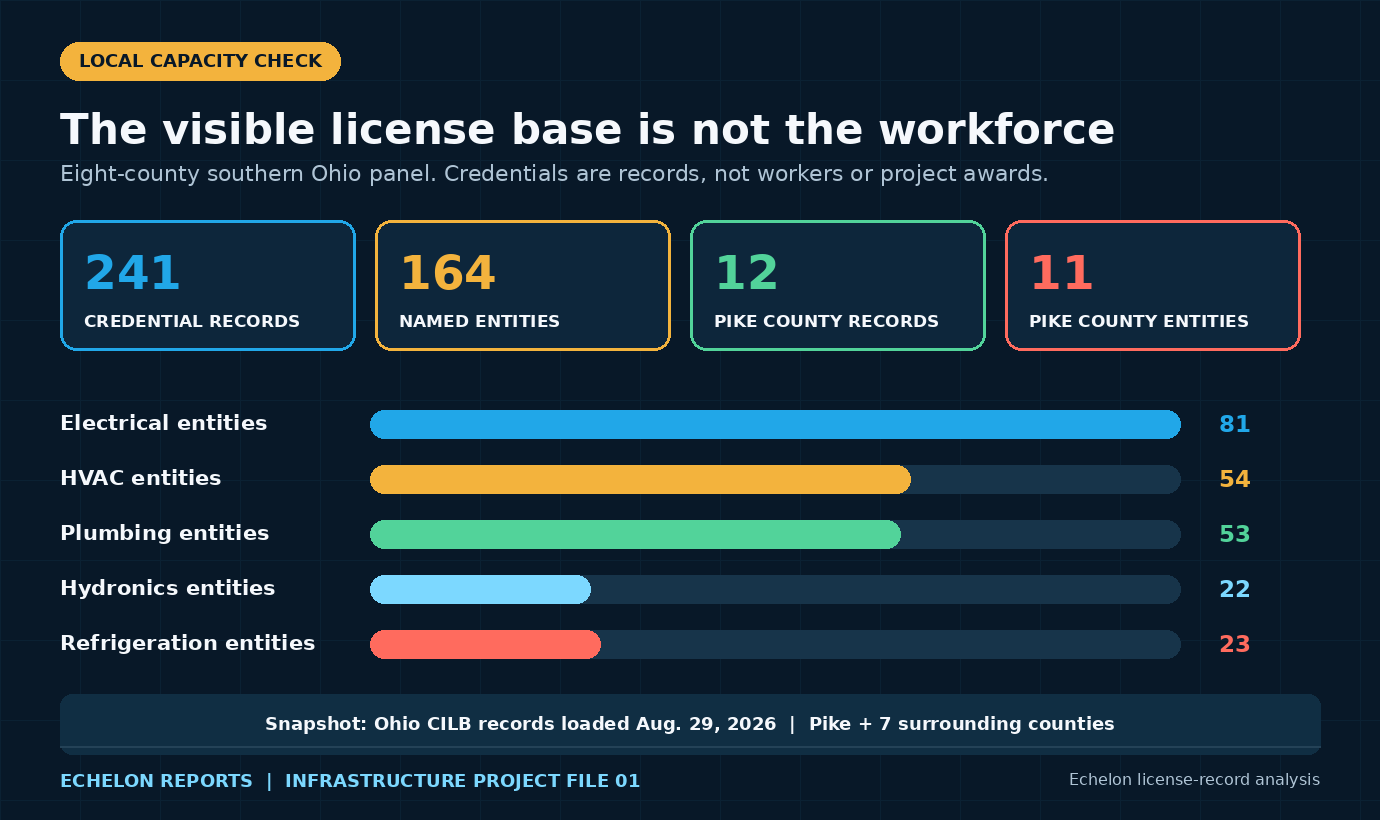
Echelon reviewed Ohio Construction Industry Licensing Board records loaded through August 29, 2026. We counted active and active-in-renewal electrical, HVAC, hydronics, plumbing, refrigeration, and source-native TA credentials in Adams, Brown, Highland, Jackson, Pike, Ross, Scioto, and Vinton counties. The contractor data coverage page explains the wider state coverage and counting limits.
The eight-county panel contained:
| Measure | Count |
|---|---|
| Active or active-in-renewal credential records | 241 |
| Distinct named companies or holders | 164 |
| Entities with electrical credentials | 81 |
| Entities with HVAC credentials | 54 |
| Entities with plumbing credentials | 53 |
| Entities with hydronics credentials | 22 |
| Entities with refrigeration credentials | 23 |
Entities with source-native TA credentials |
3 |
These are licenses, not employees. A county is a record field, not a service boundary. Companies can hold several credentials or work outside their recorded county. The counts cannot establish project awards, worker availability, bonding, safety record, or industrial experience.
Pike County itself contained 12 active or active-in-renewal records tied to 11 named entities. Six were electrical records, four HVAC, one hydronics, and one plumbing.
Pike County contractor records: August 29 snapshot
The following table reproduces the Pike County records in Echelon’s August 29 Ohio extract. Inclusion means a public license record existed. It does not mean the company has been selected, has applied, is qualified for mission-critical work, or has sufficient scale for PORTS-Pike.
| Company | Credential holder | Type | License | Status | Recorded city |
|---|---|---|---|---|---|
| Dans Skilled Services LLC | Daniel Rush | Electrical | EL.51290 | Active | Waverly |
| JT Electric LLC | Jeremy T. Smith | Electrical | EL.49720 | Active | Columbus |
| Miller Electrical Contracting LLC | Jeremy M. Miller | Electrical | EL.44892 | Active | Waverly |
| Ohio Valley Electric | Marc J. Harlow | Electrical | EL.48371 | Active | Wheelersburg |
| Perry Electric Inc. | Dan Perry | Electrical | EL.24272 | Active | Waverly |
| WE Contracting LLC | Wesley A. Davis | Electrical | EL.45954 | Active | Piketon |
| Airmax Heating & Cooling LLC | Robert M. Starett | HVAC | HV.46625 | Active | Pataskala |
| Brownies HVAC LLC | Jeff Brown | HVAC | HV.27933 | Active | Waverly |
| Superior Refrigeration & HVAC LLC | Steven W. Swaim Jr. | HVAC | HV.51181 | Active | Waverly |
| True Comfort Heating and Cooling | Corey Q. Hougland | HVAC | HV.51604 | Active | Piketon |
| Willis & Sons Plumbing HVAC Inc. | Gilbert D. Willis III | Hydronics | HY.25042 | Active in renewal | Waverly |
| Willis & Sons Plumbing HVAC Inc. | Gilbert D. Willis III | Plumbing | PL.25042 | Active in renewal | Waverly |
This list is a starting point for field verification, not a bidder recommendation.
Other multi-credential names in the eight-county records include Appalachian Heating & Cooling, Campbell Heating & A/C, Donnie Martin Heating & Cooling, Accurate Mechanical, Mechanical Construction Company, Geiger Brothers, The Wright Company, and Weller’s Plumbing & Heating. Their licenses show trade coverage, not project capacity or an award.
The union and training base
Southern Ohio has industrial craft institutions that predate the data-center announcement.
IBEW Local 575
IBEW Local 575 represents the Portsmouth and southern Ohio electrical market. Its history is directly connected to the original Portsmouth plant. The local reports that the “A Plant” once employed approximately 2,000 electricians at peak.[18]
That history matters. The region has institutional memory for large federal industrial work. It does not mean 2,000 electricians are currently available.
Boilermakers Local 105
Boilermakers Local 105 is based in Piketon. It runs a four-year apprenticeship in welding, rigging, and industrial construction. Its business manager described a labor plan using members, travelers, and new recruits.[13]
Plumbers and Pipefitters Local 577
UA Local 577 serves Portsmouth and southern Ohio with plumbers, pipefitters, welders, and mechanical-service technicians. The local says labor-management partners invest nearly $650,000 annually in training.[17]
The workforce conclusion
If the buildout proceeds at its announced scale, Echelon expects recruitment to extend beyond Pike County. Southern and central Ohio, northern Kentucky and western West Virginia are plausible recruiting areas, alongside travelers and contractors’ existing crews. The license panel does not measure how many people would accept the work.
Overlapping schedules could put PORTS-Pike in competition with other Ohio data centers, factories, hospitals and utility projects. The practical question is how many qualified people can take an assignment when a particular package starts. Neither union membership nor license totals answer it.
What contractors should do now
1. Choose the correct entry channel
Contractors should separate four procurement channels:
- Bechtel for data-center and associated infrastructure packages.
- Kiewit for generation and balance-of-plant packages.
- AEP Ohio and its transmission contractors for 765-kV and substation work.
- SB Energy and its development team for owner-direct, enabling, and local-service scopes.
Registering with one does not place a contractor into the other three.
2. Build a project-specific capability file
A generic brochure will not win this work. Contractors need a package that answers:
- Which licenses are active, in whose name, and through what date?
- Can the company work on federal and private sites?
- What is its single-project and aggregate bonding capacity?
- How many foremen, journeymen, apprentices, and specialty technicians can it deploy?
- How many can travel?
- What mission-critical, utility, power-generation, pharmaceutical, semiconductor, or industrial references can it document?
- Does it have written QA/QC, turnover, lockout, testing, and commissioning procedures?
- Can it manage certified payroll, badging, background checks, and controlled-site access?
- Can it finance payroll and materials before progress payments arrive?
3. Do not overextend for the first package
Megaproject revenue can destroy an undercapitalized contractor. Warning signs include:
- One package exceeds normal annual revenue
- Material deposits outrun the line of credit
- Retainage creates a cash gap
- Bonding depends on personal guarantees
- Field supervision is pulled from every existing customer
- Schedule damages are uncapped
- Change-order approval lags field execution
- The prime pushes design incompleteness downstream
A smaller first package may fit a contractor’s capital and field capacity better than a larger one. Completing it builds a project record; taking on too much can put the business at risk.
What contractor buyers should look for
Echelon’s analysis: if the buildout proceeds, industrial capability and workforce access could become more valuable before nearby contractors see higher earnings. An announcement alone is not acquisition revenue.
The most exposed acquisition categories
- Commercial and industrial electrical contractors with medium-voltage, controls, data, testing, or substation capability.
- Mechanical and process-piping contractors with welding procedures, hydronics, industrial HVAC, and commissioning.
- Utility and transmission contractors with high-voltage, right-of-way, substation, relay, and fiber experience.
- Civil contractors with mass grading, underground utilities, environmental controls, and large equipment fleets.
- Fire-protection contractors with licensed design and mission-critical installation capacity.
- Commissioning and electrical-testing firms with NETA-type capability, relay testing, infrared inspection, and documented turnover systems.
- Specialty industrial service firms in rigging, insulation, coatings, nondestructive testing, water treatment, and controls.
The acquisition trap
Do not buy a nearby residential contractor because a data center is coming. Geography alone is weak exposure.
A buyer should verify:
- The licensed qualifier will remain after closing
- Key foremen and estimators are retained
- The firm can satisfy prime-contractor safety and financial thresholds
- Industrial references are real and transferable
- Customer concentration will not become fatal
- Backlog quality is stronger than backlog size
- Working capital can support growth
- Union or merit-shop labor access matches likely package requirements
- The company has no undisclosed prevailing-wage, payroll-tax, OSHA, or warranty liabilities
The scarce asset may not be the business name. It may be the qualifier, the estimating team, the foremen, the labor relationship, the commissioning record, or the bonding line.
Where value could move first
For buyers, three capabilities deserve closer review before assigning value to project exposure:
- A license and responsible qualifier that survive a transaction.
- Demonstrated industrial or mission-critical execution.
- Enough management and working capital to pass prime-level prequalification.
Small service contractors may benefit later from housing, commercial expansion, facility maintenance, and population growth. They are not automatically direct data-center plays.
Permits and schedule constraints
PORTS-Pike gained FAST-41 coverage in June 2026, with the Army Corps as lead federal agency. The September 28 extension and the revised timetable above are the material updates. FAST-41 coordinates review; it does not authorize construction.[7][26]
FAST-41 improves coordination and makes permitting milestones more visible. It does not eliminate environmental review or guarantee approval.
The project’s current constraint map includes:
Wetlands and streams
SE DC DevCo’s May Section 401 application included alternative layouts affecting state waters. The September federal determination now records subsequent project-area and building-design changes. The older filing should not be treated as the final layout.[8][26]
Federal cleanup and land release
Cleanup and demolition continue at the federal Portsmouth site, along with groundwater and soil work. The reviewed sources do not establish how much land is ready for immediate data center construction.
Transmission
AEP route planning and Ohio Power Siting Board proceedings must advance before the full 765-kV program is built.[6]
Generation and pipeline
The project needs 9.2 GW of gas generation plus interstate pipeline infrastructure. Public sources reviewed by Echelon do not yet provide a complete plant-by-plant schedule, turbine assignment, pipeline route, air-permit inventory, or construction-package calendar.
Sequencing
The first 800 MW is expected in 2028. AEP expects new transmission power to begin flowing in 2029.[1][6] That one-year gap is not necessarily a contradiction. OpenAI says the initial phase will rely primarily on the existing grid, while later capacity will depend on new plants and transmission.[10]
If the first phase slips while civil, generation, and transmission work accelerates, their labor peaks could overlap.
What is confirmed, what is analysis, and what remains unknown
Verified
- SB Energy is developing the campus.
- OpenAI has agreed to approximately 8 IT-GW under a 20-year lease.
- NVIDIA will invest $1.5 billion and provide the compute platform.
- The total campus plan is 10 GW across private and remediated federal land.
- The power plan includes at least 10 GW of generation and 9.2 GW of natural gas.
- AEP’s March transmission announcement states $4.2 billion; the developer homepage now states $5.1 billion. The difference remains unresolved.
- Bechtel and Kiewit are named project participants.
- Stantec is named in the Ohio EPA application.
- FAST-41 applies, with the Army Corps as lead federal agency.
- The current public job claim is 35,000 construction jobs over six years and 2,500 operating jobs.
Analytical read
- The project will require a national traveling workforce in addition to local labor.
- Electrical, generation, transmission, mechanical and commissioning capacity are possible constraints to investigate as schedules develop.
- Qualifier stability, industrial references, bonding, safety, and working capital will matter more than proximity.
- Industrial capability could attract acquisition interest if the project produces executable packages. No increase in transaction demand is established here.
- The federal and private footprints may produce separate packages and execution rules even though they belong to one campus.
Unknown after the October 16 review
- The final split between federal and private acreage
- The final private-site layout
- The complete subcontractor and supplier list
- Bechtel’s and Kiewit’s final contracted scopes
- Whether a project labor agreement will govern any portion of the work
- Peak workers by craft and year
- Bid-package release dates
- Gas-turbine and major equipment awards
- Final pipeline route and operator
- Final transmission routes
- Final water-use estimate
- Final tax-abatement structure on private property
- Exact local-hiring requirements
- How the revised permitting timetable affects package releases, mobilization and the first 800 MW delivery plan
The signals Echelon will watch next
The next useful evidence will be permits, route decisions, bid packages, and named subcontract awards:
- Ohio EPA and Army Corps decisions on the revised private-site application and footprint.
- Ohio Power Siting Board filings for 765-kV routes and substations.
- Air permits for gas-generation units and backup generation.
- Pipeline applications and route disclosures.
- Bechtel and Kiewit supplier events or project-specific prequalification notices.
- Public subcontract awards.
- Craft-specific hiring or referral calls.
- Project labor agreement terms and craft referrals beyond the announced building-trades memorandum.
- County tax, road, housing, water, or emergency-service agreements.
- Evidence that the first 800 MW has moved from site preparation into vertical and MEP construction.
Bottom line
The project has an OpenAI capacity agreement, named delivery participants and active owner-side recruiting. Its final federal review target is now January 29, 2027. Contractors should prepare qualifications while waiting for a defined package; workers should pursue a named employer or hall referral rather than travel on the strength of announced job totals.[21][26][31]
Labor, permits, equipment, and subcontract awards now determine how much of that plan can be delivered on schedule.
The August 29 license snapshot contained 12 relevant Pike County credentials tied to 11 named entities, within an eight-county panel of 241 records and 164 names. Those historical records are not current vacancies or a measure of available crews.
The license counts show a small local record base, not a measure of how many workers the project can recruit.
Contractors with the needed licenses, foremen, safety systems, capital, and industrial record may compete for multiyear work. Buyers should verify those capabilities before treating a nearby license as project capacity. The reviewed sources do not establish a signed subcontract for every nearby company.
Contractors can register through the relevant procurement channels, protect working capital, and follow permits and bid packages as the plan moves toward construction.
ECHELON PROJECT AND CONTRACTOR INTELLIGENCE
A project announcement does not tell you which contractors, qualifiers, and trades control delivery.
Echelon maps licensed contractor capacity, ownership exposure, project schedules, and the records that show when a market is moving.
Methodology and limitations
Echelon published the baseline on August 22, updated it September 3, and rechecked project, procurement and hiring evidence on October 16, 2026. The federal dashboard was inspected live and its September 28 decision was read separately. Local license counts remain the August 29 snapshot; this refresh did not recollect them.
Licenses do not count employees. A person or company may hold several. The recorded county need not be headquarters or the full service area. A license does not prove project participation, scale, availability, union status, finances, or data center experience.
Echelon marks a contractor role as confirmed when an owner, government record, contractor, union, or construction publication names the organization. Consortium intent, location, recruiting, and general capability do not establish a subcontract award.
Frequently asked questions
What is the PORTS-Pike Technology Campus?
PORTS-Pike is a planned 10 GW data-center and power campus in Pike County, Ohio. OpenAI has agreed to use approximately 8 IT-GW under a 20-year lease. The wider project includes new generation, transmission, substations, civil infrastructure, and development across private and remediated federal land.
Who is building the Piketon data center?
SB Energy is the developer, owner and operator. Public sources identify Bechtel with the data-center portion and Kiewit with generation. AEP Ohio is the transmission partner; Stantec is named in the May state application. The sources reviewed do not identify all subcontractors.
How many construction workers will PORTS-Pike employ?
OpenAI projects 35,000 construction jobs over the six-year buildout through 2032, not 35,000 simultaneous workers. The developer’s first-phase forecast is nearly 4,000 construction jobs and 300 to 400 operating jobs. These forecasts overlap in scope and should not be added together.
Which skilled trades will PORTS-Pike require?
The buildout calls for electricians, pipefitters, plumbers, welders, boilermakers, millwrights, and operating engineers. It also calls for ironworkers, linemen, controls and HVAC workers, fire-protection and civil crews, testing technicians, and commissioning staff.
Have the electrical and mechanical subcontractors been announced?
The reviewed sources do not name all electrical, mechanical, plumbing, fire-protection, civil, controls, or commissioning subcontractors. Bechtel, Kiewit, AEP Ohio, and Stantec have identified roles. The 21 Portsmouth Consortium participants expressed intent to participate, not proof of a subcontract.
Does Pike County have enough licensed contractors for the project?
The August 29, 2026 license records do not answer that question by themselves. Echelon found 12 relevant active or active-in-renewal credentials tied to 11 Pike County names. These are contractor records, not workers or proof of industrial capacity.
Has PORTS-Pike received its final federal permit?
The October 16 federal dashboard showed review in progress, with a January 29, 2027 estimated completion date. The September 28 determination extended the final environmental assessment and Section 10/404 permit-decision targets. It is not a permit approval.
How can contractors bid on PORTS-Pike?
Start with the relevant Bechtel, Kiewit or AEP supplier route and confirm the project-specific process. Bechtel says its quotation requests are invitation-only. Echelon did not verify a public PORTS-Pike trade package, scope sheet or bid deadline in the reviewed routes.
Are the advertised SB Energy jobs construction craft positions?
The selected local listings in this report are mainly owner-side management and engineering roles. They are separate from electrician, pipefitter, welder or equipment-operator hiring. Use the employer career boards and regional trade halls to check current craft opportunities and exact assignments.
Sources
- PORTS-Pike Technology Campus, official project site
- U.S. Department of Energy partnership announcement, March 20, 2026
- U.S. Department of Energy Ohio project fact sheet, March 20, 2026
- NVIDIA, OpenAI and SB Energy PORTS-Pike announcement, August 17, 2026
- SoftBank Portsmouth Consortium announcement and participant list, March 21, 2026
- AEP Ohio $4.2 billion transmission announcement, March 20, 2026
- Federal Permitting Council FAST-41 announcement, June 16, 2026
- SE DC DevCo, LLC Section 401 Water Quality Certification application, submitted May 28, 2026
- WOUB report on private and federal land configuration, June 15, 2026
- WOUB report on OpenAI lease, jobs, water and schedule, August 18, 2026
- Construction Dive report on Bechtel, Kiewit and the power program, March 26, 2026
- Engineering News-Record project and contractor report, March 23, 2026
- International Brotherhood of Boilermakers report on contractor roles and Local 105 workforce plans
- SB Energy investment and Studio 151 acquisition announcement, January 9, 2026
- Bechtel supplier registration
- Kiewit vendor participation and opportunities
- UA Local 577, Portsmouth and southern Ohio
- IBEW Local 575 profile and Portsmouth plant history
- DOE award to Southern Ohio Cleanup Company
- DOE Portsmouth decontamination and decommissioning program
- OpenAI joins the PORTS-Pike project, August 17, 2026
- DOE special report on the PORTS-Pike public-private development, April 7, 2026
- Federal permitting dashboard, observed October 16, 2026
- Permitting Council extension decision, September 28, 2026
- Bechtel supplier portal guide, September 2026
- Bechtel opportunities, updated October 7, 2026
- Kiewit supplier invitation route
- AEP business and supplier routes
- SB Energy employer job board, checked October 16, 2026
- SB Energy public employer job feed, checked October 16, 2026
- Bechtel employer careers
- Kiewit employer careers
- Project Manager, Site Development – Power Generation
- Development Project Manager – Data Center
- Project Engineer – Data Center Power
- Electrical Engineer – Data Center Power Generation
- Instrumentation and Controls Engineer, Data Center Power Generation
- High Voltage Project Manager/Senior Project Manager – Data Center Power
- Current campus updates and FAQ, browser checked October 16, 2026
- Official campus vendor inquiries and job notifications form
- SB Energy and OpenAI $6 million childcare initiative, September 2026
MIKE WARNER | ECHELON REPORTS
mike@echelonreports.com | linkedin.com/in/jmichaelwarner | x.com/_Mike_Warner
Public-records intelligence. Not accounting, legal, or investment advice.