
Editorial update: October 14, 2026. Original reporting dates are unchanged.
The archived index was computed August 23 and this article was published August 24, before its assigned August 29 week-ending label. That label identifies the reporting slot, not a completed observation period. The comparisons below retain the original index values and source windows rather than implying that information from the rest of that week was already available.
The Echelon Residential Demand Index (ERDI) combines six measures of US residential trades conditions: financing, housing turnover, permits, search demand, weather and Echelon’s contractor review panel. Each component is normalized against a comparison baseline suited to its source before entering the equally weighted composite. A reading of 100 marks that component’s baseline; the index summarizes these measurements rather than counting completed jobs.
1. The Print
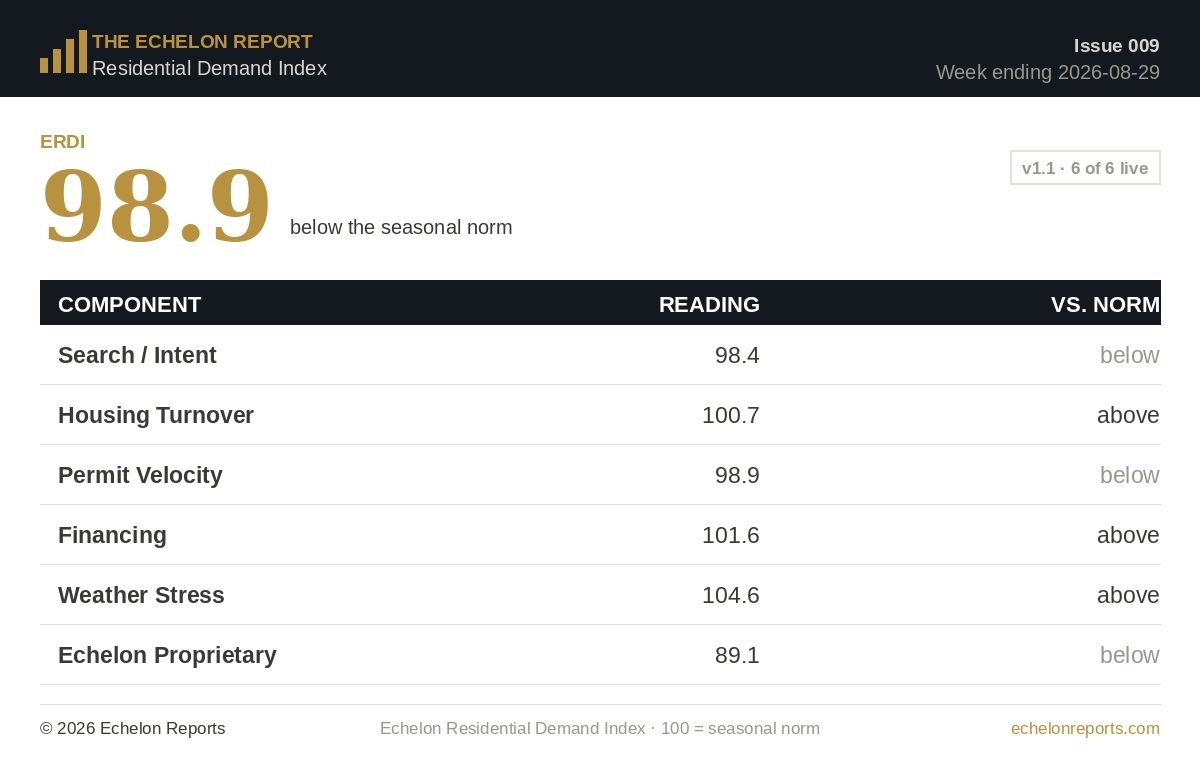
Under the historical August 29, 2026 label, the archived ERDI reached 98.9, an increase of 3.7 points over the preceding 95.2 print. This is the figure that the historical six-component method produced for the issue, not a replacement value reconstructed under a method adopted in later editions. The comparison is useful only when the change in each component is considered alongside the headline movement.
The panel’s recovery drove the 3.7-point index rebound. It had fallen sharply in the previous observation, while the five market-facing measures declined on average this time. The composite thus partly reversed an earlier panel drop; it does not show a broad acceleration in demand.
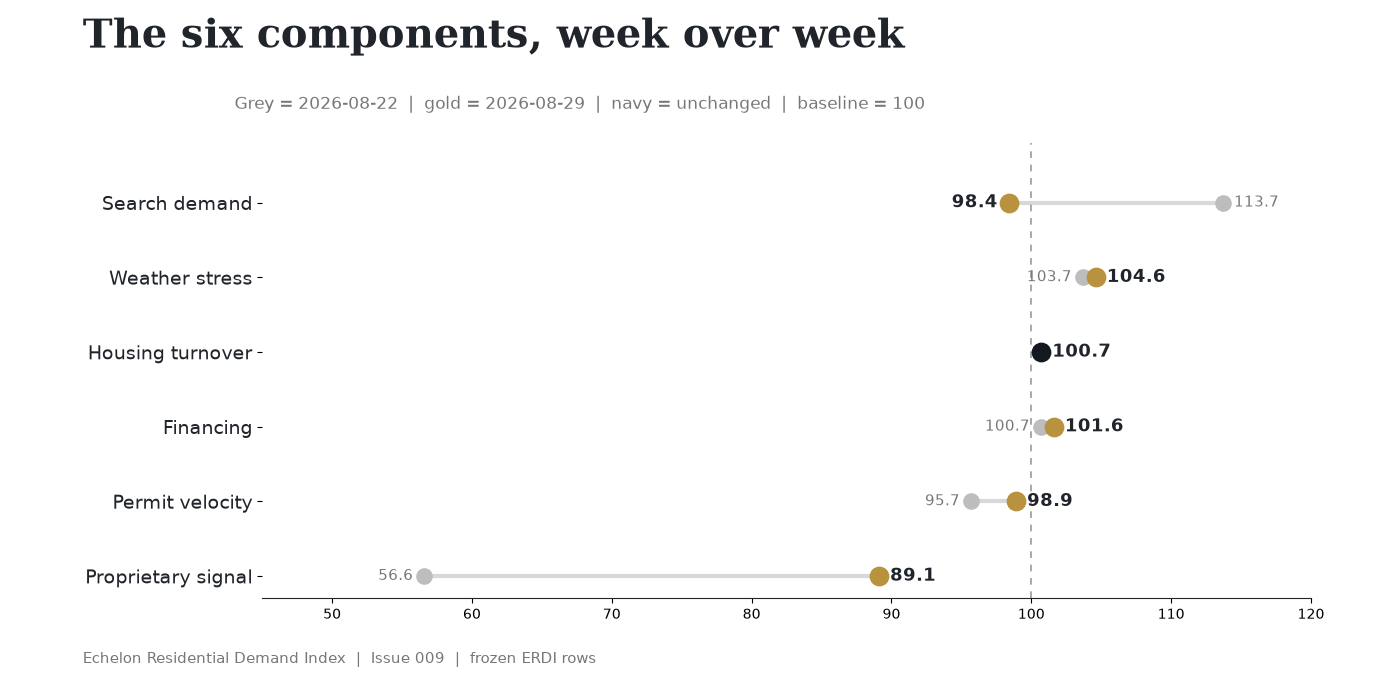
The contractor-panel signal climbed 32.5 points, from 56.6 to 89.1, adding 5.42 points to the six-component composite. Search worked against that improvement: it fell 15.3 points from 113.7 to 98.4 and subtracted 2.55 composite points. The opposing contributions explain why the final index gain was smaller than the panel contribution and why the headline alone would misdescribe the week.
The five market-facing measures averaged 100.8 after averaging 102.9 in the preceding print, even though the six-component index increased. Three of the six measures remained above 100, but the 2.1-point fall in the separate market-facing average shows that the direction of the headline and the direction of those five inputs diverged. The panel’s large reversal explains how both statements can be true in the same observation.
2. The Components
| Component | This week | Last week | What moved |
|---|---|---|---|
| Search demand | 98.4 | 113.7 | Search fell 15.3 points after last week’s mechanical and replacement surge. DataForSEO supplies the Google Trends series used in the ten-keyword basket.[5] |
| Housing turnover | 100.7 | 100.7 | Existing-home sales remained at a 4.06 million annual rate against a 4.03 million three-year same-month average.[3] |
| Permit velocity | 98.9 | 95.7 | July permits improved to 1.443 million against a 1.459 million three-year same-month average. The component rose 3.2 points but remained below baseline.[4] |
| Financing | 101.6 | 100.7 | The 30-year mortgage rate averaged 6.65 percent against a 6.76 percent three-year same-week average.[2] |
| Weather stress | 104.6 | 103.7 | The ten-market thermal-stress basket remained above its same-week seasonal norm. The weather series uses NOAA daily station observations.[6] |
| Echelon proprietary | 89.1 | 56.6 | Review velocity recovered from 0.97 to 1.48 net new reviews per comparable panel member, against a 1.67 weekly baseline. |
Numbers of Record
The four frozen prints were 105.1, 99.9, 95.2 and 98.9, making the latest value 3.7 points higher than the one immediately before it. Read as a sequence, they show a fall across the earlier observations followed by a partial rebound, not a return to the first value. Their historical comparison remains intact even though later editions revised the index method; a newly calculated series would answer a different question.
Three of the six components exceeded their seasonal reference and three did not: search stood at 98.4, turnover at 100.7, permits at 98.9, financing at 101.6, weather stress at 104.6 and the contractor panel at 89.1. The split shows that the positive composite movement was not a uniform recovery. It also places the panel’s improvement in context: after a large increase, that component still sat below reference.
3. The Read
The rebound came from the signal that broke last week
The contractor-panel signal partially reversed as 934 comparable contractors gained 1,386 net new reviews, or 1.48 per member. In the preceding observation, 936 comparable members gained 905 net reviews, or 0.97 each. Both the membership count and the rate changed, so the comparison should be read as review velocity among comparable members, not as a direct count of jobs completed by a fixed set of businesses.
Net reviews per comparable member increased 53.5 percent from the preceding observation, but the resulting rate of 1.48 remained below the panel’s 1.67 weekly baseline. The indexed component recovered from 56.6 to 89.1 without returning to its reference of 100. Distinguishing the magnitude of the rebound from the level reached prevents a sharp recovery from being mistaken for a fully restored review-posting rate.
Search demand gave back the surge
Search demand fell from 113.7 to 98.4, giving back much of its preceding rise, although the complete weekly service basket retained relative strength in several terms shown below. The broad decline and those stronger individual services are compatible because an aggregate search reading can move down while some categories continue to stand out. That is why the table should be read as a service mix rather than as evidence of uniform weakening.
- HVAC replacement: 68 on the 0-to-100 Trends scale, 12.8 points above its prior four-week average;
- water heater replacement: 64, up 8.2 points;
- AC repair: 69, up 6.2 points;
- foundation repair: 45, up 3.8 points.
Bathroom remodeling was the weakest term in the search basket at 45, or 20.8 points below its prior four-week average, while furnace repair was nearly flat. The service-level contrast gives an operator a better question than the composite search score alone: whether local inquiries show the same difference between remodeling and essential repair. National normalized searches do not answer that local question on their own.
The average concealed different component readings
The five market-facing components averaged 100.8, with financing and weather above their comparison baselines and housing turnover only slightly above 100. Permits improved without clearing their baseline, while search moved below it. This distribution is more informative for evaluating a contractor’s exposure than a single near-normal average: the relevant question is whether the company relies on work associated with the stronger or weaker indicators.
For a contractor allocating a service budget, the relevant comparison is between the search categories it serves and its own inquiries, estimates and accepted jobs. Essential-repair and mechanical-replacement searches held up better than remodeling in this observation, but the national readings do not establish which offers converted in a particular market. A budget decision should depend on those local outcomes rather than the composite’s rebound.
4. What to Watch
1. Does review velocity finish the recovery?
The panel rose to 89.1 but remained below its seasonal reference after the previous 56.6 reading. Another gain would make a temporary review-velocity break more plausible, whereas renewed weakness would require another look at work volume, collection practices and timing. The panel alone cannot distinguish those causes, which is why its movement should be compared with the independent search and permit readings.
2. Does search stabilize near 100?
Search fell 15.3 points after the prior surge. A later print near its seasonal reference, with continued relative strength in AC repair, HVAC replacement and water-heater replacement, would support the service-mix interpretation despite a softer broad basket.
3. Do permits cross back above baseline?
Permit velocity moved from 95.7 to 98.9, approaching but not clearing its reference. Another monthly gain would bring the three housing and financing components to or above 100; a reversal would leave the gap between easier financing and permit activity unresolved.
The Bottom Line
The ERDI reached 98.9 after the contractor-panel signal recovered sharply from its preceding low. The five market-facing measures moved lower on average, which limits the interpretation of the 3.7-point index gain. A contractor deciding where to investigate demand should therefore look at service-specific searches and local inquiries instead of treating the composite rebound as a direct measure of new jobs.
Methodology and Limitations
ERDI is an equal-weighted composite of six components. Each component is indexed to 100 using a baseline suited to the source series.
- Financing uses the current 30-year mortgage rate against the average for the same calendar week in the prior three years. Lower rates score higher.
- Housing turnover and permit velocity use the latest monthly level against the same-month average for the prior three years.
- Search demand uses the latest complete weekly value from a ten-keyword residential-trades basket against its trailing 52-week median.
- Weather stress uses the latest complete week from ten US weather stations against the same-week median from prior years.
- The proprietary signal uses weekly net review growth across a fixed contractor panel against the panel’s prior weekly median.
Monthly measures update when their sources publish new figures, so their observation windows do not necessarily close on the report’s week-ending date. The search series has a different limitation: Google Trends normalizes within its selected query window and can recalculate earlier values. Echelon freezes the first computed weekly index as the archived number of record, preserving the historical print while recognizing that the components do not all advance together.
The proprietary panel measures review activity, not booked revenue. Review additions can reflect completed-job volume, review collection practices, platform timing, review removals, or a combination of those factors.
This issue uses Echelon’s archived source pulls and contractor-panel snapshots frozen on August 23, 2026. ERDI is a directional demand indicator, not a revenue forecast. Echelon Reports publishes public-records and market intelligence. This is not accounting, legal, or investment advice.
Sources
See ERDI in context
ERDI leads every issue of The Echelon Report, the weekly residential-trades intelligence brief. Read the latest issue, or commission a market-level read for your own metro.