
Platform File: Redwood Services
Redwood Services bought six companies in the first seven months of 2026. That pace, more than any single deal, is what an owner should weigh before taking a call from one of its brands. A platform’s ownership clock, meaning how long its current backer has held it and how much runway is left, tells a seller whether they are joining a buyer still building or one being dressed for its own sale. Redwood sits near the start of that clock, not the end, and that points the opposite way from most of its peers.
The short answer: Redwood Services is a national residential HVAC, plumbing, and electrical platform founded in 2020 and headquartered in Memphis, Tennessee, built on a partnership model that keeps local brands and their names in place. Toronto-based Altas Partners took majority control in a transaction that closed in the second quarter of 2025, valuing Redwood near 1.1 billion dollars on a reported multiple of about 17 times earnings. Union Main Group, the founding backer, remains an investor, and its co-founder Adam Hanover chairs the board. Redwood is the buyer of the Sierra Platform, not a company SE Capital owns; SE Capital was the seller in that May 2026 deal. The Echelon Database tracks 23 partner brands across roughly 20 states. In the six states Echelon tracks that license the contracting company and expose HVAC, Arizona, California, Nevada, Ohio, Virginia, and Wisconsin, Redwood brands hold 11 active HVAC company licenses. In Colorado, where HVAC is licensed at the county level, its Denver brand Brothers holds 2 active state electrical and plumbing licenses. And unlike most of its national peers, Redwood is early in a fresh ownership hold and visibly still buying, which on our read makes it an accumulator, not a seller. We label that analysis, not prediction.
Who owns Redwood, and who controls it now
The brands under the platform
What Redwood holds on the ground
The platform in active build
Frequently asked questions
- Redwood Services runs residential HVAC, plumbing, and electrical across roughly 20 states, headquartered in Memphis, Tennessee, founded in 2020 on a partnership model that preserves local brand names.
- Ownership sits with Altas Partners, which took the majority in a deal that closed in the second quarter of 2025 at a reported valuation near 1.1 billion dollars. Union Main Group, the founding backer, remains an investor, and co-founder Adam Hanover chairs the board. Piper Sandler advised Redwood. There was no change of control after that.
- Redwood is frequently placed on the wrong side of its own biggest deal. It bought the five-company Sierra Platform from SE Capital in May 2026, so SE Capital was the seller, not an owner. It is also not Redwood Materials, Redwood Trust, or Redwood Software, unrelated firms that share the name.
- The Echelon Database tracks 23 partner brands. At the May 2025 Altas investment, with 19 partners, Redwood reported over 500 million dollars in revenue and more than 2,500 employees; the Sierra Platform added roughly 100 million dollars and about 400 employees a year later.
- Across the tracked states: 11 active HVAC company licenses in the six that license by company and expose HVAC, Arizona 5, California 2, Nevada 1, Ohio 0, Virginia 2, and Wisconsin 1; plus 2 electrical and plumbing licenses for Brothers in Colorado, where HVAC is county-licensed, and 57 active individual HVAC credentials for Arlinghaus in Kentucky, where the Cincinnati-market brand licenses its workforce across the state line.
- Two findings a brand roster hides. Neither Ohio brand holds an Ohio HVAC company license under its own name: Arlinghaus runs the Cincinnati market on that Kentucky credential bench, and Apollo’s only Ohio match is an unrelated Cincinnati company. And Redwood’s Las Vegas brand, Sierra Air Conditioning and Plumbing, shares its name and founding year with a new-construction installer that a competitor, Airtron, acquired in 2025.
- Redwood added six brands in 2026 and entered four new states, roughly fourteen months into the Altas hold. Where the longest-held national platforms look overdue for an exit, Redwood looks like a platform still filling out, and on our read an active buyer rather than a seller.
Redwood is one of the fastest-rising names in the great trades roll-up, and among the most active buyers working the market right now. That makes it a platform a lot of owners meet from the other side of a conference table. A file useful to that reader cannot just copy the brand list. It has to get the ownership exactly right, since the Sierra deal parks Redwood next to SE Capital’s name in a way that misleads a quick reader. It has to add the ground truth a brand roster leaves out. And it has to read the platform’s phase for the person most likely to be courted by it. Here is all three.
Who owns Redwood, and who controls it now
Redwood Services was founded in 2020 by Richard Lewis, who remains chief executive, with Union Main Group as the founding backer and operating partner. Union Main’s co-founder and chief executive, Adam Hanover, chairs Redwood’s board. Across its first years the company built the partnership model that defines it, buying established residential HVAC, plumbing, and electrical brands, keeping their names and local leadership, and offering owners continued upside rather than a clean exit. In May 2025 Redwood announced a majority investment from Altas Partners, a Toronto-based long-hold investment firm, in a transaction that closed in the second quarter of 2025. Reported figures placed the valuation near 1.1 billion dollars, roughly 17 times about 65 million dollars of trailing earnings. Piper Sandler advised Redwood. Union Main retained a stake and the board chair, and through the first half of 2026 there has been no change of control.
Now the part a fast reader gets backward. In May 2026 Redwood made the largest move of its history when it acquired the Sierra Platform, a five-company group, from the private equity firm SE Capital. Because SE Capital’s name travels with that coverage, it is easy to read it as Redwood’s owner or its seller. It is neither. SE Capital sold the Sierra Platform to Redwood and has no ownership of Redwood, whose majority holder is Altas. The distinction matters, because a reader who thinks Redwood just changed hands, or is being sold by SE Capital, will misjudge its phase completely. One smaller note for owners searching the name cold: this is the Memphis home-services Redwood, not Redwood Materials, Redwood Trust, or Redwood Software, which are unrelated businesses in other industries.
The brands under the platform
By its own account Redwood supports more than two dozen partner companies across roughly 20 states, led by founder and chief executive Richard Lewis. The Echelon Database tracks 23 named brands, assembled in clear waves that also trace where the platform has aimed its capital over time.
The founding partnerships, in 2021, were Rite Way Heating, Cooling & Plumbing in Tucson and John C. Flood in the Washington, D.C. metro, anchored in Alexandria, Virginia.
The 2022 and 2023 build spread across the South and Southwest: Allbritten in Fresno, Arlinghaus in the Greater Cincinnati area, Apollo Heating, Cooling & Plumbing in the Akron area, Environment Masters in metro Jackson, Best Care Home Services in Memphis and Huntsville, Keefe’s in New Orleans, Signature Heating, Cooling & Plumbing in Albuquerque, and B and J Plumbing, Heating, and Air Conditioning in Wilson, North Carolina.
The 2024 and 2025 expansion reached the Northeast, the Midwest, the Central Valley, and the Jersey Shore: Crisafulli Bros. in Albany, Parks Heating Cooling Plumbing & Electrical in the Charlotte area, Dean’s Home Services in Minneapolis, Tony’s Plumbing, Heating & Air in Modesto, Hope Plumbing in Indianapolis, Cardinal Heating, Cooling, Plumbing, & Electric in the Madison, Wisconsin market, and Guaranteed Service on the New Jersey shore.
The 2026 wave is the largest and the most concentrated, and most of it arrived as a single sub-platform. In May, Redwood acquired the Sierra Platform from SE Capital in one transaction, bringing in Sierra Air Conditioning & Plumbing in Las Vegas, Brothers Plumbing, Heating & Electric in Denver, Ultimate Heating, Air & Plumbing in the Boise area, and Russett Southwest and Pioneer Plumbing in Tucson. That deal entered Las Vegas, Denver, and Boise at once and deepened Tucson, which now carries three Redwood brands. RJ Magee, who led the Sierra Platform, joined Redwood as Senior Vice President of Operations. In July, in a separate deal, Redwood added Hendrick Heat, Air & Plumbing in Tulsa, its first investment in Oklahoma.
What Redwood holds on the ground
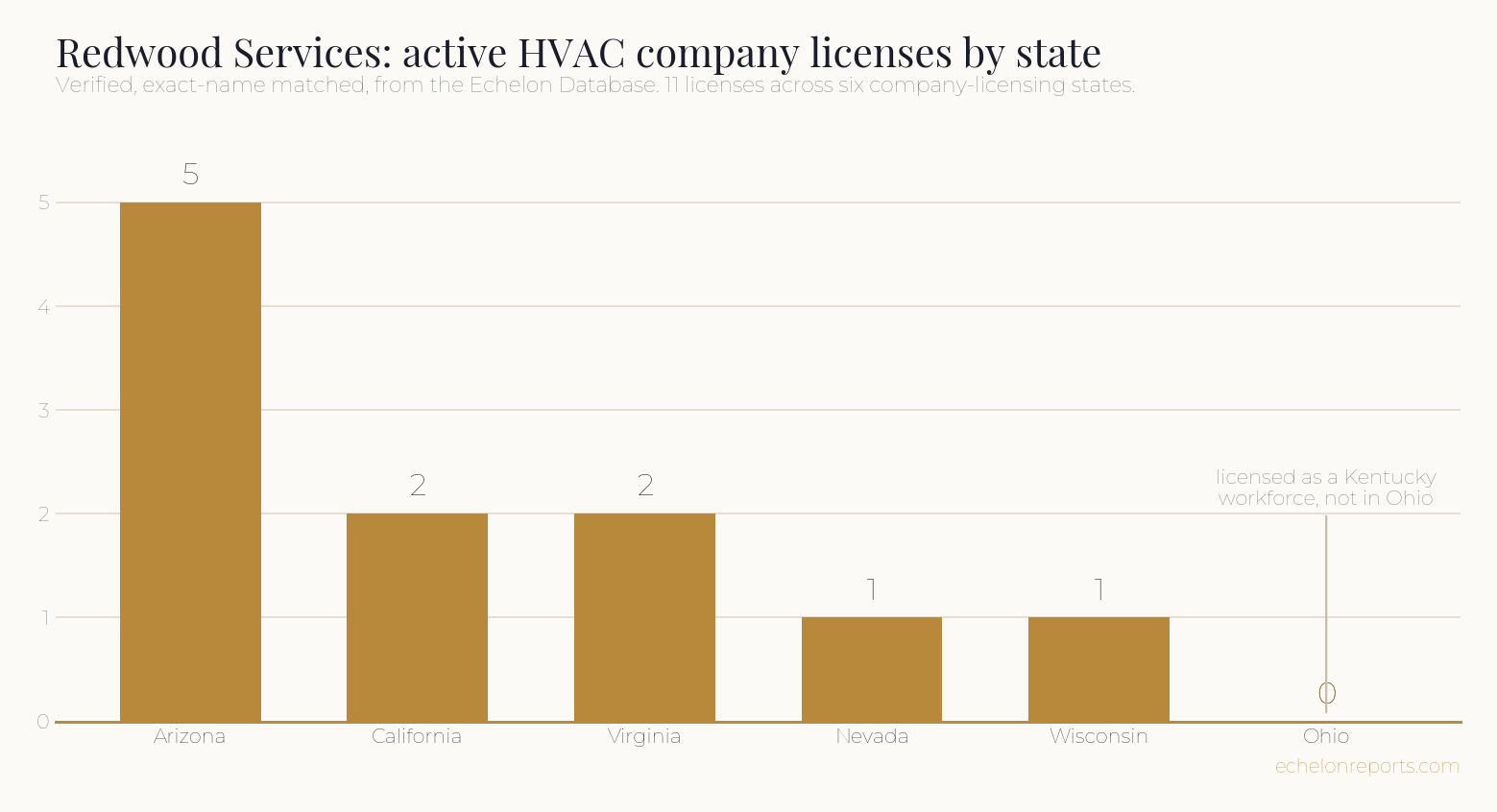
Here is the part no aggregator publishes. A brand list is easy to copy. What is hard, and what actually shows where a platform is dug in, is a count of the licenses each brand holds in each state. The Echelon Database produces that by cross-referencing the Redwood brand map against active state contractor license rosters, then stripping out the common-name collisions where an unrelated local company happens to share a brand’s name, and there were many. Redwood’s footprint runs through states that license in very different ways, which changes what a fair count looks like. Six of the states Echelon tracks, Arizona, California, Nevada, Ohio, Virginia, and Wisconsin, license the contracting company and expose HVAC at the state level, so there we count HVAC company licenses, and the table below is that count. Colorado licenses the company but pushes HVAC to the county level. Kentucky licenses individuals, not companies, so a brand there shows up as a workforce. Each of those, and several other Redwood states, gets its own treatment beneath the table. Every figure is an exact-name match confirmed in the brand’s home state.
| Brand | Market | State | Active HVAC company licenses |
|---|---|---|---|
| Rite Way, Russett Southwest, Pioneer Plumbing | Tucson | Arizona | 5 |
| Allbritten, Tony’s | Fresno, Modesto | California | 2 |
| Sierra Air Conditioning & Plumbing | Las Vegas | Nevada | 1 |
| Cardinal | Madison | Wisconsin | 1 |
| John C. Flood | Washington, D.C. metro | Virginia | 2 |
| Arlinghaus, Apollo | Cincinnati, Akron | Ohio | 0 |
| Total, 6 HVAC company-licensing states | 11 |
What the roster overstates, and the names that fooled the aggregators
The Ohio zero is not a gap, it is the file’s sharpest finding. Redwood lists two Ohio brands, Arlinghaus in the Greater Cincinnati area and Apollo in the Akron area, and neither holds an Ohio HVAC company license under its own name. Arlinghaus sits on the Kentucky side of the Cincinnati metro and licenses there, as a workforce rather than a company, covered in the Kentucky section below. Apollo’s only Ohio match is an unrelated Cincinnati company, Apollo Heating and Air Conditioning Inc, two hundred miles from Redwood’s Akron brand and not connected to it. A brand list counts Ohio as two live HVAC operators. The license data says the state exposes neither as a company, which is the kind of distinction this file exists to catch.
Nevada carried the same trap in reverse. Two Las Vegas companies share the Sierra Air name, both founded in 1987 by the same family. One, Sierra Air Conditioning and Plumbing, is Redwood’s residential-service brand from the Sierra Platform, and it holds the single Nevada HVAC license counted above. The other, Sierra Air Conditioning Inc, is a new-home installer that a competitor, Airtron, acquired in 2025, and Redwood does not buy new-construction businesses. Counting on the name alone would have handed Redwood a rival’s license. The figure above counts only the exact residential entity, which is why Nevada reads one and not two.
Colorado: a company-licensing state where HVAC lives at the county level
Colorado licenses the contracting company as an entity, the way Arizona and Ohio do, but with a structural catch: HVAC is licensed at the county level in Colorado, not by the state, so the state roster does not carry it. What the state does license, and what Echelon captures, is electrical and plumbing contractors. Redwood’s Colorado brand, Brothers Plumbing, Heating & Electric in the Denver metro, holds 2 active state licenses, an electrical contractor credential registered to the Denver operation and a plumbing contractor credential registered under its incorporated name at a Thornton address, with its HVAC footprint sitting in county records the state roster does not reach. Eight other Colorado companies carrying the Brothers name, from Wolking to Kemble to Twin Brothers, were verified out by home city and exact name.
Kentucky: a Cincinnati brand that licenses as a workforce across the river
Arlinghaus is where the Ohio zero resolves. Kentucky licenses individuals, not companies, so a contractor there appears not as one company row but as a bench of credentialed people whose employer is recorded on each license. Arlinghaus, physically in Northern Kentucky and serving the Greater Cincinnati market across the river, shows up exactly that way, and it is a deep bench: one active Master HVAC Contractor license, the credential that legally carries the company’s permits, standing behind 31 active Journeyman HVAC Mechanics and 25 active HVAC Apprentice Registrations. That single Master license nearly matches a competing platform’s entire two-brand Kentucky bench on its own.
| Arlinghaus, Kentucky credentials | Active |
|---|---|
| Master HVAC Contractor | 1 |
| Journeyman HVAC Mechanic | 31 |
| HVAC Apprentice Registration | 25 |
| Total active HVAC credentials | 57 |
Tennessee: a brand present, HVAC not exposed at the state level
Tennessee is a reminder that a state can show a platform present and still not let you count its HVAC. The state licenses general contractors and limited licensed electricians and plumbers, but it does not expose HVAC as a distinct contractor class at the roster level, so an HVAC-first brand can operate with no HVAC company row to find. Redwood runs Best Care Home Services in the Memphis area, in Shelby County, and it holds one active Tennessee license, a general contractor credential under Best Care Home Services LP, with no HVAC-specific record because the state files none. Tennessee therefore enters this file as a market where the brand is licensed and present but whose HVAC footprint the state structure does not record, which is the finding, not a gap in the data.
The rest of the footprint, and what Echelon does not yet count
Three more tracked states carry Redwood brands on structures that need their own handling. Minnesota, home to Dean’s in the Minneapolis area, licenses the entity but exposes HVAC only through a mechanical contractor bond, so the fair count is that proxy: Dean’s, licensed as Deans Professional Plumbing LP out of Brooklyn Center and doing business as Dean’s Home Services, holds one active mechanical contractor bond alongside active plumbing and electrical licenses. Mississippi, home to Environment Masters in Jackson, holds two active state board licenses, one commercial and one residential, but the board files HVAC and plumbing under a single mechanical-work classification, so Echelon confirms the presence and holds any HVAC-specific Mississippi figure until that split is audited rather than publish a number it cannot yet defend. Louisiana, home to Keefe’s, licenses the company but files no trade breakdown, so Keefe’s, registered as Keefe’s Air Conditioning & Heating, LP in Harvey, enters as a confirmed presence without a per-trade count.
Beyond the states above, Redwood operates in markets Echelon does not yet refresh weekly, and this file says so plainly rather than imply coverage it does not have: Huntsville in Alabama, Albuquerque in New Mexico, Wilson and the Charlotte area in North Carolina, Albany in New York, Indianapolis in Indiana, the New Jersey shore, the Boise area in Idaho, and Tulsa in Oklahoma. Several of these sit on licensing structures Echelon is actively building toward, and the North Carolina general-contractor board is next in line. A brand roster counts all of these markets the same. The license data is what tells them apart, and cataloging that difference is the entire point of this file.
One honest note on the counts above, because a number you cannot defend is worth nothing. Each figure reflects the primary state license records for an exact-name match confirmed in the brand’s home state. Where a state holds business-entity records in a separate file, those may raise a total in a future refresh, so treat the printed figures as a verified floor, not a ceiling.
The platform in active build
The clearest way to place Redwood in 2026 is to set it against what its peers did, and when. Over roughly two years, nearly every large national residential-services platform changed hands or recapitalized. Sila moved to Goldman Sachs Alternatives in November 2024. Redwood took its Altas Partners majority in May 2025. Service Logic went to Bain Capital and Mubadala in December 2025. Champions Group agreed to a Blackstone acquisition in February 2026 at a reported 2.5 billion dollars, near 18.5 times earnings. Apex drew a reported 2 billion dollar Apollo investment at a reported 10 billion dollar valuation in May 2026. In that company, Redwood is not the platform running long on the clock. It is one of the most recently recapitalized, and the one adding brands at the fastest visible pace.
Fourteen months into a fresh majority hold, Redwood has bought six brands in 2026 and entered four new states, most of it in a single May platform deal and a July tuck-in. A sponsor that recently took control and is still deploying capital into new markets is accumulating, not harvesting. For the owner deciding whether to answer a Redwood brand’s call, that is the read that matters: this is a buyer with fresh capital and runway, not a platform being dressed for its own sale. We label that read analysis rather than forecast, and we note the counterweight plainly. Sponsors do sometimes move faster than expected, Altas will eventually seek its own liquidity, and a fourteen-month-old hold is not a permanent one. The phase says accumulation today, and phases turn.
That is the double vision this file is built to give you. The analyst reading the cap table sees a young hold and capital still going out the door. The owner reading the trucks sees a buyer that keeps the local name on the door and is adding brands, not trimming them, with a Tucson cluster that tripled this year. Both are true at once. The owner who holds both pictures is the one who understands, before the first meeting, exactly what kind of counterparty is calling and where it stands on its own clock.
Frequently asked questions
Who owns Redwood Services in 2026?
Toronto-based Altas Partners holds the majority, in a transaction that closed in the second quarter of 2025. Union Main Group, the founding backer, remains an investor, and its co-founder Adam Hanover chairs Redwood’s board. There has been no change of control since.
Did SE Capital sell Redwood Services?
No. The direction runs the other way. In May 2026 Redwood acquired the five-company Sierra Platform from SE Capital, so SE Capital was the seller in that deal, not an owner of Redwood. Redwood’s majority owner is Altas Partners. This is also not Redwood Materials, Redwood Trust, or Redwood Software, which are unrelated companies that share the name.
How large is Redwood Services?
The Echelon Database tracks 23 named partner brands across roughly 20 states in residential HVAC, plumbing, and electrical. At the May 2025 Altas investment, when Redwood had 19 partners, it reported more than 500 million dollars in revenue and over 2,500 employees. The Sierra Platform added roughly 100 million dollars in residential revenue and about 400 employees in May 2026.
How many contractor licenses does Redwood Services hold?
Across the states Echelon tracks under weekly refresh where Redwood operates, its brands hold 11 active HVAC company licenses in the six company-licensing states that expose HVAC at the state level: Arizona, California, Nevada, Ohio, Virginia, and Wisconsin. In Colorado, where HVAC is licensed at the county level, its Denver brand Brothers holds 2 active state licenses in electrical and plumbing. In Kentucky, its Cincinnati-market brand Arlinghaus operates on 57 active individual HVAC credentials, one Master, 31 journeyman, and 25 apprentice, rather than a company license. Ohio’s company count is zero, which is a finding rather than a gap: neither Ohio brand licenses in Ohio under its own name. Other Redwood states license on different structures and are treated individually in the file above. The figures reflect primary state license records and are a verified floor.
Is Redwood Services still acquiring companies?
Yes. Redwood added six brands in 2026 alone, the five-company Sierra Platform in May and Hendrick Heat, Air and Plumbing in Tulsa in July, and entered four new states in the process. It is roughly fourteen months into a fresh majority-ownership hold under Altas Partners. On our read that places Redwood in an accumulation phase, an active buyer rather than a seller. We present that as analysis, not prediction.
Does the business survive the sale or transfer?
The Quality of License Report is the government-records counterpart to a Quality of Earnings: license integrity, qualifier risk, entity standing, liens, litigation, and regulatory record on a single acquisition target.
See the Quality of License ReportIf a Redwood brand, or any platform, is circling your market, the questions that decide your outcome are what they pay, how they treat the owners they buy, and where they sit on their ownership clock. Echelon reads these platforms for a living, from the same data behind this file. Tell us where you stand, in confidence, and we will help you read the platform before you answer.
Platform File: Wrench Group
The Great Trades Roll-Up: why Wall Street buys some trades and walks past others
Why private equity is buying HVAC companies in Ohio
The one number that decides what your trades business is worth
Methodology and sources. The corporate snapshot and partner roster are drawn from Redwood Services’ own materials and partner listings. The ownership timeline is assembled from sponsor and company announcements and M&A trade press, and the direction of the Sierra Platform transaction, Redwood as buyer and SE Capital as seller, was confirmed against the deal announcements after the two names travel together in coverage. The license footprint is produced by the Echelon Database, which cross-references a maintained platform-ownership map against active state license rosters in the states Echelon currently tracks, then resolves each brand to its exact licensed entity by hand. Where a state licenses the contracting company as an entity and exposes HVAC, Arizona, California, Nevada, Ohio, Virginia, and Wisconsin, Echelon counts active HVAC company licenses. Colorado licenses the company but licenses HVAC at the county level, so only its state-level electrical and plumbing licenses are counted. Kentucky licenses individuals rather than companies, so a brand there is counted as its active HVAC credential bench, master, journeyman, and apprentice, rolled up to the employer of record. Tennessee does not expose HVAC as a state contractor class, and its brand is reported on the general contractor license it holds. Mississippi files HVAC and plumbing under a single mechanical-work classification, so its presence is confirmed but no Mississippi HVAC figure is published until that split is audited. Common-name collisions are removed through home-state, county, and exact-name verification, which in this file meant excluding, among others, a Cincinnati company sharing the Apollo name, a Las Vegas new-construction installer sharing the Sierra Air name and now owned by a competitor, and eight Colorado companies carrying the Brothers name. Printed figures reflect primary state license records and are presented as a verified floor. Peer transaction values and multiples are from public announcements and M&A trade press and are presented as reported figures. The platform-phase read is labeled analysis, not prediction. Echelon takes no position on the merits of any transaction referenced.