
Platform File: American Operator
American Operator finances its acquisitions the way few private buyers do, as registered securities offerings, and that single choice makes its deal history readable in public, one filing at a time. For an owner weighing a call from a buyer that promises to keep the name on the door, and for anyone trying to size a company that has changed names twice in three years, that public trail is the difference between a marketing story and a verifiable record. This file assembles it.
The short answer: American Operator, legally American Operator Holdings Co., is an Austin, Texas acquirer that buys small businesses from retiring owners and installs a vetted operator who earns majority ownership over time, a model it calls operate-to-own. It was known as Mainshares until December 2025, and as Beacon Business Brokerage before that, and it reports more than 97 transactions across that history. It is backed by the venture firm 8VC, whose founder Joe Lonsdale sits on the board, alongside Gallery Ventures and Nomad Ventures. Its target is businesses of two to seven million dollars in home services, B2B services, value-add distribution, and light manufacturing. Its acquisitions have been financed as Regulation D securities offerings, which the Echelon Database traced through SEC filings: nine offerings raising roughly 8.3 million dollars from August 2024 through January 2026, three of them resolved to named operating businesses in painting, plumbing, and metal fabrication. Its own broker-dealer, Main Street Securities, wound down in late 2025 as the company shifted toward balance-sheet funding and a stated long-term goal of a retail public offering. On our read, American Operator is early in its build and actively buying, an accumulator rather than a seller. We label that analysis, not prediction.
Who owns American Operator, and how it got here
The operate-to-own model, and what it buys
The deal record, read from public filings
Where American Operator sits
Frequently asked questions
- American Operator, formerly Mainshares and before that Beacon Business Brokerage, is an Austin operate-to-own acquirer that buys small businesses from retiring owners and hands majority ownership to a local operator over time. Will Fry is founder and chief executive; Michael Friedman is chief financial officer.
- It is venture-backed, not private-equity-backed: 8VC, Gallery Ventures, and Nomad Ventures, with 8VC founder Joe Lonsdale on the board. It positions itself explicitly against private-equity roll-ups.
- Its buy-box is two to seven million dollars in home services, B2B services, value-add distribution, and light manufacturing, 10 or more years in operation, continental U.S., low customer concentration, and minimal project-based revenue, a clear preference for recurring-revenue businesses.
- Its acquisitions are financed as Regulation D securities offerings. The Echelon Database traced nine offerings raising roughly 8.3 million dollars from August 2024 through January 2026, in two eras: broker-intermediated deals through its affiliate Main Street Securities, then issuer-direct syndications after that broker-dealer wound down in late 2025.
- Three operating businesses are independently confirmed: Greenway Painting in Jackson, Mississippi; the Crawl Pros and Plumber Pros plumbing operation in Tacoma, Washington; and FabTek in Gallman, Mississippi. American Operator separately announced Anne the Plumber in Rhode Island in early 2026.
- Its broker-dealer, Main Street Securities, held a clean regulatory record and deregistered in November 2025 as the company moved to balance-sheet funding. It has stated a long-term goal of a retail public offering it calls “America’s small business stock.” The public filing trail captures its syndicated deals and is a floor, not a full count, because balance-sheet purchases leave no securities filing.
- On our read, American Operator is early in its build and visibly still buying, an accumulator rather than a seller. We present that as analysis, not prediction.
American Operator is a new kind of entrant in the great trades roll-up, and a deliberately contrarian one. Where the private-equity platforms consolidate the trades into regional and national brands, American Operator pitches the opposite: local ownership preserved, transferred to an operator, and funded eventually by everyday retail investors. A file useful to an owner it might approach, or a competitor sizing it up, has to do three things a marketing page will not. It has to get the ownership and name history exactly right, since the company has rebranded twice. It has to read the deal record from primary filings rather than press releases. And it has to place the company on its own clock. Here is all three.
Who owns American Operator, and how it got here
American Operator was founded and is led by Will Fry, a Wharton economics graduate whose earlier career ran through software and finance before he built the brokerage and broker-dealer businesses that became the company. The corporate history runs through three names. It began as Beacon Business Brokerage, a business brokerage. It became Mainshares, a broker-dealer-backed marketplace that connected a network of more than 1,300 accredited investors with small-business acquisition deals. And in December 2025 it rebranded to American Operator, marking the shift from a marketplace that arranged other people’s deals to a principal that acquires businesses itself alongside its operators. Michael Friedman serves as chief financial officer, Jackie Sheely leads operations and legal, and Judd Goodrich leads capital markets and business development.
The backing is venture, not private equity, and it is heavier than the company’s Main Street framing suggests. Its investors include 8VC, Gallery Ventures, and Nomad Ventures, and 8VC’s founder Joe Lonsdale, a co-founder of Palantir, Addepar, and OpenGov, sits on the board alongside venture investor Baris Akis. Each acquisition also seats an industry veteran as an advisor on that company’s board, drawn from a bench organized by vertical across home services, distribution, manufacturing, landscaping, and general contracting.
The rebrand is visible in the regulatory record, and it matters for reading the company’s phase. American Operator’s broker-dealer affiliate, Main Street Securities LLC, carried a clean FINRA record with no disclosure events. It ceased business in September 2025 and its FINRA registration was withdrawn in November 2025, the same window as the American Operator rename. From late 2025 the company’s acquisition financings appear as issuer-direct offerings rather than broker-intermediated ones, and its own broker materials state that it now funds acquisitions from its balance sheet with committed capital. One note for anyone researching the name cold: this Main Street Securities, tied to American Operator, is a distinct firm from other unrelated broker-dealers that share the name, and the company itself is not Redwood, Wrench, or any of the private-equity trades platforms it defines itself against.
The operate-to-own model, and what it buys
American Operator acquires an established small business whose owner is ready to retire, and pairs it with a seasoned industry operator who runs it as chief executive and buys the company back over time until they hold the majority. The firm supplies the capital, an Owner Success support team, an industry advisor on the board, and a certain, all-cash close. The pitch to a retiring owner is continuity: the business keeps its name, its staff, and its place in the community, rather than being folded into a larger fund’s portfolio. The company frames this explicitly against private-equity consolidation, arguing that large PE-backed firms buy up Main Street for bolt-on acquisitions and platform plays while cutting staff and raising prices.
Its stated acquisition criteria are specific, and they tell you more than the mission language does. It targets businesses of two to seven million dollars in total enterprise value, across home services, B2B services, value-add distribution, and light manufacturing, typically with 10 or more years in operation, anywhere in the continental United States. It prefers companies with less than 20 percent customer concentration and minimal project-based revenue, which is a clear signal that it favors recurring, repeat-customer businesses over lumpy, one-off project work. Its stated disqualifiers include heavy owner dependence, off-books labor, declining revenue, outstanding legal or compliance issues, and more than three key people departing after the sale. In practice, its confirmed deals cluster in exactly those recurring-revenue categories: residential painting and plumbing, and industrial fabrication.
The deal record, read from public filings
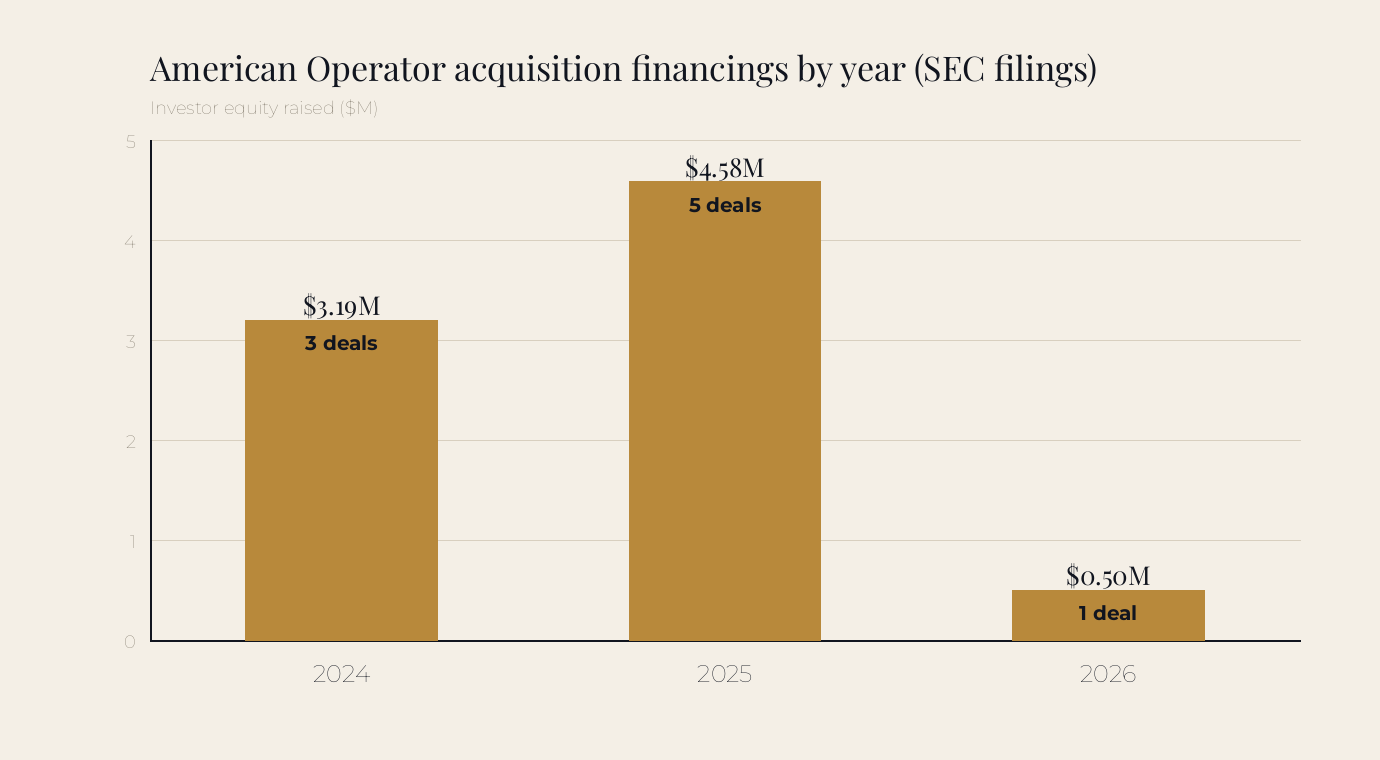
Here is the part no aggregator publishes. Because American Operator’s acquisitions have been financed as securities offerings, they surface as Regulation D exempt-offering notices filed with the SEC by per-deal entities. Read in sequence, those filings are a running ledger of the firm’s cadence. The Echelon Database identified and reviewed the filings tied to the company and its Mainshares and Main Street Securities lineage, verified each against the company’s Austin address and its broker-dealer identifier, and set aside the same-named strangers that a keyword search pulls in. What remains is a clear two-era pattern and roughly 8.3 million dollars in investor equity across nine offerings from August 2024 through January 2026.
In the first era, through mid-2025, six offerings were placed with Main Street Securities as broker, each filed under the target’s own holding-company name.
| First sale | Filed as | Sector | Raised | Investors |
|---|---|---|---|---|
| Aug 2024 | Point B Communications Corp | Communications | $370,000 | 6 |
| Sep 2024 | Junction Creative Corp | Creative services | $300,000 | 4 |
| Dec 2024 | Fabtek Investments LLC | Metal fabrication | $2,525,000 | 10 |
| Feb 2025 | Nash Holdings, LLC | Retail | $1,353,000 | 6 |
| Aug 2025 | Bloom & Tusk Collective LLC | Technology | $1,353,625 | 9 |
| Aug 2025 | Claymont Equity Holdings LLC | Holding company | $1,000,000 | 10 |
In the second era, from late 2025, after the broker-dealer wound down, the offerings shift to self-syndicated vehicles under the Mainshares Syndicate name, with no broker, each codenamed after its operator.
| First sale | Filed as | Operator | Raised | Investors |
|---|---|---|---|---|
| Oct 2025 | Mainshares Syndicate (Project Memento) | Pitts | $300,000 | 9 |
| Oct 2025 | Mainshares Syndicate (Project Paint) | Anthony Douglas | $575,000 | 15 |
| Jan 2026 | Mainshares Syndicate (Project Boil) | J. Feinerman | $500,000 | 13 |
| Total, nine offerings, Aug 2024 to Jan 2026 | ~$8.3M |
The businesses behind the filings
A filing names a vehicle, not always a business. Three of the operating companies behind these offerings are independently confirmed. Greenway Painting, a residential painting company in Jackson, Mississippi, was taken over in October 2025 by operator Anthony Douglas, a former U.S. Air Force combat controller; it is the deal American Operator features publicly. The Crawl Pros and Plumber Pros home-services operation in the Tacoma and greater Seattle area of Washington, led by Joshua Feinerman, sits behind the January 2026 offering, and Washington licensing records show its plumbing license activating that March, shortly after the raise. And FabTek, a power-and-utility metal fabricator in Gallman, Mississippi that has scaled aggressively since 2024, is tied to the December 2024 offering whose named officer is James Bodnar. The remaining filings are reported as filed; their operating businesses are not independently confirmed here.
One honest limit on the record above, because a number you cannot defend is worth nothing. American Operator states that it now funds acquisitions from its balance sheet with committed capital, and a balance-sheet purchase is not a securities offering, so it leaves no Regulation D filing. Its February 2026 partnership with Anne the Plumber, a residential plumbing company in Rhode Island led by operator Wilson Molina, does not appear in the securities trail under the same lineage, consistent with that shift. The nine offerings are therefore a verified floor on the company’s syndicated activity, not a complete count of everything it owns. An offering is reported here as an offering, and is identified with an operating business only where that business is independently confirmed.
Where American Operator sits
American Operator’s stated long-term goal is unusual: a public offering that lets ordinary retail investors, rather than large Wall Street firms, fund its acquisitions and own a stake in its portfolio, an idea it calls building “America’s small business stock.” The company frames retail investors not only as a funding source but as a distributed network for spotting local businesses in need of a successor. As of mid-2026 this remains a stated ambition rather than a live, qualified public offering, and the company retired its own registered broker-dealer in late 2025, so the regulated distribution such an offering would require is a piece still to be built or partnered for. That gap between the ambition and the machinery is the single most important thing to watch on this company.
The clearest way to place American Operator is to set it against the market it is entering. Small businesses in the trades are being consolidated on two clocks at once. Private-equity platforms buy dozens of shops a year at scale and roll them into regional and national brands, a pattern visible from private equity buying HVAC in Ohio to the largest national roll-ups profiled elsewhere in this series, including Redwood Services and Wrench Group. American Operator is betting that a slower, operator-led, community-branded model can win the same retiring owners, and that everyday investors will fund it. Its realized deals so far are small, from a few hundred thousand to a few million dollars of equity each, and skew to recurring-revenue home services and light manufacturing rather than the large regional platforms the private-equity buyers assemble.
Fourteen months into its rebrand, backed by fresh venture capital and visibly still filing new deals, American Operator reads as a company in an accumulation phase, an active buyer rather than one being dressed for a sale. For an owner deciding whether to answer its call, that is the read that matters: this is a young, well-capitalized buyer with a distinctive promise to keep the local name in place, still early enough that its retail-ownership endgame is unproven. We label that read analysis rather than forecast, and we note the counterweight plainly. The retail public offering may not arrive on the timeline the branding implies, venture backers eventually seek their own liquidity, and a company that has rebranded twice in three years may not wear its current shape permanently. The phase says accumulation today, and phases turn.
Frequently asked questions
Who owns American Operator?
American Operator Holdings Co. is a private, venture-backed company founded and led by Will Fry. Its investors include 8VC, Gallery Ventures, and Nomad Ventures, and 8VC founder Joe Lonsdale sits on its board. Michael Friedman is chief financial officer.
What was American Operator called before?
It operated as Mainshares until December 2025, and as Beacon Business Brokerage before that. The reported figure of more than 97 transactions spans that earlier marketplace history as well as the newer balance-sheet acquisitions.
Is American Operator a private equity firm?
Not in the conventional sense. It is a venture-backed acquirer that uses an operate-to-own model, buying a business and transferring majority ownership to a local operator over time, and it positions itself explicitly against private-equity roll-ups.
What does American Operator buy?
Established small businesses worth two to seven million dollars in home services, B2B services, value-add distribution, and light manufacturing, typically with 10 or more years in operation, across the continental United States, favoring recurring-revenue companies with low customer concentration and minimal project-based revenue.
Which businesses has American Operator acquired?
Confirmed operating businesses include Greenway Painting in Jackson, Mississippi, the Crawl Pros and Plumber Pros home-services operation in Tacoma, Washington, FabTek in Gallman, Mississippi, and Anne the Plumber in Rhode Island. The Echelon Database traced nine securities offerings totaling roughly 8.3 million dollars from August 2024 through January 2026, and the figures are a verified floor.
How does American Operator fund its acquisitions?
Historically through Regulation D securities offerings, brokered through its affiliate Main Street Securities and later self-syndicated. That broker-dealer wound down in late 2025, and the company states it now funds acquisitions from its balance sheet with committed capital, with a stated long-term goal of a retail public offering.
If American Operator, or any acquirer, is circling your business, the questions that decide your outcome are what they pay, how they treat the owners they buy, and where they sit on their own clock. Echelon reads these buyers for a living, from the same data and filings behind this file. Tell us where you stand, in confidence, and we will help you read the buyer before you answer.
Does the business survive the sale or transfer?
The Quality of License Report is the government-records counterpart to a Quality of Earnings: license integrity, qualifier risk, entity standing, liens, litigation, and regulatory record on a single acquisition target.
See the Quality of License ReportPlatform File: Redwood Services
Platform File: Wrench Group
The Great Trades Roll-Up: why Wall Street buys some trades and walks past others
The one number that decides what your trades business is worth
Methodology and sources. The corporate snapshot, model, and buy-box are drawn from American Operator’s own materials and from its Mainshares and Beacon lineage. The ownership and rebrand timeline, and the status of the Main Street Securities broker-dealer, are assembled from company announcements and FINRA BrokerCheck. The deal record is produced by the Echelon Database, which identified the company’s Regulation D filings on SEC EDGAR, parsed each Form D for issuer, amount, investor count, and date, and verified each against American Operator’s Austin address, its broker-dealer identifier, or a named principal before counting, setting aside unrelated same-named issuers. Three operating businesses were resolved to their filings through the company’s announcements and state contractor-licensing records; the remaining issuers are reported as filed. Because American Operator also funds acquisitions from its balance sheet, which leaves no securities filing, the nine offerings are presented as a verified floor on syndicated activity, not a complete portfolio count. The platform-phase read is labeled analysis, not prediction. Echelon takes no position on the merits of any transaction referenced.