
Issue 002 · Week of July 6, 2026
The Mix Shifts
1 · The Number
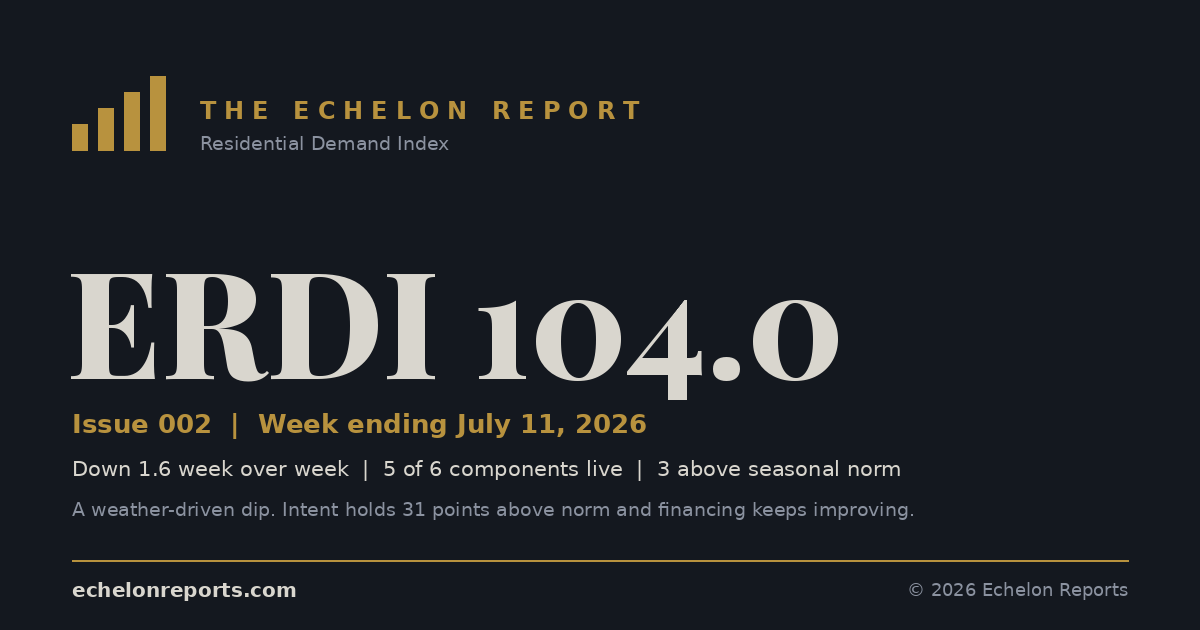
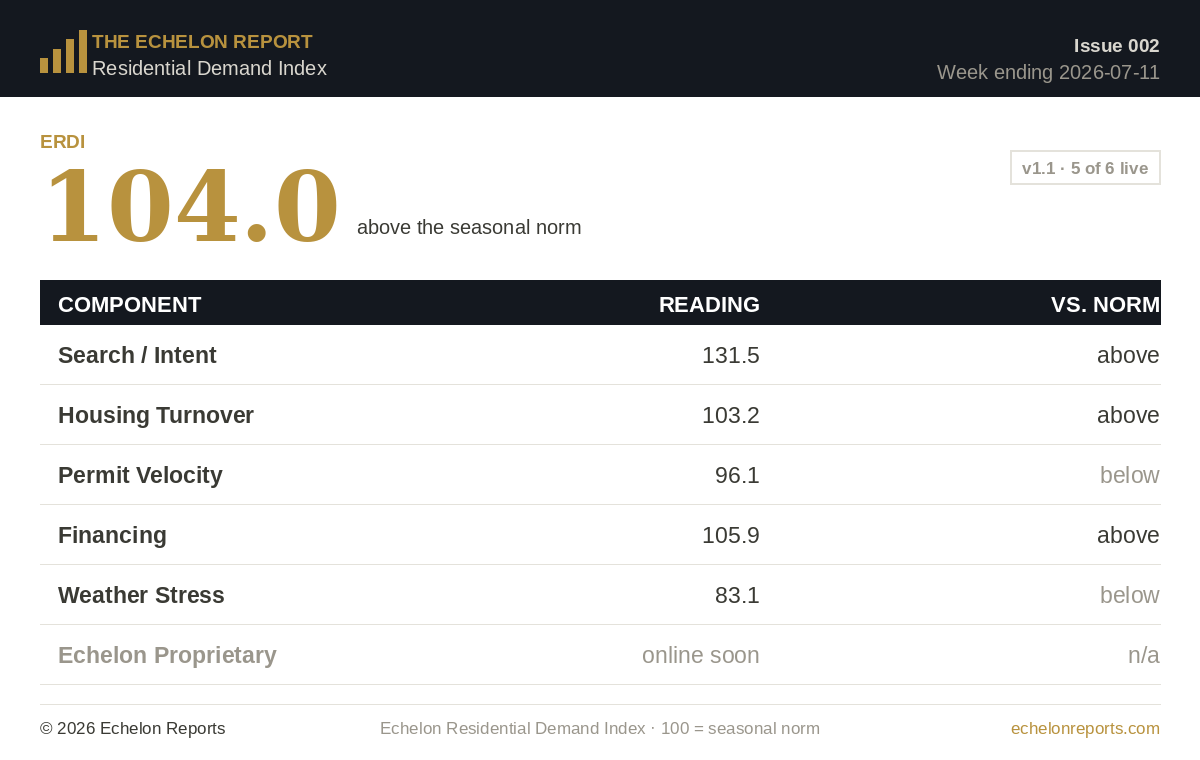
104.0
down 1.6 on the week, still above the seasonal norm
v1.1 · 5 of 6 live
Residential trades demand is running about 4 percent above its seasonal norm, with three of the five live components above baseline. The 1.6-point decline from last week’s 105.6 is the index’s first week-over-week move, and it is a weather story rather than a demand story: a mild holiday week across most of the country pulled weather stress down 8.2 points, taking the emergency-call pressure out of the composite. Strip that away and the underlying demand held. Homeowner search for trades work eased slightly but still runs nearly a third above its recent norm, financing improved again as rates drifted to 6.43 percent, and turnover held at its firmest reading in months. Two weeks of history: 105.6, then 104.0. The four-week trend begins compounding from here.
| Component | Reading | WoW | vs. seasonal norm |
|---|---|---|---|
| Search / Intent | 131.5 | -1.4 | above |
| Housing Turnover | 103.2 | 0.0 | above |
| Permit Velocity | 96.1 | 0.0 | below |
| Financing | 105.9 | +1.4 | above |
| Weather Stress | 83.1 | -8.2 | below |
| Echelon Proprietary | in calibration | — | — |
Readings are indexed so that 100 equals the seasonal norm. Search and weather are measured against their own recent baselines; financing, turnover, and permits against the same period in prior years.
2 · National Pulse
Last week both engines were running. This week the weather engine idled and showed us something useful: what demand looks like when nothing is forcing it.
The heat took the holiday off. Weather stress fell 8.2 points to 83.1, well under its seasonal norm, as the July 4 week ran even milder across the interior than late June did. The reading is built from NOAA station records, so it measures the load the weather actually put on homes, not the forecast. Fewer failed condensers, fewer no-cool emergencies, less of the work that does not wait. That single component accounts for essentially all of this week’s decline in the composite.
Search barely blinked. With the emergency pressure off, homeowner search for trades work still held at 131.5, nearly a third above its recent norm. That is the tell. When intent stays elevated in a mild week, the demand is planned, not panicked. People are researching jobs they have decided to do, not reacting to a dead system.
Rates kept drifting the right way. The 30-year fixed eased to 6.43 percent from 6.49 last week, against 6.81 a year ago. Every step down widens the pool of homeowners who can finance a replacement system, a bathroom, a roof. Financing is now the quietest and steadiest tailwind in the index.
Turnover and permits held their split. Existing-home turnover held at its firmest level in months while permits stayed below norm on monthly data. Same message as last week, now with a second confirming reading: the activity is in the existing housing stock, in service, replacement, and resale-driven work, not in new construction.
The read for an operator: the mix is shifting from break-fix to booked. A week like this rings the phone less, but the callers who do ring researched you first, can finance the job, and are worth more over the life of the relationship. Capture weeks and convert weeks are different disciplines. This was a convert week.
3 · Regional Spotlight: Midwest-East
OH, IN, MI, KY (regional sub-index online soon)
The home region stayed temperate through the holiday week, which is a large part of why national weather stress sits so far under norm. The work here continues to lean on the firming resale market rather than emergency cooling, and the Midwest turnover strength that led the country this spring carried into this week’s reading.
The sharper story is underneath the demand. The Echelon license engine now reads Ohio’s full state roster every week: 10,650 active credentials across 3,514 electrical, 2,762 plumbing, 2,654 HVAC, 884 hydronics, and 702 refrigeration licenses, with 211 more parked in escrow or unassigned status. That escrow pool is one of the most underwatched transition indicators in the trades, because licenses do not go to escrow for no reason. Owners park them when they wind down, sell, or restructure. And this week the roster produced exactly that kind of movement: an owner-held electrical license in Franklin County moved to escrow overnight. The full signal, with names and our read, runs in the first issue of the Echelon Deal Ledger. For the map of who is buying Ohio operators and what they pay, see our owner’s guide to private equity in Ohio HVAC. And owners watching moves like this while weighing their own timing can see what a sale actually involves in our guide to selling an electrical business.
4 · The Deal Desk
Two developments from our own desk this week, both built for the buy side.
The platform ownership map came online. Brand-level ownership attribution is now confirmed in the Echelon database across the Wrench Group, Redwood Services, and Trades Holding Company portfolios, from Phoenix to Tampa to Indianapolis to Columbus. The Apex Service Partners portfolio, the largest brand set in residential services at more than 100 names, enters the map next. This is the layer that lets our diff engine flag the week an independent stops being independent, instead of the quarter the press release lands. How these platforms assemble, and why the math forces them to keep buying, is covered in our guide to the trades roll-up.
The Deal Ledger launched. Last issue we wrote that Sila planting a flag in Ohio was the story. This issue we start publishing the paper trail that precedes stories like it. The Echelon Deal Ledger is a weekly pre-announcement signal brief built from license migrations, escrow events, entries and exits, and platform ownership changes, and Issue 001 opens with a live qualifier-to-escrow signal caught within the engine’s first tracking window. Private Deal Ledger coverage monitors five defined markets for $500 per month and begins with an application. Details here.
5 · The Operator’s Edge
One move this week: sell furnaces in July.
The search movers produced a genuine anomaly. Furnace repair jumped 14.8 points to a peak reading in the first week of July, the wrong season by every instinct in the trade. Off-season furnace interest at that level means homeowners researching replacements while the system sits idle, which is exactly when shoulder-season replacement work gets booked, at full margin, on your schedule instead of a February emergency’s. Water heater replacement is up 9.5 and AC repair up 7.5, both in season. The soft end is discretionary: window replacement fell 16.2 and kitchen remodel slipped 3.0. Put a furnace replacement offer in front of your list this week while your competitors are still staring at condensers, and lean the marketing budget toward urgent trades over discretionary remodel work until those categories turn.
6 · Strategic Lens: Revenue Quality
The most useful way to read a week like this is revenue quality. An index held up by weather is an index built on emergency calls, and emergency revenue evaporates the day the weather turns. An index held up by intent and financing, which is what 104.0 is this week, is demand that customers planned, researched, and can afford. Two contractors can post identical trailing revenue and be carrying entirely different books: one is a break-fix machine that lives and dies by the thermometer, the other holds a base of booked, financed, relationship work that compounds.
Operators should know which one they are, because the second kind commands the premium when the platforms come calling. Buyers should ask the question in every diligence meeting, because the trailing twelve months will not tell you. The weather will not stay mild, and when the heat broadens the composite will likely climb again. The book you built underneath it is what you keep.
7 · The Watch
Whether the furnace-repair search anomaly holds a second week or fades as a one-week blip. If it holds, it is a genuine early-replacement wave worth a campaign, not just a curiosity.
Whether July heat broadens beyond the coasts and snaps weather stress back toward norm, which would put upward pressure on the composite and restart the both-engines stretch we flagged last issue.
The rate drift. 6.49 last week, 6.43 this week. The NAR’s 6 percent line, the level it flags as the trigger for a fresh wave of transaction-driven replacement work, is now inside view if the drift continues.
And Franklin County. An owner-held electrical license moved to escrow this week, and the disposition of that license will tell us how the transition resolves. The Ledger is watching, along with the 211-credential escrow pool behind it.
The Echelon Report is the weekly residential-trades intelligence brief from Echelon Reports. Built on the Echelon database and the Echelon Residential Demand Index.
See where your own market and competitors stand with an Echelon Intelligence Report, read how ERDI is built, get the weekly deal signals in the Echelon Deal Ledger, or browse every issue of The Echelon Report.
Mike Warner · linkedin.com/in/jmichaelwarner