Water distribution construction jobs involve installing and replacing the mains that carry drinking water through a community and the service lines that connect properties to those mains. Contractor crews perform pipe installation, excavation and restoration, with different responsibilities for laborers, pipelayers and equipment operators.[2][3][6]
For an experienced pipelayer, C.J. Hughes advertises water-division positions in Martinsburg, West Virginia, and Louisville, Kentucky, at $19.86 to $24.28 an hour.[2][12] Garney lists underground-pipe roles in North Carolina and Tennessee with different experience requirements.[14][15] Start with the work you can perform, then compare the location, pay and travel terms before applying.
Find a role that fits
Use the experience guide and employer listings to choose a relevant application. Check the full description for screening, physical requirements and current terms.
Compare employer listingsHiring a water crew?
Describe the work location, wage range, required experience and travel arrangements so applicants can assess the opening.
Post a free trades jobMatch the opening to your experience
Job titles alone do not tell you how much training an employer expects to provide. The selected Garney pipelayer description asks for two years installing large-diameter pipe, while C.J. Hughes asks its lead-operator applicants for three years of lead-operator experience laying water mains.[13][14] These are employer-specific requirements, not an industry-wide career ladder.
| Your starting point | Opening to inspect | What to check |
|---|---|---|
| New to construction | Garney laborer, Saint Joseph, Missouri.[16] | Explicitly entry-level, starting at $20 an hour. Reliable transportation and willingness to complete employer-provided training are required. Confirm the project assignment. |
| Experienced pipelayer | C.J. Hughes in West Virginia or Kentucky; Garney in North Carolina.[2][12][14] | C.J. Hughes asks for prior pipelaying experience. Garney specifies two years installing large-diameter water, sewer or storm-drain pipe. |
| Experienced water-main operator | C.J. Hughes, Gallipolis, Ohio.[13] | At least three years as a lead operator laying water mains, plus trench-box experience. |
| Experienced underground-pipe worker seeking a lead role | Garney, Pigeon Forge, Tennessee.[15] | Four or more years of underground-utility or pipelaying experience; one year in a lead or advanced role preferred. |
Water-construction employer listings
The following descriptions were checked on October 29, 2026. Follow each employer’s application link for the full terms. The listings identify possible applications, not confirmed unfilled positions or assignments to the municipal projects discussed later.
| Employer and application link | Location and advertised pay | Requirements and travel questions |
|---|---|---|
| Garney: entry-level laborer, requisition 13662[16] | Saint Joseph, Missouri. Starting at $20 an hour, paid weekly. | Entry-level construction role; basic tool skills and reliable transportation. OSHA 10 and fall-protection training provided. Overtime willingness required. Specific water-main assignment, travel, CDL and per diem terms are not stated. |
| C.J. Hughes: pipelayer, listing 725733[2] | Martinsburg, West Virginia. $19.86 to $24.28 an hour. | Prior pipelaying experience; driver’s license and reliable transportation. Water-division role. Travel as needed; expected 40 to 50 hours a week. Per diem is not stated. |
| C.J. Hughes: pipelayer, listing 725737[12] | Louisville, Kentucky. $19.86 to $24.28 an hour. | Separate location listing with the same water-division role and experience requirements. Travel as needed; expected 40 to 50 hours a week. Per diem is not stated. |
| C.J. Hughes: heavy equipment operator PSD, listing 725734[13] | Gallipolis, Ohio. Displays $25.02 to $35.10 but does not identify the pay interval. Confirm it with the employer. | Lead-operator duties; at least three years laying water mains in that role and experience digging in trench boxes. CDL preferred. Travel required; typical weeks of 40 to 60 hours. Per diem is not stated. |
| Garney: pipelayer, requisition 11143[14] | Asheboro and Apex, North Carolina, on one requisition. Pay is not disclosed. | Two years installing large-diameter water, sewer or storm-drain pipe. Willingness to complete listed training, travel and work overtime. Mixed utility scope. CDL and per diem terms are not stated. |
| Garney: lead pipelayer, requisition 13086[15] | Pigeon Forge, Tennessee. Pay is not disclosed. | Four or more years of underground-utility or pipelaying experience required; one year in a lead or advanced role preferred. Water, sewer and storm-drainage work. Travel, CDL and per diem terms are not stated. |
C.J. Hughes describes installing PVC and ductile-iron pipe, preparing trenches, checking alignment and grade, testing joints, backfilling and compaction. Its pipelayer positions ask for prior experience, a valid driver’s license and reliable transportation.[2][12] An application that identifies those tasks gives the employer more useful information than a general claim of construction experience.
Garney’s North Carolina requisition covers water, sewer and storm-drain pipe, rather than drinking-water work alone. It names rigging and signaling, confined-space training and OSHA 10 among the training applicants must be willing to complete.[14] Check the actual assignment with the employer if you want to work specifically on water mains.
Entry-level and service-line replacement routes
An entry-level application in Missouri
Garney describes its Saint Joseph laborer position as entry-level, with weekly pay starting at $20 an hour and an opportunity for overtime. Tasks include handling materials, operating tools and helping with concrete and excavation-related work. Applicants must have reliable transportation and be willing to complete OSHA 10 and fall-protection training provided by Garney.[16]
The listing does not require prior pipelaying experience, but it does require basic tool skills and the ability to work on your feet throughout the day.[16] It is a construction entry route, not a promise of immediate pipe-installation training. Ask which project the crew serves before treating it as a water-main assignment.
Looking specifically for lead service line replacement?
We did not verify a field-crew opening explicitly assigned to lead service line replacement in this review. The selected water-main and underground-pipe roles should not be read as service-line replacement jobs. Use municipal contractor lists, such as South Milwaukee’s, to identify firms, then check their current listings for the exact work and location.[5]
The Department of Labor’s Apprenticeship Job Finder provides another way to search by occupation and location. When no suitable opening appears, its Partner Finder can identify organizations to ask about upcoming intake.[11] Ask the sponsor whether its work includes water-utility construction, what the selection process requires and when applications are accepted.
Compare pay, hours and travel before accepting
The Martinsburg and Louisville pipelayer listings state an hourly range. C.J. Hughes’s Gallipolis equipment-operator listing displays $25.02 to $35.10 without identifying the pay interval, so that figure needs clarification before comparing offers.[2][12][13] The Garney descriptions reviewed do not disclose a wage range.[14][15]
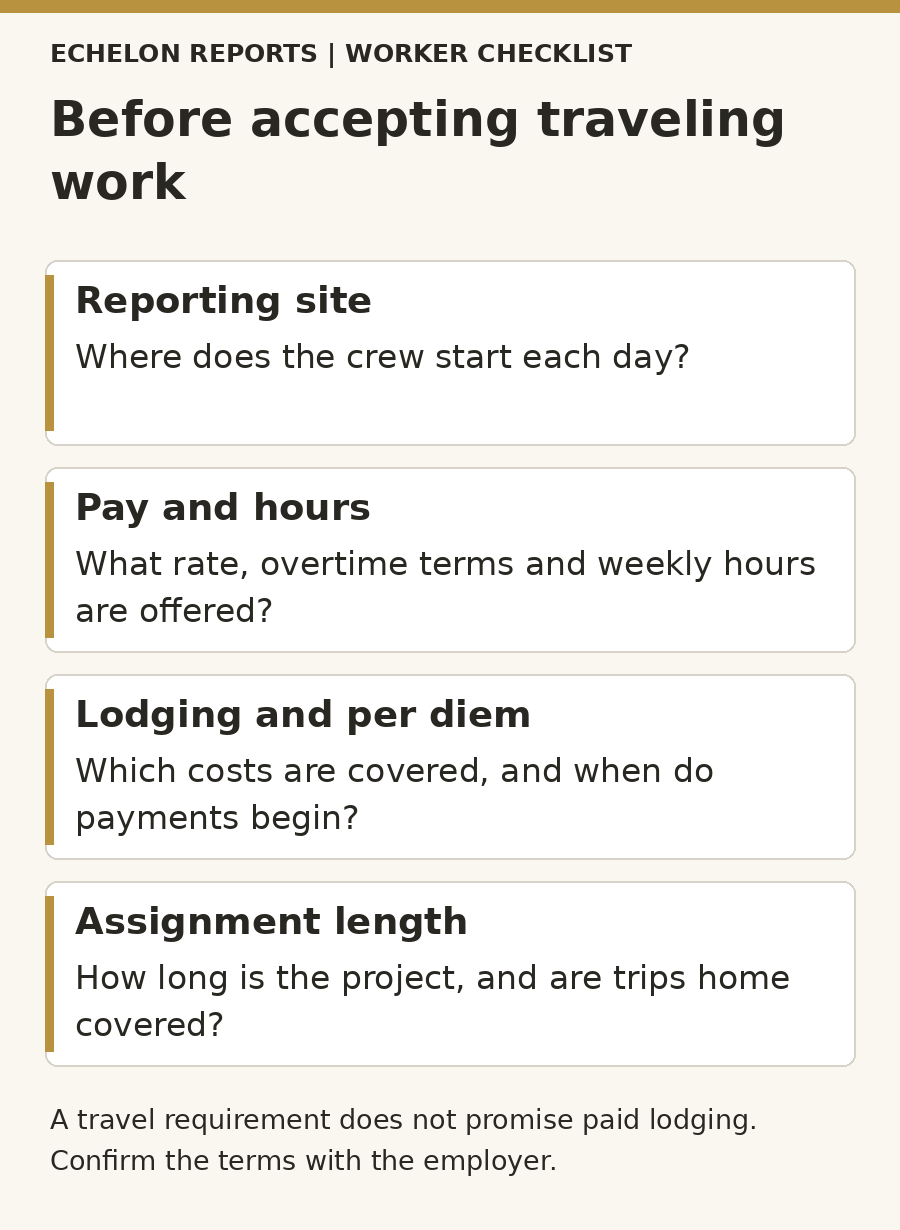
A travel requirement and a travel allowance are different terms. The selected C.J. Hughes descriptions require travel as needed, while Garney’s North Carolina role requires willingness to travel and work overtime.[2][13][14] Those statements do not specify a per-diem amount or promise employer-paid lodging.
Before committing to an assignment, settle these questions:
- Where does the crew report, and does that location change between projects?
- What are the base rate, overtime terms and expected weekly hours?
- Does the employer provide accommodation or reimburse lodging, and when does payment begin?
- Are travel time, mileage and trips home covered?
- How long is the assignment, and what happens when the project ends?
- Which equipment or installation tasks must you already perform independently?
Water-main work and service-line work
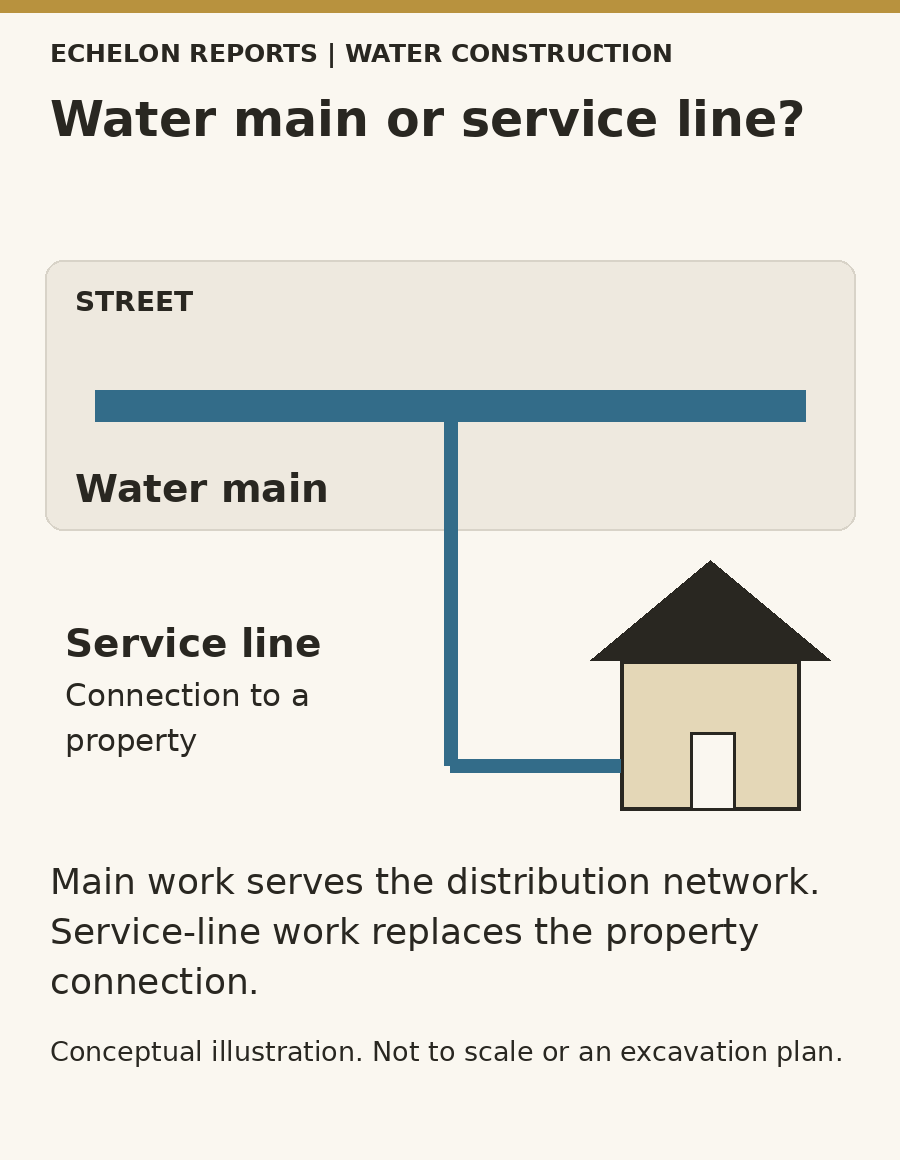
Water-main replacement serves the distribution network. Service-line replacement addresses the connection from the street main to a property. Chicago’s guidance describes both open-trench and trenchless methods for replacing service lines, with the method depending on conditions at each location.[6]
San Francisco’s WD-2918 solicitation illustrates the wider range of trades around a main-replacement project. Alongside pipe construction, it identifies possible subcontracting work in shoring, trucking, hauling, saw cutting, curb ramps, pavement restoration and traffic control.[3] Workers should describe their actual scope and equipment experience; contractors should identify which package they can perform before approaching an estimator.
Safety responsibilities on an excavation crew
OSHA requires a competent person to inspect excavations and protective systems before work and as needed during the shift, with additional inspections after rainstorms or other events that increase hazards when employee exposure is anticipated.[9] Its protective-system rule requires cave-in protection except in excavations made entirely in stable rock or those under five feet where a competent person’s examination finds no indication of a potential cave-in.[10]
Ask the employer who provides site-specific instruction, which tasks require further training and who determines whether the excavation is safe to enter. This guide explains employment routes; it is not a substitute for site-specific safety training or the applicable excavation requirements.
Tell us what water work fits you
Use Echelon Trades Jobs to describe your experience, preferred locations and travel limits. Your worker-interest profile stays private, with separate permission required before sharing your information with a named employer or recruiting partner.
Create a private worker profileThis is an expression of interest, not an employer application. Apply to a specific role through its listing. Employers can submit a free trades-job listing for review; the privacy and listing terms explain the service.
For contractors: distinguish bids from replacement programs
A construction solicitation, an ongoing program and a contractor qualification list offer different starting points. Use the records below to identify the buying process rather than treating every water-infrastructure announcement as a contract available to bid.
| Location and record | What it establishes | Where to go next |
|---|---|---|
| San Francisco, California: WD-2918 | Advertised combined water-main, sewer and paving contract. Estimated cost $18,901,000; approximately 3.50 miles of 8-inch ductile-iron water-main replacement. Displayed deadline: December 3, 2026, at 2:00 p.m.[3] | Obtain the current bid package and confirm the deadline and applicable time zone. Review license, safety and subcontracting qualifications before estimating. |
| Minneapolis, Minnesota: service-line replacement | An ongoing city program. Contractors perform replacements and the city inspects the work; state and federal funding covers eligible replacements at no cost to owners.[4] | Follow the program into current procurement or awarded-contractor records. The resident information page is not an open bid. |
| South Milwaukee, Wisconsin: contractor qualification list | Lists Earth X, Essential Sewer and Water, Five Star Energy Services, Mid-City and Miller Pipeline as prequalified service-line contractors.[5] | Use the list to identify relevant firms. Check awards and careers separately; qualification does not establish a current contract or vacancy. |
Before pricing the San Francisco package
SFPUC requires a California Class A license to bid on WD-2918 and appropriate active licenses for each subcontractor’s work. Bidders must pass safety prequalification; the agency encourages submission at least three weeks before bid opening.[3] The $18,901,000 estimate covers the combined contract, not water work alone.
The solicitation sets separate Local Business Enterprise subcontracting requirements of 15% for Micro-LBEs and 5% for Small-LBEs. Certification and participation rules determine which firms count.[3] Review those rules against your actual scope rather than assuming any small business qualifies.
The October 28 pre-bid meeting has passed, and the advertisement labels attendance as not mandatory.[3] The document index lists a meeting sign-in sheet and questions and answers, but selected documents require login or registration.[8] Obtain the current package and addenda before pricing; the public interested-parties list identifies possible contacts, not confirmed bidders or awardees.[7]
EPA identifies transmission and distribution pipe rehabilitation, replacement and installation among the eligible categories for Drinking Water State Revolving Fund assistance.[1] That explains a possible financing route. The local solicitation and award records establish who can pursue a particular construction package.
Questions about water-distribution jobs
Can I start without pipelaying experience?
Yes, for some roles. Garney explicitly describes its Saint Joseph laborer listing as entry-level, starting at $20 an hour, with employer-provided OSHA 10 and fall-protection training.[16] That is a construction entry route; confirm the project assignment. The experienced pipelayer and operator positions in this guide have separate requirements.
Do water-distribution jobs require a CDL?
Requirements depend on the role. C.J. Hughes lists a valid driver’s license for its selected pipelayer positions and says a commercial driver’s license is preferred for the Gallipolis lead-operator role.[2][12][13] Check the full listing and assignment before assuming a CDL is required or unnecessary.
Does required travel include paid lodging or per diem?
Not necessarily. The selected C.J. Hughes and Garney North Carolina descriptions require travel but do not specify a per-diem amount.[2][13][14] Ask the employer which costs it covers, whether it provides accommodation and when payment begins before arranging a move.
What does a water-distribution pipelayer do?
C.J. Hughes describes installing and connecting water pipelines, preparing trenches, setting pipe alignment and grade, testing joints, backfilling and compaction. Its selected pipelayer roles include PVC and ductile-iron pipe and ask for prior pipelaying experience.[2][12]
Do these listings show what all water crews earn?
No. Compensation belongs to each specific employer listing and location. C.J. Hughes displays $19.86 to $24.28 an hour for its Martinsburg and Louisville pipelayer roles; that range is not a national wage estimate.[2][12] Confirm the current rate and travel terms with the employer.
Is a service-line contractor list proof of hiring?
No. South Milwaukee’s page identifies prequalified contractors for lead service line replacement.[5] Use it to identify relevant companies, then inspect their current careers pages. Qualification alone does not establish an available job or assignment to a particular replacement program.
Reporting scope
This report combines selected employer descriptions with public procurement and program records checked on October 29, 2026. It is not a national vacancy census or a complete bid inventory. We did not submit applications, contact employers or inspect SFPUC’s registration-gated bid documents. Recheck listings, deadlines and qualifications before applying or quoting.
For the broader industry map, read Water & underground infrastructure: projects, contractors and jobs. It covers sewer rehabilitation, stormwater, drilling and hydro excavation alongside water distribution.
Sources
- Drinking-water infrastructure eligible for financing
- C.J. Hughes: Martinsburg water-division pipelayer
- SFPUC WD-2918: water-main and sewer construction solicitation
- Minneapolis: lead water service line replacement
- South Milwaukee: prequalified service-line contractors
- Chicago: service-line replacement methods and programs
- SFPUC WD-2918: interested parties
- SFPUC WD-2918: documents and registration boundary
- OSHA 1926.651: excavation requirements
- OSHA 1926.652: protective systems
- U.S. Department of Labor: Apprenticeship Job Finder
- C.J. Hughes Construction Co., Inc.: Pipelayer / Laborer, Water Division, Louisville, KY
- C.J. Hughes Construction Co., Inc.: Heavy Equipment Operator PSD / Lead Operator, Water Department, Gallipolis, OH
- Garney Construction: Pipelayer, Asheboro and Apex, NC (both on same requisition)
- Garney Construction: Lead Pipelayer, Pigeon Forge, TN
- Garney: entry-level laborer, Saint Joseph, Missouri, requisition 13662