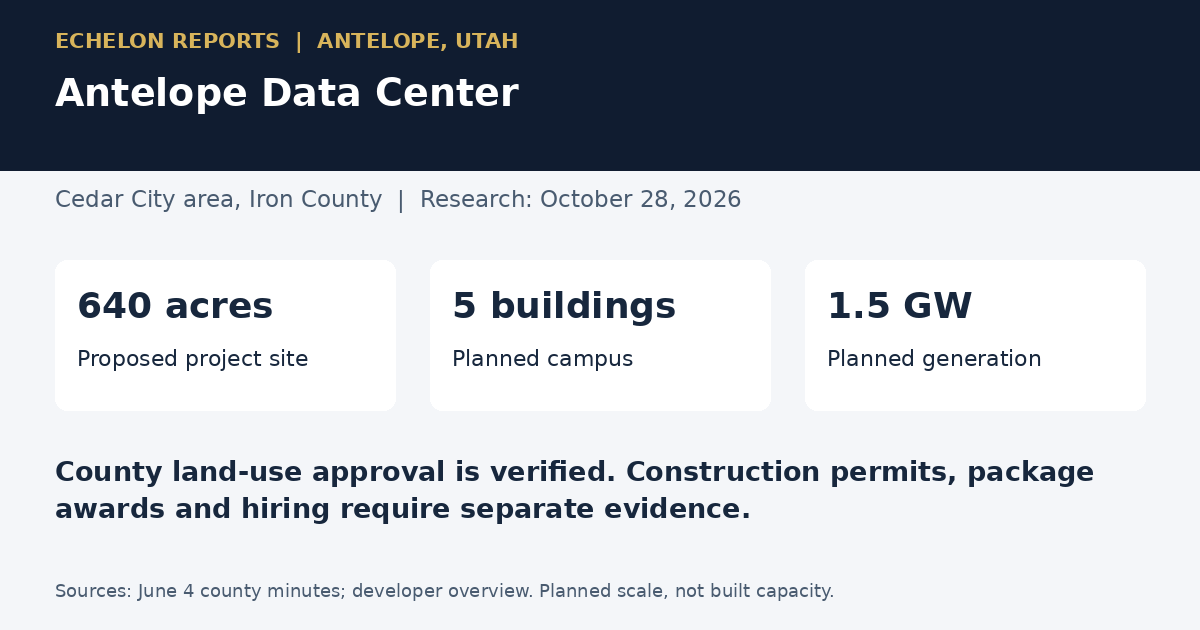
Antelope Data Center is a proposed 640-acre campus near Cedar City, Utah, developed by Pronghorn Development, LLC. Its plan includes five large buildings and up to 1.5 GW of on-site gas generation. Iron County approved a conditional use permit on June 4, 2026. Builder selection and a verified route to construction work remain the next questions for contractors and workers. [1] [2]
Research checked October 28, 2026. The project owner offers a general inquiry route. This report identifies that route, regional trade contacts and the evidence to check before pricing work or traveling.
The proposed development combines a large computing campus with its own natural-gas generation. Prospective work includes site preparation, roads and fuel supply. Other scopes include power generation, electrical distribution, mechanical systems and the data halls. The practical question is which company will control each package, and when the required approvals will allow that work to proceed.
This report is part of Echelon’s data-center construction and workforce series.
Antelope at a glance
| Item | What the sources establish |
|---|---|
| Applicant | Pronghorn Development, LLC. An operating customer is not established in the reviewed sources. |
| Location | Unincorporated Iron County, along Antelope Springs Road, approximately eight miles west of Iron Springs Road. |
| Property | 640 acres; parcel E-0825-0000-0000, Section 36, Township 34 South, Range 14 West. |
| Planned buildings | Five buildings of approximately 1.35 million square feet each. The developer describes up to 6.75 million square feet at full buildout. |
| Planned generation | Up to 1.5 GW of on-site natural-gas generation at full buildout. |
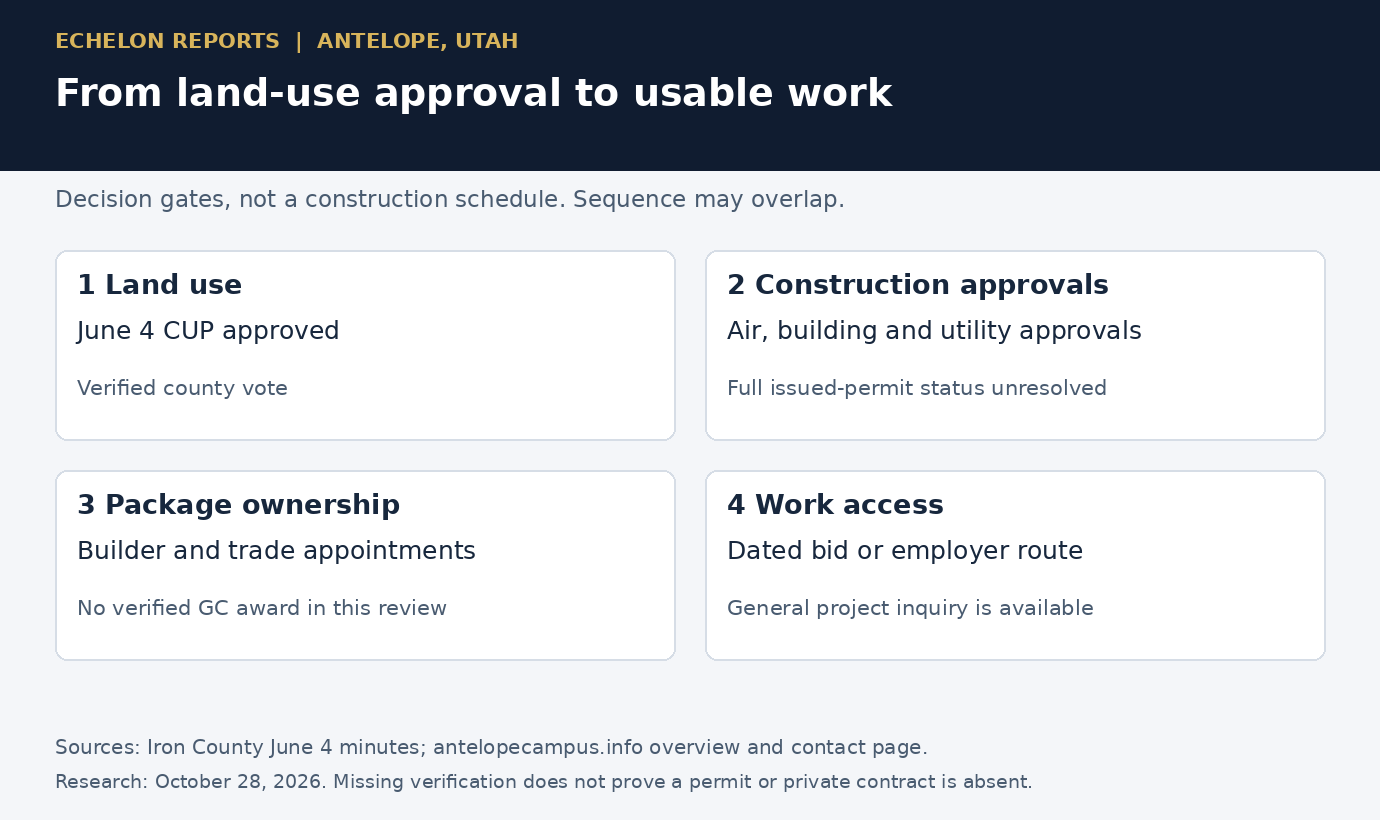
| Verified county action | Conditional use permit approved June 4, 2026. This is distinct from building and air-quality permits. |
| Contractor access | A developer inquiry route is available. No project-specific open solicitation or prequalification portal was verified in this review. |
Sources: Iron County Planning Commission minutes and the developer’s project overview. Capacity and building area describe the planned development, not completed facilities. [1] [2]
What Iron County approved, and what still needs checking
| Milestone | Evidence and meaning |
|---|---|
| June 4, 2026 | County minutes record CUP approval, six ayes and one abstention. Land-use terms are established. [1] |
| October 26, 2026 | Countywide rules and moratorium repeal reported by the Tribune. Applicability to Antelope needs the enacted text. [7] |
| October 28 source check | The developer describes planning and entitlement before builder, operator and tenant selection. [2] |
| Before a construction claim | Confirm the issued air and county permits, relevant utility approvals and the dated site work authorized. |
| Before bidding or traveling | Obtain a named package buyer or employer, site/phase, dated solicitation or job call, and commercial or employment terms. |
The June 4 minutes record a motion to grant the conditional use permit. Commissioners then amended terms for on-site energy and fencing. Six commissioners voted in favor and one abstained. The minutes also state that Utah Division of Air Quality approvals must precede county building permits. Land-use approval does not authorize every part of construction. [1]
We checked Utah DAQ’s issued Approval Order list for Antelope and Pronghorn on October 28 and found no campus match under those names. The county building page directs applicants to its permit portal. These checks did not establish an issued campus building permit or complete air-permit history; a different applicant name or record route could require another search. [9] [10]
The county discussed water rights, noise controls, lighting, road improvements and utility approvals as part of its review. The proposed fuel connection is a 24-inch natural-gas line from the Kern River pipeline system, a little more than four miles west of the property. New utility lines would also need approvals. The minutes identify the Bureau of Land Management and private property owners among the parties involved. These are infrastructure requirements and proposed scopes, not announcements of awarded contracts. [1]
The Salt Lake Tribune reported that county commissioners adopted new data-center regulations and repealed the moratorium on October 26. That is a countywide policy change, separate from Antelope’s June approval. The signed ordinances and their application to this already-approved project remain unverified in this review. [7]
A building-area discrepancy worth correcting
Early Data Center Dynamics coverage described five buildings totaling approximately 1.35 million square feet. The June county minutes instead say each building would be approximately that size. The developer’s current overview agrees with the per-building figure and describes up to 6.75 million square feet at full buildout. This report uses the primary records rather than carrying the earlier total forward. [1] [2] [6]
That distinction changes how a contractor should assess the proposed scale. It still does not identify the first construction package, the usable floor area in an initial phase, or the schedule for completing all five buildings.
Who is identified in the project records?
| Organization | Documented connection | What to avoid assuming |
|---|---|---|
| Pronghorn Development, LLC | County applicant and project developer. | Developer identity does not establish the eventual tenant or operating customer. |
| Jones & DeMille Engineering | Project technical-support and traffic-study materials in the county-linked application packet. | Engineering participation does not establish authority to award construction packages. |
| Terracon Consultants, Inc. | Phase I environmental site assessment prepared for Pronghorn. | An environmental assessment is not a general-construction contract. |
| Wärtsilä | 18V50SG generating-set specifications appear in the packet and inform planning analysis. | A product specification does not establish an equipment order, delivery or EPC award. |
| Alpen Systems | Alpen describes economic and fiscal analysis, community engagement and support through county approval. [8] | This is an advisory role, not a GC, procurement or craft-hiring appointment. |
Sources: county minutes, developer overview and the application packet linked from the county’s project page. The reviewed materials do not establish an appointed general contractor or construction subcontractor. [1] [2] [5]
Where prospective trade work would sit
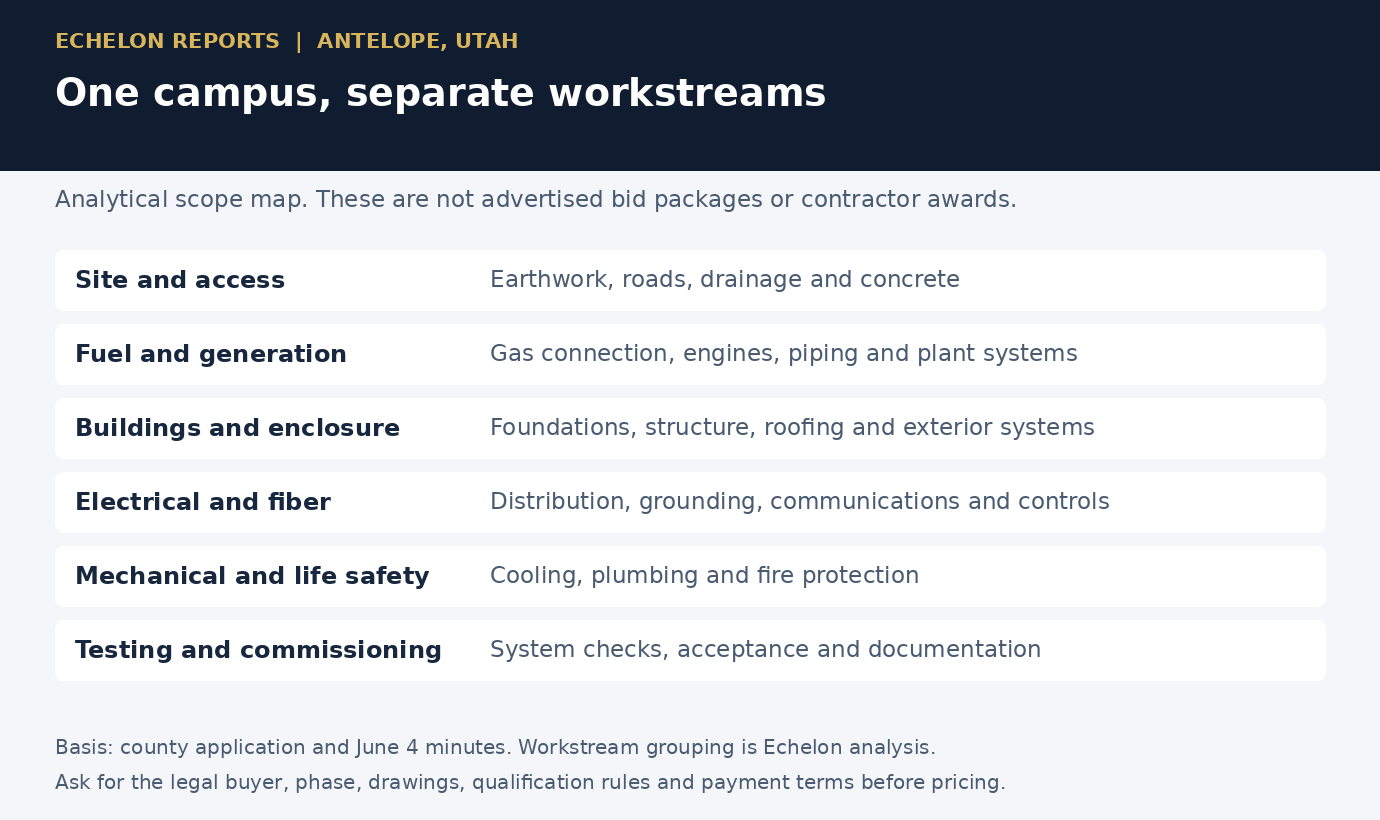
For business development, separate the campus into work packages rather than approaching it as a single contract. The following is an analytical breakdown of the proposed infrastructure, not a list of available bids.
- Civil and access: grading, drainage, concrete, roadway improvements and utility corridors. Identify the approved drawings, site limits and responsible civil contractor before pricing.
- Generation and fuel: gas supply, engine installation, mechanical piping, electrical connections and associated testing. Verify the final equipment selection and plant contractor.
- Buildings and enclosure: foundations, structure, roofing and exterior systems. A full-buildout concept does not establish released drawings for an initial building.
- Electrical and communications: distribution, grounding, controls, fiber and low-voltage systems. Establish whether the package belongs to the plant, data halls or off-site infrastructure.
- Mechanical and life safety: cooling, plumbing, fire protection and supporting controls. Confirm design requirements rather than assuming conventional commercial-building specifications.
- Testing and commissioning: verification of installed electrical, mechanical and control systems. Determine who owns acceptance testing and the required documentation.
How contractors can approach Antelope
| Your decision | Route | What to establish |
|---|---|---|
| Find a package buyer | Project owner inquiry | Who holds civil, generation, buildings or MEP work? Is a dated qualification or bid process open? |
| Check Utah eligibility | Utah DOPL contracting guidance; (801) 530-6628 | Which company license and trade classification match the actual scope? [11] |
| Verify a contracting entity | DOPL license lookup | Match legal identity, current status and classification. A credential is not a project award. [12] |
| Price responsibly | Named buyer’s actual solicitation | Obtain drawings, exclusions, schedule, qualification rules, insurance/bonding terms and payment conditions. |
Start with the Antelope project contact page or hello@antelopecampus.info. Ask which company controls your proposed scope and whether it is accepting qualifications. This is a general inquiry channel, not an invitation to bid. [4]
Utah DOPL provides separate guidance for general and specialty classifications. Ask the agency about the scope you intend to perform rather than assuming an out-of-state credential authorizes Utah work. Individual trade credentials and the contracting entity’s license are different checks; not every worker needs a contractor license. [11]
Keep engineering questions separate from purchasing questions. A consultant may explain a plan without having authority to appoint a subcontractor. Likewise, the county’s permit archive is a research source, not a procurement portal.
Jobs: separate forecasts from applications
The developer forecasts 11,345 jobs across the construction lifecycle. That total includes 6,808 direct roles. It also forecasts 1,802 long-term roles, including 672 direct permanent on-site positions. These are projected economic effects. They do not establish that thousands of people will work on site at once, or that an employer is currently accepting applications for those positions. [3]
No Antelope-specific employer application or confirmed campus dispatch call was verified in this research pass. Before leaving another job, workers should confirm the employer, site and start date. Settle wages, shifts, overtime and travel terms before booking lodging. An operational salary projection should not be presented as construction pay.
Regional referral and training routes
The following organizations provide regional employment-related or training routes. None is identified here as an Antelope labor provider, and enrollment does not promise placement on the campus.
| Trade | Verified regional route | Ask before making plans |
|---|---|---|
| Electrical and communications | IBEW Local 354 job board; dispatcher (801) 972-9354. St. George office: (435) 319-4447. | Confirm current call, employer, site, book eligibility, shift and travel terms. St. George is not Cedar City. |
| Plumbing, pipefitting, welding, HVAC/R | UA Local 140; general hall (801) 973-6784. | Ask for the correct current referral or apprenticeship route. Dated event contacts can differ from the joining page. |
| Heavy equipment | Operating Engineers Local 3 Utah; (801) 596-2677. Training: (801) 664-6934. | Separate current dispatch questions from training enrollment and confirm jurisdiction. |
| Laborers and site support | LIUNA Local 295; (801) 972-5380. | Confirm the hall’s jurisdiction, active calls and intake requirements. No Antelope assignment is established. |
Other training routes include Ironworkers Local 27, Sheet Metal Local 312 and Southwest Technical College electrical apprenticeship. Southwest Tech’s published requirements include employment with a licensed electrician and apprentice licensing. These programs are training options, not Antelope job offers.
Water, power and the next useful signals
The county’s June minutes estimate 7.83 acre-feet of annual operating water demand. The developer’s current FAQ gives 12.75 acre-feet annually. Both describe a separate initial eight-acre-foot cooling fill at full buildout. The difference between the recurring estimates remains unresolved; neither should be presented as measured use. [1] [3]
The minutes also estimate 10 to 20 acre-feet annually during construction. That covers a different phase and use, including concrete and dust control. Keep initial fill, construction demand and operating demand separate when evaluating the water plan. [1]
Watch for an issued air-quality order and county construction permits. Other useful evidence includes documented water arrangements, a named builder or plant contractor, and dated bid notices. For workers, a named employer’s Antelope requisition or a site-specific hall call would be a stronger signal than another economic-impact forecast.
Echelon’s assessment: Antelope warrants early relationship and qualification research. The evidence reviewed does not yet support treating it as an immediate dispatch destination or pricing an assumed open package. Advance the opportunity assessment when a responsible buyer, work scope and dated route become identifiable.
Frequently asked questions
Is Antelope Data Center approved?
Iron County approved a conditional use permit on June 4, 2026. That land-use approval is distinct from building permits and state air-quality authorization. This review has not established issuance of those later permits. [1]
Who is building Antelope?
Pronghorn Development, LLC is the applicant. The developer’s website says builder, operator and tenant selection follows its planning and entitlement phase. The inspected sources do not establish a general contractor award. [2]
Can contractors submit a bid?
The verified developer route is a general inquiry page. No public Antelope-specific bid invitation or deadline was verified in this review. Ask for the responsible package holder before sending pricing or assuming that qualifications are being accepted. [4]
Are construction jobs available now?
No Antelope-specific vacancy or dispatch call was verified. The developer’s construction employment figures are forecasts, not current vacancies. Regional training and referral programs are separate routes and do not establish a campus assignment. [3]
For a different Utah development, see our Meta Eagle Mountain contractor and jobs report. Keep its companies and work routes separate from Antelope. Compare other locations in the data-center project finder.
Sources and research limits
This report uses county minutes, the county-linked application packet, developer disclosures, state licensing and air-permit sources, regional trade organizations and attributed reporting. Evidence was reviewed October 28, 2026. We did not submit bids, applications or project inquiries. Retrieval dates do not turn historical documents into current construction updates.
The remaining checks are the executed amended CUP, complete issued-permit history, water arrangements and the October ordinances’ effect on Antelope. Private contracting and hiring may not appear in the reviewed public sources. Regional contact routes are not confirmed campus assignments.
- Iron County Planning Commission, June 4, 2026 minutes.
- Antelope developer project overview.
- Antelope developer FAQ and employment projections.
- Antelope developer contact page.
- Iron County project documents and linked conditional-use application packet. The landing page’s older scheduling language does not supersede the June minutes.
- Data Center Dynamics, initial project coverage.
- The Salt Lake Tribune, October 27 reporting on county regulations. Countywide policy reporting is not proof of a project construction permit.
- Alpen Systems: advisory work and Antelope project role.
- Utah DAQ issued Approval Orders.
- Iron County Building Department.
- Utah DOPL contracting guidance and classification routes.
- Utah DOPL license lookup.