
The finding
Editorial update: October 14, 2026. Original reporting dates are unchanged.
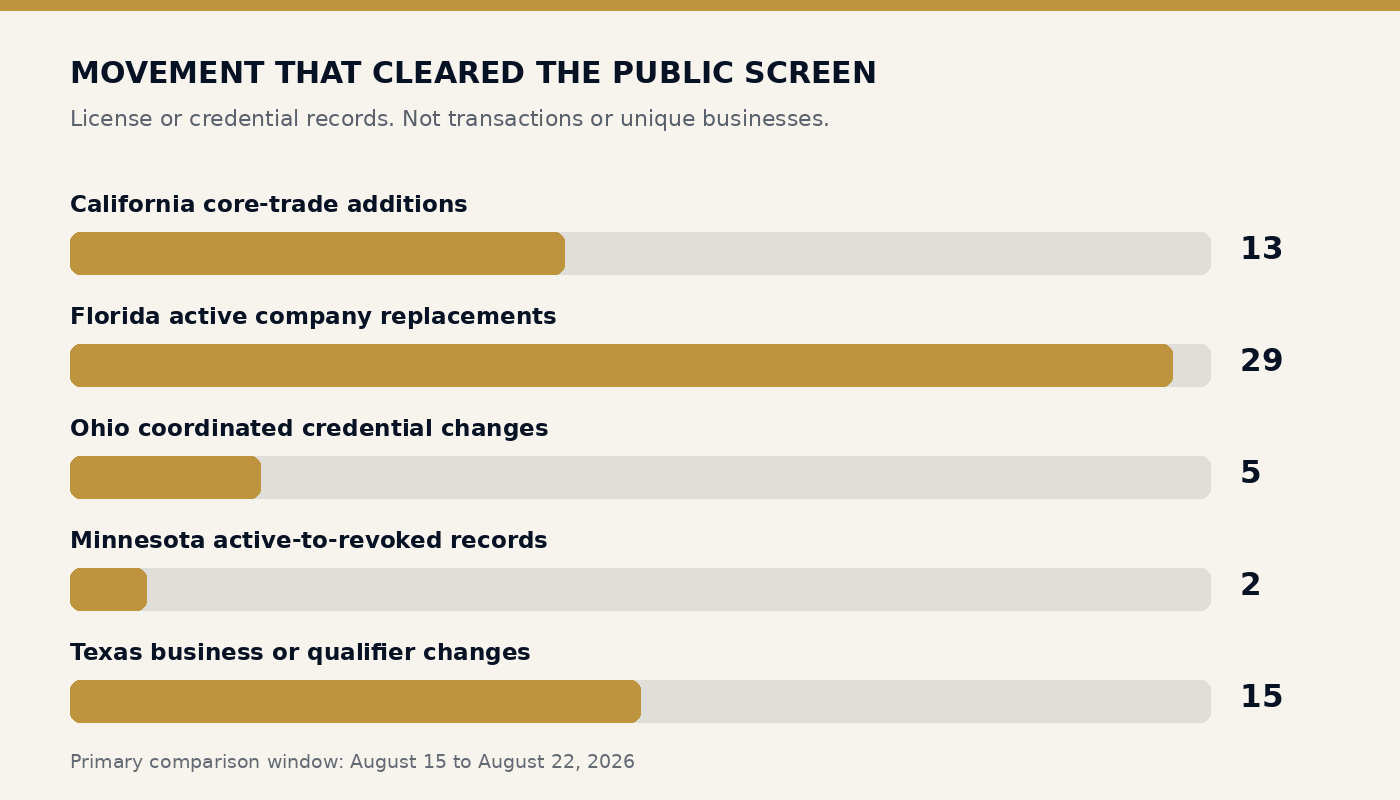
Echelon reviewed the latest available contractor records across 20 covered states. Six states produced movement that cleared the public screen.
The records show several kinds of change in operating authority and company affiliation. The counts below refer to license or credential records, not completed transactions:
- 13 California license records added an electrical, HVAC, plumbing, or roofing classification.
- 29 active Florida core-trade license records replaced one named company with another after normalized-name screening.
- Five Ohio credential relationships moved together from one company name to another across HVAC, hydronics, plumbing, and refrigeration.
- Two Minnesota residential building contractor licenses moved from active to revoked.
- Texas recorded 15 business or qualifier changes across 54,338 credential keys.
- Arizona recorded 100 named qualifying-party changes, but the public issue withholds them because much of the set contains spelling and formatting normalization.
None of those numbers is an acquisition count. They describe changes in regulated operating authority between weekly endpoints.
That distinction matters. A new classification can show a contractor entering another service line. Several license relationships moving to the same brand can show an integration reaching state records. Revocation can expose operating risk. A changed qualifier can reflect a real departure, a name correction, or a filing update.
State records can point to an operating change, but the filing alone cannot tell a buyer whether a transaction occurred.
California: 13 contractors added a core trade
California recorded 59 classification changes between its August 15 and August 22 license-master snapshots. Thirteen license records added at least one of four core classifications:[1]
| Added classification | License records |
|---|---|
| C-10 Electrical | 6 |
| C-20 HVAC | 2 |
| C-36 Plumbing | 4 |
| C-39 Roofing | 1 |
The 13 classification additions occurred across 13 license records.
Four other license records removed at least one of these core classifications during the same window.
By August 22, these 13 California license records carried new authority in electrical, HVAC, plumbing or roofing and remained clear in the snapshot.
New classifications are a reason to check whether the company is putting a service into operation. The license establishes authority, not deployed crews, booked revenue or an acquisition. Websites, hiring, coverage areas and permits can help place the addition on an operating timeline.
This is where timing matters. A classification can appear before the marketing changes. It can also arrive after the company has already begun presenting the service publicly. The license record helps place the expansion on a timeline.
Florida: 188 changes narrowed to 29 active core-trade replacements
Florida’s collector reported 188 normalized company or qualifier changes between August 15 and August 22.[2]
The first screen reduced that movement:
| Screen | License records remaining |
|---|---|
| All normalized company or qualifier changes | 188 |
| HVAC, plumbing, electrical, alarm, and registered air-conditioning records | 56 |
| Active company-to-company replacements | 29 |
The 29 records are still not 29 businesses or 29 deals. The same company can appear on several licenses. A license holder can carry more than one trade. A company-name replacement can reflect employment, a rebrand, an internal entity change, or post-deal integration.
Public example: Powerhouse Home Services reached two trade records
Two active Florida records changed from Powerhouse Electrical Service to Powerhouse Home Services during the weekly window:
- One certified HVAC license
- One certified plumbing license
The records are held by two different named licensees. Powerhouse’s public website already markets electrical, plumbing, HVAC, and generator services across Southwest Florida.[3]
The Powerhouse Home Services name appeared in active HVAC and plumbing records held by two different licensees during the same weekly comparison.
The synchronized brand change fits an interpretation of regulated brand consolidation, not proof of a new acquisition. Powerhouse’s public offer already covered more services than the older company name suggested, so these filings may reflect the records catching up with that identity.
This is a low-sensitivity example because the customer-facing brand already states the service stack. The useful capability is the timing: archived snapshots show when the regulated relationships adopted the consolidated name.
Ohio: one coordinated change crossed five credentials
Ohio recorded eight company affiliations added and eight removed between August 15 and August 22.[4]
Five credential relationships moved in one coordinated cluster. The records covered HVAC, hydronics, plumbing, and refrigeration. They involved two named license holders and changed from one company name to the same successor company name.
Echelon is withholding the company and holder identities from the public issue. The movement is current, concentrated, and more useful on a subscriber action board than in a public lead list.
Five filed credential-company relationships changed together across HVAC, hydronics, plumbing and refrigeration.
Movement across several trades and people warrants closer investigation than a single changed row. A legal-entity conversion, coordinated rebrand or platform integration could explain it; the license comparison does not identify which cause applies.
The next diligence steps are direct:
- Compare the predecessor and successor entities.
- Check officers, addresses, and formation records.
- Review the company’s public brand and service claims.
- Determine whether customers still encounter the predecessor name.
- Confirm whether ownership changed or only the regulated company affiliation changed.
Minnesota: two residential contractors moved to revoked
Minnesota’s August 16 to August 23 comparison produced 500 status changes across its construction-license export. Two residential building contractor records moved from active to revoked.[5]
The public issue withholds the two company names. A revocation is material operating-risk intelligence, but the state export does not state the cause in the movement row.
Two organization-level residential building contractor credentials changed from active to revoked between the Minnesota endpoints.
These regulator-level changes call for license-detail and enforcement review. Revocation is not an acquisition signal and does not, by itself, establish financial distress, seller intent or closure.
Texas and Arizona: useful movement, unresolved meaning
Texas added 61 credential keys, dropped 27, and recorded 15 business or qualifier changes between August 15 and August 22.[6] The set includes A/C contractors and electrical credentials. Several records look like ordinary entity-name cleanup. Others deserve entity resolution. None cleared the public acquisition threshold.
Arizona recorded 126 new licenses, 26 removals, 163 status changes, and 100 named qualifying-party changes.[7] The qualifying-party set includes capitalization, spelling, suffix, and abbreviation changes. Those records cannot be treated as 100 qualifier departures.
A changed field identifies a record to investigate. It does not explain the event that produced the change.
$500 per month, five monitored markets
What the subscriber receives
The public edition shows the movement pattern. The private Deal Ledger is built around a buyer’s actual acquisition mandate.
A subscriber defines five metropolitan markets, target trades, service mix, business model, size range, transaction preference, and known exclusions. Each Tuesday’s action board then answers:
- Which businesses moved?
- What exact license or qualifier relationship changed?
- Is the movement new, administrative, or known history reaching the state record?
- Which legal entity, brand, license, and named qualifier are involved?
- What evidence supports the interpretation?
- What should the buyer verify next?
- Does the business fit the mandate?
- Is the signal already assigned for first look?
Standard coverage is $500 per month for five monitored markets. Actionable targets receive one active first-look assignment at a time within directly overlapping mandates. The standard first-look period is 14 calendar days.
Coverage and limitations
All 20 covered states were reviewed. The source position at publication was:
| Coverage group | States | Treatment |
|---|---|---|
| Current or recent usable evidence | Arizona, California, Colorado, Florida, Idaho, Kentucky, Minnesota, Ohio, Oregon, Tennessee, Texas, Virginia, Washington, Wisconsin | Movement reviewed; only records clearing the public screen appear above |
| Degraded or incomplete movement | Louisiana, Mississippi, North Carolina | Roster retained with stale or incomplete weekly-change coverage |
| Failed current refresh | Nevada | August 23 refresh failed; prior August 9 state preserved |
| Unsafe movement | Oklahoma, Rhode Island | Excluded from movement claims |
Wisconsin’s August 24 repair produced a new 142,433-row snapshot after failed attempts on August 16, 22, and 23. That recovery occurred after the August 23 health audit. Wisconsin movement was reviewed cautiously because the new comparison spans more than three weeks rather than one weekly interval.[8]
Oklahoma remains excluded. Its Chrome-profile collision was repaired on August 24, but the transport path still failed its live probe and the verification gate can allow loss conditions to exit successfully. Rhode Island remains excluded because poisoned query blocks and weak fallback keys make part of its movement layer unsafe.
Weekly diffs compare endpoints. A record can change and revert between snapshots without being observed. A record absent from the later endpoint is treated as not observed until source scope is reconciled. It is not automatically called departed, expired, closed, or sold.
Methodology
Echelon preserved state-native records, compared the latest usable endpoints, and applied state-specific event tests.
For this issue:
- California classifications were compared as sets. Counts separate license records from individual classification additions.
- Florida company changes used normalized company fields to suppress punctuation-only movement. The screen then isolated core-trade prefixes and active company-to-company replacements.
- Ohio affiliation additions and removals were paired by license type, license number, and holder.
- Minnesota status changes were restricted to organization-level residential building contractor records moving from active to revoked.
- Texas business movement remained credential-level and was not converted into company or transaction counts.
- Arizona qualifying-party changes were held from public event claims when normalization offered a credible alternative explanation.
- Current collection failures and unsafe scopes were excluded rather than filled with prior-week movement.
Sources
[1] California Contractors State License Board, Public Data Portal, license master snapshot files dated August 15 and August 22, 2026: https://www.cslb.ca.gov/onlineservices/dataportal/ContractorList
[2] Florida Department of Business and Professional Regulation, Construction Industry and Electrical Contractors public-record extracts used for Echelon snapshots dated August 15 and August 22, 2026: https://www2.myfloridalicense.com/construction-industry/public-records/
[3] Powerhouse Home Services, Southwest Florida service and company pages, accessed August 26, 2026: https://www.powerhouseswfl.com/
[4] Ohio Construction Industry Licensing Board, roster and license lookup, Echelon snapshots dated August 15 and August 22, 2026: https://elicense4.com.ohio.gov/lookup/licenselookup.aspx
[5] Minnesota Department of Labor and Industry, license and registration lookup and construction-license export, snapshots dated August 16 and August 23, 2026: https://www.dli.mn.gov/license-and-registration-lookup
[6] Texas Department of Licensing and Regulation, license data files, Echelon snapshots dated August 15 and August 22, 2026: https://www.tdlr.texas.gov/LicenseSearch/licfile.asp
[7] Arizona Registrar of Contractors, contractor-search records and Echelon snapshots dated August 15 and August 22, 2026: https://roc.az.gov/search
[8] Wisconsin Department of Safety and Professional Services, credential lookup, Echelon snapshots dated August 1 and August 24, 2026: https://dsps.wi.gov/Pages/SelfService/LicenseLookUp.aspx
The Deal Ledger is public-records intelligence and analytical research. It is not legal, tax, financial, investment, or brokerage advice. A public-record signal does not establish seller intent, ownership, transaction status, or investment suitability. Confirm all material facts through legal, financial, regulatory, and operational diligence.
MIKE WARNER | ECHELON REPORTS
mike@echelonreports.com