
THE DEAL LEDGER · ISSUE 006 · SUNDAY, AUGUST 9, 2026
California qualifier records: correction to Issue 006
1 · Ninety Days
Here is the part of the contractor economy almost nobody outside it understands, and it is the reason this brief exists.
A California contractor license belongs to the business. The qualification belongs to a person.
Every active license must name a qualifying individual: a Responsible Managing Officer or Employee who sat the trade examination and holds the experience the license was granted on. In a family firm that is usually the founder. Sometimes it is the founder’s son or daughter. Occasionally it is a long-tenured employee nobody outside the payroll has ever heard of.
When that person disassociates from the license, the business has 90 days to name a replacement.
Miss it and the license is suspended for Lack of Qualifier, or the affected classification is stripped. A suspended contractor cannot legally contract, bid, or advertise. For a firm whose entire revenue depends on holding that number, it is an operational stop.
The Contractors State License Board prints the exact deadline on the public license record. A line appears stating the license may be suspended at a future date if the qualifying person is not replaced by a stated date. It is not an estimate. It is a date the state has committed to in writing.
We tested it against five separate records this week. A qualifier who departed July 20 carries a printed deadline of October 18. June 24 carries September 22. May 28 carries August 26. June 30 carries September 28. July 2 carries September 30.
All five are exactly 90 days. No code citation needed. The state does the arithmetic and publishes the answer.
Why this is a business signal and not a compliance footnote
Three properties, and all three are unusual.
The date is fixed and cannot be negotiated. Most business intelligence tells you something happened. This tells you something must be resolved by a specific day, and the state chose the day.
It starts with a person, not a transaction. A qualifier who has held the seat for twenty-seven years does not disassociate casually. Retirement, illness, death, or a decision to step back. In a firm licensed in the 1960s, the qualifier and the founder are frequently the same human being.
The business is still trading the whole time. That is what separates this from a lapsed license. A lapse usually means the business already stopped. A qualifier departure means it is still running and has a problem to solve.
2 · The Resolution Board
Issue 005 published two California licenses at succession moments. Both are still on the board.
Kahn Air Conditioning Inc · Van Nuys · License 206552
| Feb 5, 1962 | License first issued. HVAC, plumbing, electrical, refrigeration, general building |
| Jul 22, 1973 | David Arthur Kahn associates as RMO, later CEO and President |
| Apr 18, 2026 | After 53 years in the qualifier seat, Kahn disassociates. No successor named |
| Jul 25, 2026 | Suspension prints: Lack of Qualifier |
| Aug 2, 2026 | Reported here in Issue 005. Bond current, workers’ comp in force. The firm reads as operating |
| Aug 9, 2026 | Verified again on the live CSLB portal. Still suspended. Still no qualifier |
| Aug 31, 2026 | License expiration. Twenty-two days |
The read: a sixty-four year old license with five classifications either names a qualifier and renews inside three weeks, or it lapses. Nothing in the record suggests the business stopped operating.
One correction to Issue 005. That issue described the workers’ compensation policy as newly effective months after the departure was in motion. The portal shows the policy effective February 1 and the disassociation April 18. The policy came first. The inference was ours and it was wrong. We print corrections because a number you cannot check is worth nothing.
Engineering and Seismic Construction Inc · Glendale · License 1041609
Expired July 31 and verified as unable to contract. Resolved, and it stays on the board as the completed version of the same mechanism: qualifier gone in March, workers’ compensation cancelled in April, suspension in July, expiry in July. The file told that story sixteen weeks before the closure date, one record at a time.
3 · What It Costs to Find Out Late
Let us be blunt about the commercial point, because the rest of this brief is evidence for it.
A suspension is easy to find. Anyone can read a status field on a state portal. By the time it appears, the ninety days are gone, the owner has been dealing with it for a quarter, and if the business is worth buying, other people have already called.
The ninety days before the suspension are not easy to find.
Seeing them requires the CSLB personnel file, which records the association and disassociation date of every individual on every license. Titles and dates ship as parallel lists, so one person holding four roles carries four dates, and identifying which role ended when requires aligning them by position rather than searching text. Get the alignment wrong and you attribute a departure to the wrong role and put a healthy company on a distress list.
Then it requires knowing what the license looked like last week, and the week before that. A current roster can be scraped by anyone. A change history has to be accumulated week after week, and it cannot be bought back later.
That is the whole of it. The outcome is public. The window before the outcome is not.
4 · The Week in Numbers
Week ending Sunday, August 9, 2026. Twenty states, diffed.
| State | Recorded this week | Note |
|---|---|---|
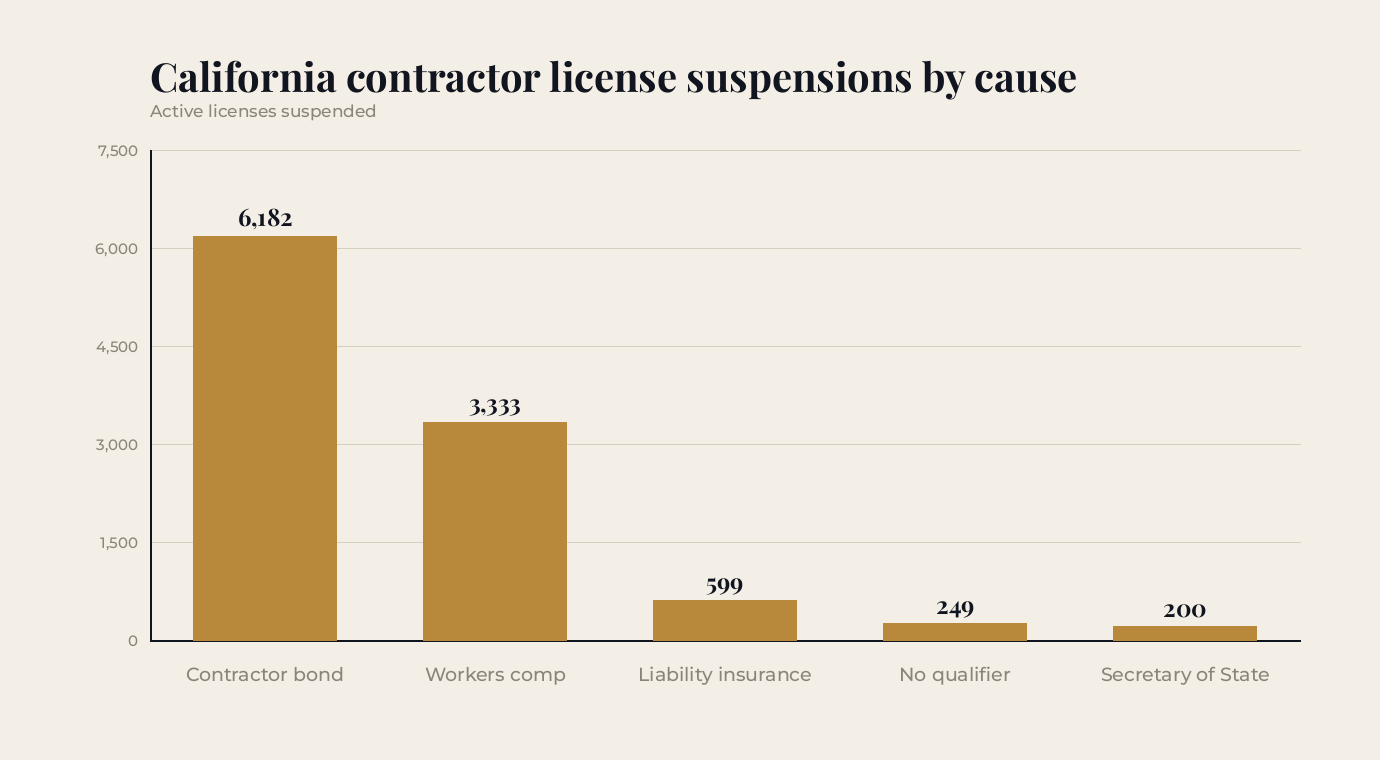
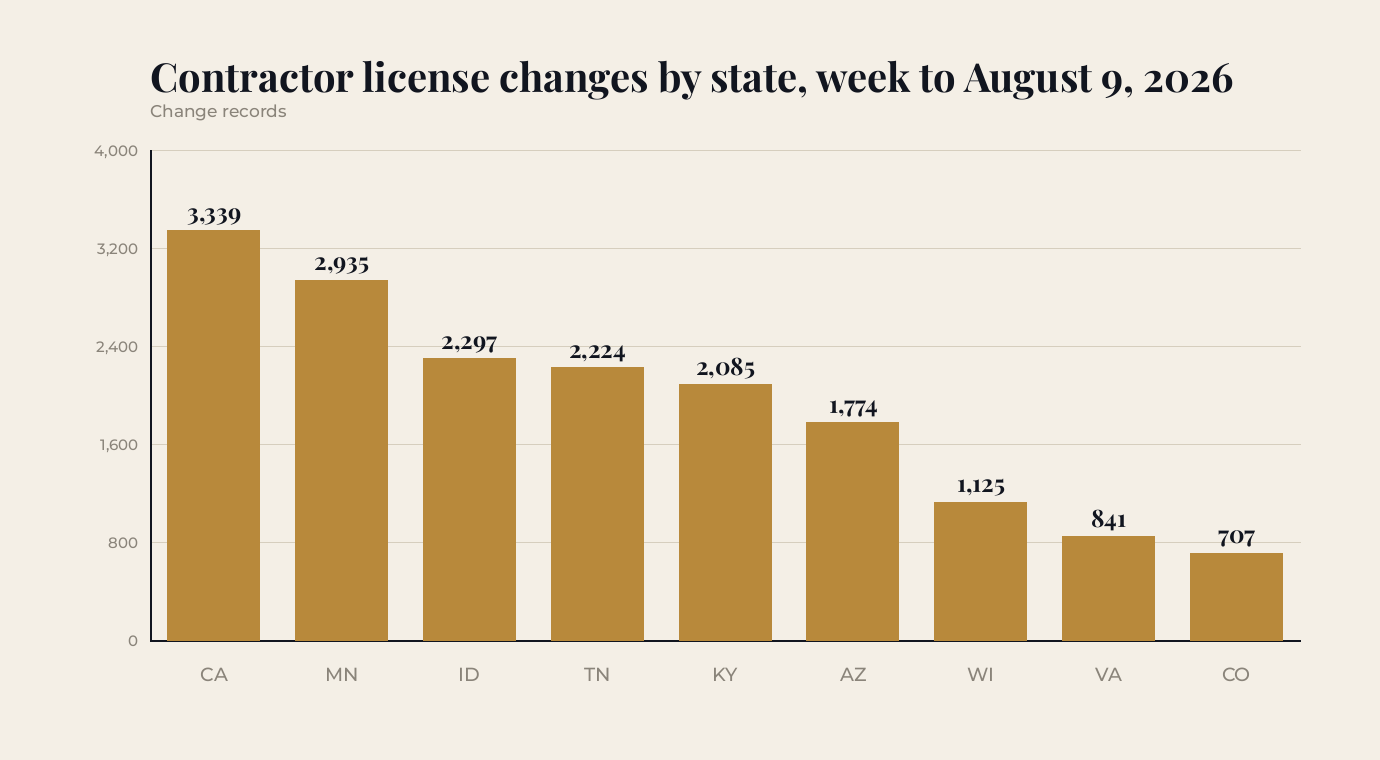
| California | 994 absent person-license pairs, not confirmed departures; 3,339 status changes; 172 company changes | 249 licenses currently suspended for Lack of Qualifier |
| Minnesota | 2,037 status changes, 609 new | |
| Idaho | 1,354 status changes, 673 new | |
| Tennessee | 2,027 changes | Decomposed by field for the first time |
| Kentucky | 2,015 changes | Decomposed by field for the first time |
| Arizona | 400 qualifying party changes, 939 status changes | 257 departures with no successor named across thirty days |
| Wisconsin | 771 status changes, 306 new | Reads as of August 1; the state portal blocked our fetch |
| Virginia | 601 expiration changes, 223 new | Returns to the board this week |
| Colorado | 374 changes, 329 new | Decomposed by field for the first time |
| Florida | 178 company changes on unchanged license numbers | The Florida qualifier-migration signal |
| Nevada | 14 monetary limits revised upward, none downward | |
| Rhode Island | 84 status changes, 14 new | |
| Ohio | 7 company changes, several leaving escrow | |
| Mississippi | Expiration flips split into lapses and reinstatements | Never reported pooled |
Numbers of record
As of August 9, 2026, Echelon Reports tracks 2,270,744 contractor license records across twenty US states, 1,210,517 of them currently active, diffed weekly. Roughly 580,000 carry a phone of record.
Correction: 994 person-license pairs were absent from the later personnel snapshot. This does not establish 994 individuals, companies, or qualifier departures. 249 California licenses are currently suspended for Lack of Qualifier. Arizona recorded 257 qualifying party departures with no successor named across the trailing thirty days.
National totals count all active licenses; per-state contractor figures exclude individually licensed tradesmen where a state licenses them separately.
5 · Things That Only Appear in a Diff
Three signals this week that a current roster cannot produce at all.
Ohio prints a deal closing in a company field
Several Ohio licenses this week show the company changing from ESCROW to a named company. An Ohio license in escrow is preserved rather than used. A license leaving escrow under a new name is a completed transfer, recorded by the parties themselves.
The read: that is a transaction, filed in public, visible only to someone holding last week’s snapshot beside this week’s. Nobody publishes it because nobody keeps the snapshot.
Florida moved qualifiers between firms 178 times in a week
Florida licenses the individual and carries the company on the license. When the license number stays the same and the company on it changes, a licensed principal moved between firms. That frequently precedes or accompanies a transaction, and this week it happened 178 times.
Nevada is the only state that publishes financial capacity
The Nevada State Contractors Board sets a monetary limit on each license: the maximum value of a single contract, set from reviewed financials. It is a regulator’s assessment, not a self-reported figure.
Fourteen licenses had theirs revised upward between August 2 and August 9. None was revised downward. One residential home services licensee went from $25,000 to $325,000 in a single week.
The read: an upward revision is a growth signal, not distress. It identifies a company getting materially stronger before that is obvious from outside. We make no claim about what a reduction would mean, because we have not yet observed one.
6 · Arizona and California Are Not the Same Signal
Arizona is the only state in our coverage that publishes qualifying party changes as a discrete field. Over the trailing thirty days it recorded 596 of them, of which 257 were departures with no successor named.
221 of those 257 sat on licenses that were already inactive.
The read: that ratio is the difference between two regulatory regimes. A California business that loses its qualifier keeps trading against a published clock. An Arizona business tends to go dark at the same moment. The signal is scarcer in Arizona and it arrives later, and any state that publishes a replacement deadline is worth more than one that does not. That is not an opinion about the states. It is what the two files say when you put them side by side, which requires holding both.
7 · The Coverage Board
| State | Status |
|---|---|
| AZ, CA, CO, FL, ID, KY, LA, MN, MS, NC, NV, OH, OK, OR, RI, TN, TX, VA, WA, WI | Twenty states live |
| North Carolina | Committed in Issue 004. Delivered. Twentieth state, 18,911 active license accounts |
| Oklahoma | Committed in Issue 005. Delivered. Complete contractor census: 5,950 licensed contractor businesses against 35,294 individually licensed tradesmen |
| Virginia | Returns to the board. A defect we reported ourselves is resolved |
| Wisconsin | Reads as of August 1. The state portal blocked our fetch on August 8 |
Two things we got wrong, and fixed
Virginia. We had flagged Virginia’s movement data as unusable because the file appeared to re-stamp its entire roster as new on every refresh. It does not. 89,438 of the 90,158 records landed on a single day: the day the table was created. Every refresh since has run at 220 to 280 new against a 90,100 roster, which is normal. The measurement window reached back past the table’s own birth and read a one-time event as an ongoing defect. Virginia contributes again from July 20.
Idaho. Our weekly runner reported success on a step that had failed, and a diff then ran against stale data and produced a week of movement that had not happened. Fifteen hundred and forty records. We caught it in the Sunday check, removed them, and rebuilt the runner so a failed step now stops the steps that depend on it.
The read: we publish our own defects because a data business that only reports its wins is asking you to take its arithmetic on faith. Every number in this brief is one we would rather you check.
8 · What Charter Firms Received Today
The charter edition is built per subscriber and it is deliberately short. A prospect list, not a report.
Each week: every licensed contracting firm in the subscriber’s states and trades that hit a signal we track, with contact of record on every row, plus flagged firms carrying an open forcing date, evidence the business is operating, a change we caught the week it printed, and verification on the state portal the day of the send.
Today’s editions carried twenty-four callable companies for one subscriber’s footprint across four states, and a hundred more across every trade for the master file. Among them: a family-named HVAC company whose departed qualifier carries the company’s own name and has seventeen days to be replaced. A thirty-eight year old electrical contractor whose license comes up for renewal three weeks before its qualifier deadline, which means renewing a license it may not be able to qualify the following month. A firm whose qualifier of twenty-seven years disassociated last November, with a same-surname officer still on the license and no successor named in nine months.
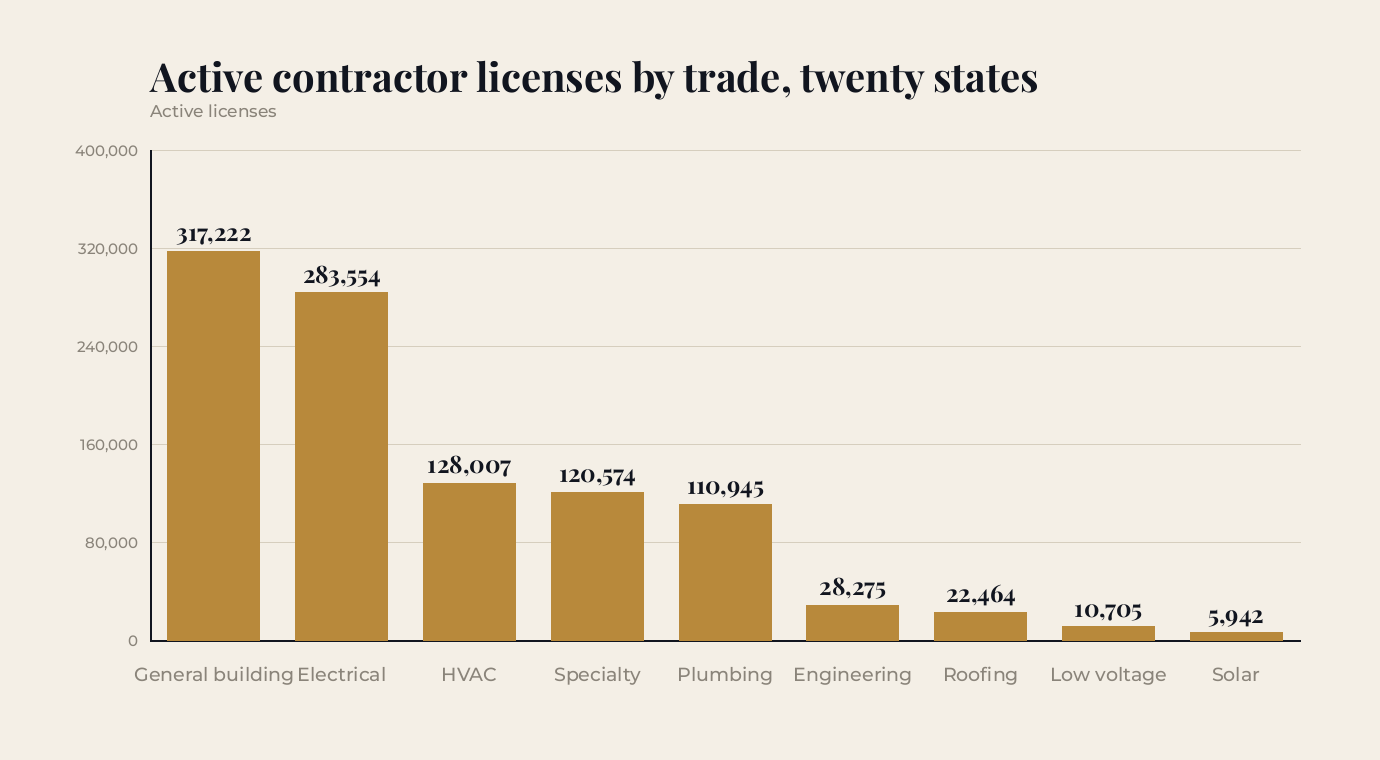
Behind the weekly list stands a pool of 3,925 companies carrying a phone of record and a reason to call, across HVAC, plumbing, electrical, roofing, solar, low voltage, general building, engineering and the specialty trades. Subscribers can license the full record set as a data file, priced per state and trade, with contact-fill percentages supplied before purchase.
Contact of record is what the licensee filed with the state. It is whatever was submitted on the application or the last renewal, and on some filings that is the attorney or the service company that prepared the paperwork rather than the owner. It is not verified contact. Every license number verifies on the issuing state portal.
A row from today’s edition: CA · C20 HVAC · qualifier departed 2026-05-28 · state-printed replacement deadline 2026-08-26 · 17 days · phone on file · [company and contact withheld in the public edition]
9 · The Arithmetic
You do not need this brief. You need the rows in it that are in your states, in your trades, at a moment that will not repeat.
An absent personnel record is a reason to investigate, not evidence that a business is for sale. Confirm the license status, the person’s role and the reason for the record change before treating it as an acquisition lead.
Private Deal Ledger coverage is $500 per month for five monitored markets. Echelon reviews each application for scope and mandate conflicts before coverage begins.
One week of the wrong prospect list costs more than a year of the right one.
Apply for Deal Ledger Coverage · echelonreports.com/deal-ledger
Frequently Asked
What is a qualifying party on a contractor license?
A qualifying party, called an RMO or RME in California and a qualifying party in Arizona, is the licensed individual whose credential authorizes a contracting firm to operate. If the qualifier leaves and is not replaced within the statutory window, the state suspends the firm’s license.
How long does a California contractor have to replace a qualifier?
Ninety days from the disassociation date. The Contractors State License Board prints the specific replacement deadline on the public license detail page, so the date is published rather than estimated.
What happens if the deadline passes?
The license is suspended for Lack of Qualifier, or the classification the qualifier covered is removed. A suspended license cannot legally contract, bid or advertise.
How many California licenses are suspended for lack of a qualifier?
249 active California contractor licenses were suspended for Lack of Qualifier as of August 9, 2026. Correction: the 994 figure counted absent person-license pairs between the August 1 and August 8 snapshots, not confirmed disassociations.
Can I check this myself?
Yes. Every license status and personnel list is public at cslb.ca.gov. What is not public is which licenses changed this week, or last week, or the week before, because that requires holding a weekly archive.
Does this happen in other states?
Yes, under different names and different clocks. Arizona publishes qualifying party changes as a discrete field. Mississippi gives a disassociated qualifying party ninety days under its own statute. North Carolina carries a qualifier layer on every general contractor license.
Related reading
- The Deal Ledger, Issue 005: The Wall Goes Up
- Selling a Trades Business in California
- Selling an Electrical Business
- The Trades Roll-Up
- Redwood Services Platform File
- The Echelon Report 005
- All Deal Ledger issues
ECHELON REPORTS · DUE DILIGENCE
Does the business survive the sale or transfer?
The Quality of License Report is the government-records counterpart to a Quality of Earnings: license integrity, qualifier risk, entity standing, liens, litigation, and regulatory record on a single acquisition target.
See the Quality of License ReportECHELON REPORTS · CUSTOM INTELLIGENCE
Need the file on a market, a platform, or a target?
Intelligence Reports are built to order from the same database: the licensed census for a market, named competitors with dated ownership events, tiered targets with contact, demand signals, and a risk register with falsifiers.
See Intelligence ReportsEchelon Reports publishes public-records intelligence on the licensed contractor economy. Facts trace to state license files and filings. Counts are from the 2026-08-09 pull. This is not accounting, legal, or investment advice.
MIKE WARNER | ECHELON REPORTS
mike@echelonreports.com | linkedin.com/in/jmichaelwarner | x.com/_Mike_Warner