
ECHELON MARKET INTELLIGENCE
The Commercial Roofing Ownership Map
Who owns what in commercial roofing, assembled from 21,860 state contractor licenses across seven states. Snapshot August 4, 2026.
Commercial roofing is a market of roughly $75 billion, and it is consolidating fast. Private equity holds at least five platforms operating across the United States. A New York Stock Exchange issuer bought its way in twelve months ago and said publicly that it intends to keep buying.
Nobody publishes a map of who owns what. Not because the information is hidden, but because assembling it is work almost nobody does.
Most of it sits in plain sight in state contractor license files. Nations Roof brands all ten of its licensed entities. Progressive Roofing brands both of its. Tecta America names itself on seventeen. Every one of those facts is public, dated, and checkable on a state licensing portal in under a minute.
What stops the map from existing is labor. It requires holding every state’s roofing roster at once, normalizing company names across seven different filing conventions that disagree about suffixes and punctuation, and then diffing the result against each acquirer’s own published acquisition list. That is a standing operation rather than a project, and the output decays weekly.
This page is that map for seven states.
One of the platforms on it is a national commercial roofer serving all fifty states whose owner has never been publicly identified. It changed hands in August 2022, and the buyer has never been named.
Quick facts
- Coverage: 21,860 active roofing licenses across seven states (AZ, CA, FL, NV, OR, VA, WA)
- Platforms mapped: five, entity by entity
- Only disclosed multiple in the sector: 9.1x trailing EBITDA
- Operator register: 25 phone-confirmed multi-state operators, 15 ownership-verified by hand
- Snapshot: August 4, 2026. Underlying database refreshes weekly
- Source: state contractor licensing records, acquirer announcements, issuer disclosures
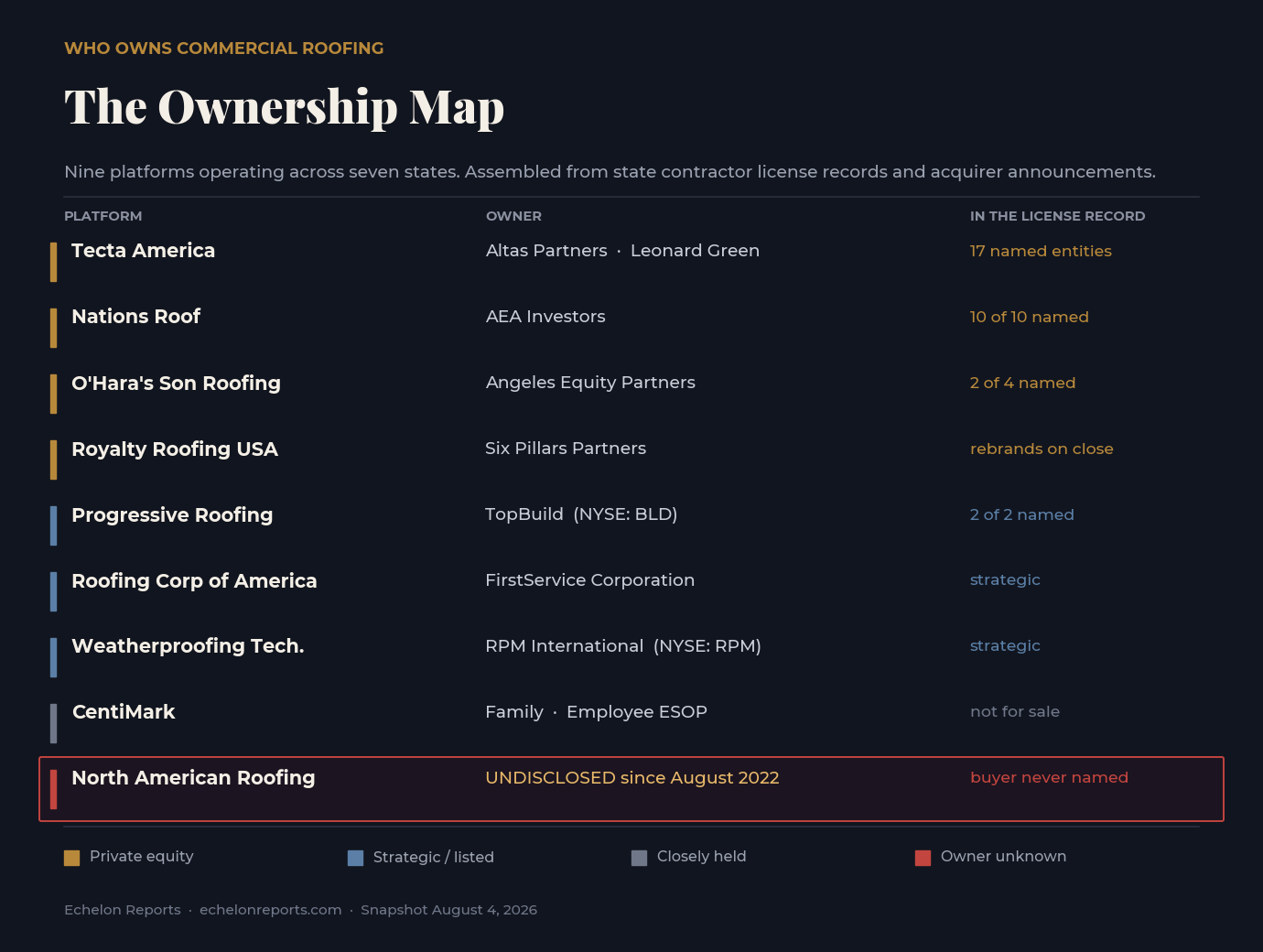
Who owns the platforms
Every ownership fact below carries the date of its last confirmed event rather than an assertion about today. That distinction matters more than it sounds, and the reason is in the North American Roofing entry.
| Platform | Owner | Last confirmed event |
|---|---|---|
| Tecta America | Altas Partners (majority), Leonard Green & Partners (minority) | Altas acquired from ONCAP October 2018; Leonard Green minority September 2021; sale process reported November 2024, not confirmed concluded |
| Nations Roof | AEA Investors | Closed July 2024, from Acacia Partners |
| O’Hara’s Son Roofing | Angeles Equity Partners | Acquired May 2024; three add-ons since |
| Progressive Roofing | TopBuild (NYSE: BLD) | Closed July 15, 2025, $810 million all cash |
| Royalty Roofing USA | Six Pillars Partners | Acquired October 2023; five add-ons since |
| North American Roofing | Undisclosed | Silver Oak Services Partners recapitalized November 2018 and exited August 2022. The buyer has never been publicly named |
| Weatherproofing Technologies | RPM International (NYSE: RPM), via Tremco | Long-held strategic |
| Roofing Corp of America | FirstService Corporation | Controlling interest closed December 15, 2023, from Soundcore Capital Partners |
| CentiMark | Family led, employee owned through an ESOP | Not a private equity holding; grew past $1 billion organically |
The only disclosed price in the sector
Commercial roofing transactions are almost entirely private, so multiples are almost never published. One exception governs the whole market.
TopBuild completed its acquisition of Progressive Roofing on July 15, 2025 in an all-cash transaction valued at $810 million. Progressive reported $438 million of revenue and $89 million of EBITDA for the trailing twelve months ended March 31, 2025, which puts the deal at approximately 9.1 times trailing EBITDA and 8.6 times after stated synergies. Roughly 70 percent of that revenue was non-discretionary re-roofing and maintenance rather than new construction, across 1,700 employees and 12 branches.
Because TopBuild is an SEC reporting issuer, those numbers are on the record. They are now the reference point any seller’s adviser in commercial roofing will cite, and the only one available.
Visibility is a branding decision, not an industry rule
Whether an acquisition shows up in the license record depends entirely on what the acquirer decides to call the company afterward. Measured across the full seven-state roster:
- Nations Roof identifies itself on 10 of 10 licensed names: Nations Roof West, Nations Roof South, Nations Roof Golden State, Nations Roof MidAtlantic, Nations Roof of Oregon, Nations Roof Southern Florida.
- Progressive Roofing on 2 of 2.
- Tecta America on 17, through its own regional entities and the suffix convention that turns an acquisition into “X, a Tecta America Company.”
- Royalty Roofing USA rebrands acquisitions outright.
- O’Hara’s Son Roofing on only 2 of 4.
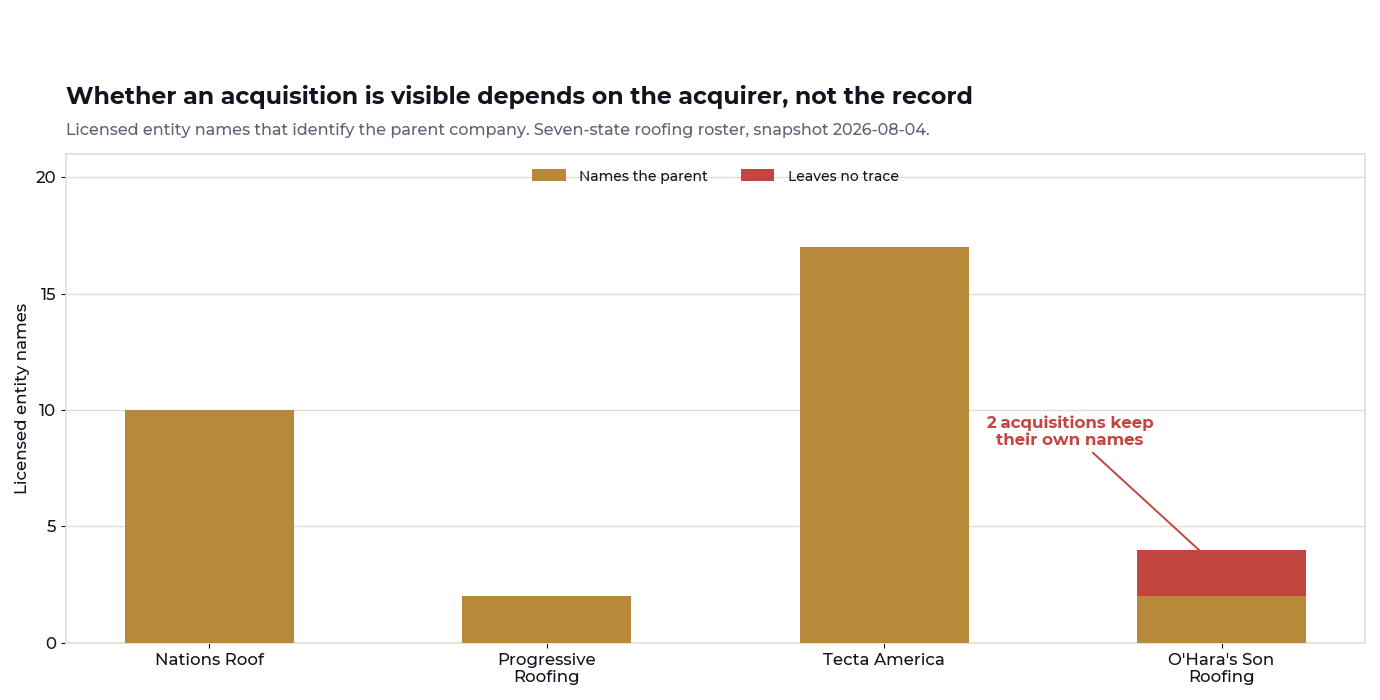
That last one is the blind spot, and it is worth understanding precisely. O’Hara’s Son acquired Starkweather Roofing in Arizona in May 2025 and Total Systems Roofing in Illinois in June 2025. Both announcements state that the acquired company will continue to operate under its existing name. Both still appear in state licensing records as apparently independent companies, and always will.
The consequence is a rule that governs everything else on this page: an absence of ownership signal in the license record is not evidence of independence. Where an acquirer preserves a name, the record shows an independent company indefinitely. Any company described as unowned has to be verified by hand against filings and announcements, one at a time.
Ownership goes stale, and almost nobody checks
Sponsors publicise acquisitions. They frequently do not publicise exits. So a firm that sold four years ago still reads as the current owner in every announcement search anyone runs.
Silver Oak Services Partners recapitalized North American Roofing in November 2018, a national commercial roofer serving all fifty states, and exited in August 2022. The exit appears in transaction indexes and was never announced. The buyer has never been publicly identified. A top-tier national platform changed hands four years ago and there is no public record of who owns it.
Every ownership row in this work therefore carries its last confirmed event and its date. Nothing asserts a present owner without a check for a subsequent transaction.
Florida renews on one date, and half the roster has not
Florida renews contractor licenses on August 31 of even-numbered years, which means the entire state roofing roster faces a single forcing date at once.
As of the August 4, 2026 snapshot, 5,066 active Florida roofing licenses carried an August 31, 2026 expiration and had not renewed. Another 5,007 had already rolled forward to 2028.
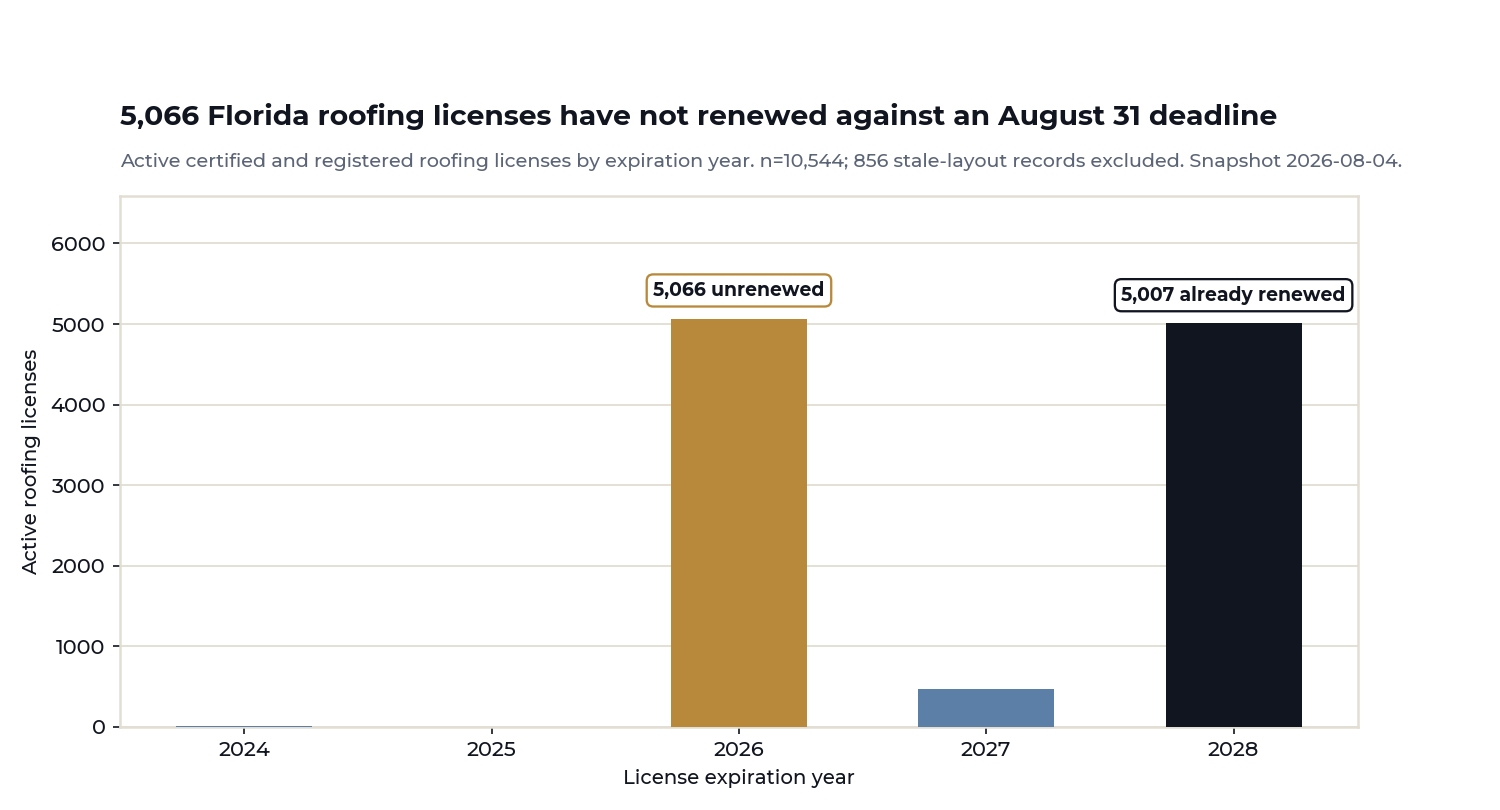
That first bucket drains every week as licensees renew. Whoever is still in it after August 31 has made a decision not to continue, and non-renewal in a licensed trade is one of the quietest exit signals available, because it lands before any listing, any broker engagement, and any announcement. The September 1 residual is the list.
Two disciplines make that figure trustworthy. Florida ships license extracts in two layouts, and one of them carries historical expiration values that do not reflect the current term. That layout accounts for 856 active roofing records, every one dated 2018, 2020, or 2021, and it contributes zero records to the 2026 or 2028 buckets. Separately, 467 licenses carry an August 31, 2027 expiration, which should not occur under an even-year cycle. Those are excluded and flagged rather than explained away.
How commercial capability is measured
No state license file flags a roofer as commercial or residential. Two proxies were tested.
Florida’s scope tier failed. Florida issues Certified roofing licenses valid statewide and Registered licenses valid only in the granting jurisdiction, and Certified is the commercial-capable tier. Of 11,400 active Florida roofing licenses, 10,739 are certified and 661 are registered. At 94 percent certified, the tier separates almost nobody. It is reported here rather than quietly dropped.
Nevada’s bonding limit works, with an important asymmetry. Nevada attaches a monetary limit to every C15 roofing license, and all 421 active licenses carry a value: 85 hold the unlimited class, 44 sit between $3 million and $10 million, 57 between $1 million and $3 million, and the remainder below that. A high limit is strong evidence of commercial capability. A low limit is weak evidence of anything, because it reflects only what that licensee bonded for in Nevada. Progressive Roofing, a $438 million business, carries a $2 million Nevada limit. No conclusion about company size is drawn from a low limit anywhere in this work.
Multi-state licensure measures reach, not size
Commercial roofers who serve national accounts have to be licensed wherever their customer’s buildings are. Retail portfolios, industrial rollouts, and government contracting all require it, and licensure is cheap relative to that revenue. So companies built for national-account work license broadly regardless of how large they are.
The spread is dramatic. Verified operators inside the same footprint band run from roughly $5 million to roughly $99 million in revenue. One company licensed in about thirty-nine states reports five employees. Another licensed in thirty-five reports about two hundred. A third with eight branches has completed work in forty states.
That matters because national-account work is the revenue model that commands the multiple. Roughly 70 percent of what TopBuild bought was non-discretionary re-roofing and maintenance. So a broad license footprint is a cheap, public, verifiable detector of companies structurally built for the revenue buyers pay up for, and it works from $5 million upward.
What is in the full report
Everything above is structural and historical, and it is published in full. What is withheld is the callable current record.
The full report contains the operator register: 25 phone-confirmed multi-state commercial roofing operators, each named, scored on a published four-part index, with confirmed state footprint, Nevada bonding tier, headquarters, responsible individual where the license record carries one, and ownership status. Fifteen of the twenty-five have been ownership-verified by hand against filings and announcements. Eight of those fifteen show no public ownership event at all.
It also contains the Florida commercial subset: the twenty-three unrenewed licenses from the August 31 cohort that carry a hard commercial signal, with license numbers, company names, and addresses, separated from the weaker name-only screen. And it ships with a companion data file of 119 license-level rows, with addresses and contact information where the license record carries it.
Two verified reversals are worth noting, because they are the reason the register is worth buying rather than reproducing. Two operators that showed no ownership signal anywhere in the license data turned out on verification to be platform owned. Apparent independence in a license file is not independence, and finding out which is which is the work.
The Commercial Roofing Ownership Map, full edition
Twenty pages. The full operator register with all twenty-five operators named, scored, and ownership-verified. The Florida commercial subset with license numbers. The companion data file, 119 license-level rows, with addresses and contact information where available.
An annual seat, not a single download. You receive the current edition and the next four quarterly editions as they publish. New states are added to the underlying database every quarter, so each edition covers more ground than the one before it.
$3,500
Each copy is registered to the purchaser and delivered by email within one business day. You will receive the report and the companion data file at the address used at checkout.
Seat holders can commission a register for a specific market: full ownership verification on every operator, contact of record, and the succession and lapse signals for that geography. Priced on the complexity of the market. Reply to your receipt to discuss it.
Coverage note: not every state licenses roofing as a separate trade. Some place it inside a general contractor class, and a few do not license it at all. Companies in those states are tracked where the information can be obtained, and coverage is stated plainly in every edition rather than implied.
Questions
Who owns Tecta America?
Altas Partners holds the majority position, acquired from ONCAP in October 2018, with Leonard Green & Partners taking a minority stake in September 2021. A sale process was reported in November 2024 with a potential value of $3 to $4 billion including debt. That process is not confirmed to have concluded, and sources through 2026 continue to describe Altas ownership.
What multiple does commercial roofing trade at?
The only disclosed multiple in the sector’s recent record is TopBuild’s acquisition of Progressive Roofing in July 2025: $810 million on $89 million of trailing EBITDA, approximately 9.1 times, and 8.6 times after stated synergies. Nearly every other transaction in the sector is private and undisclosed.
Which private equity firms own commercial roofing companies?
As of August 2026: Altas Partners and Leonard Green & Partners in Tecta America, AEA Investors in Nations Roof, Angeles Equity Partners in O’Hara’s Son Roofing, and Six Pillars Partners in Royalty Roofing USA. TopBuild and FirstService Corporation hold strategic positions in Progressive Roofing and Roofing Corp of America. North American Roofing changed hands in August 2022 and its buyer has never been publicly named.
Can you tell from a contractor license whether a company has been acquired?
Sometimes. It depends entirely on the acquirer’s branding policy. Acquirers that rebrand, such as Nations Roof and Royalty Roofing USA, or that suffix the acquired name, as Tecta America does, are visible in the license record. Acquirers that preserve the acquired company’s name, as O’Hara’s Son Roofing does, leave no trace at all, and the license record will show an apparently independent company indefinitely.
Why does Florida matter for roofing acquisitions?
Florida renews contractor licenses on August 31 of even-numbered years, so the whole state roofing roster faces one date. Licensees who do not renew have made a decision to stop operating, and that decision is visible in the public record before any listing or broker engagement. It is one of the earliest exit signals available in a licensed trade.
How is the data verified?
Every company-level claim traces to a license number, a filing, an issuer disclosure, or an attributed public announcement. Ownership facts carry the date of the last confirmed event, and transaction indexes are checked for subsequent events rather than relying on the original announcement. Match confidence is reported for every name-based match, and partial matches are excluded from published counts.
Sources and method
License and entity data: Arizona ROC, California CSLB, Florida DBPR, Nevada NSCB, Virginia DPOR, Washington L&I, and Oregon CCB, via the Echelon Database, snapshot August 4, 2026. Ownership and transaction record: acquirer acquisition pages, sponsor announcements, issuer press releases, and transaction indexes, as of August 4, 2026. The Echelon Database covers 2,122,620 contractor license records across 17 states, 1,176,343 of them active, refreshed weekly with each refresh compared against the prior week. States are added every quarter. See the current state-by-state licensed contractor counts for the full coverage picture.
Coverage is limited to states that separate roofing as a licensed trade, which is seven of the seventeen states currently loaded. Several states license roofing inside a general contractor class, where roofers cannot be isolated from the wider contractor population, and a few do not license roofing at all. Operators in those states are tracked where the information can be obtained by other means. Every edition states its coverage explicitly rather than implying national completeness.
Revenue and employee figures for privately held companies are third-party estimates, attributed as such, and are not used to support any finding. This is public-records intelligence and is not accounting, legal, or investment advice.
Related reading: The Great Trades Roll-Up on how private equity consolidation works across the trades, and The Echelon Intelligence Report for a single-market build covering any trade Echelon tracks.