
Editorial update: October 14, 2026. Original reporting dates are unchanged.
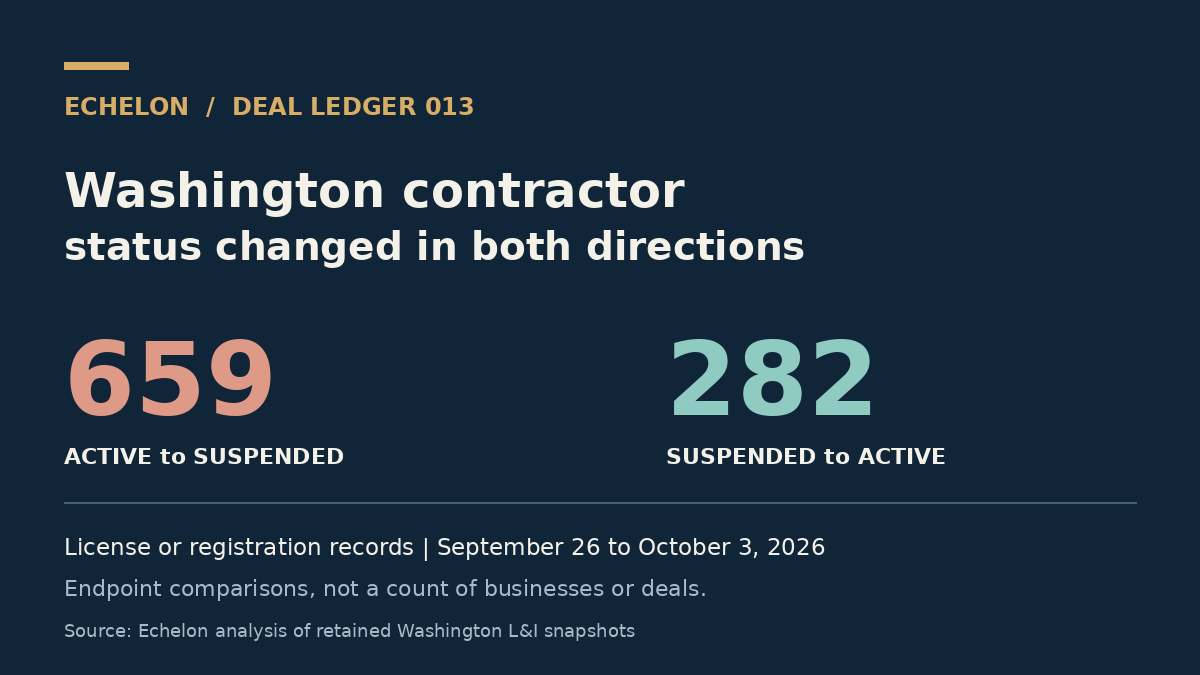
Echelon’s comparison of Washington’s September 26 and October 3 records found 659 contractor license or registration records that changed from ACTIVE to SUSPENDED. Another 282 changed from SUSPENDED to ACTIVE. Both counts concern records present at both endpoints, not businesses disappearing from a search result.[3]
For an owner hiring subcontractors or a buyer reviewing a target, the useful response is to recheck operating authority before the next commitment. A suspension flag deserves attention. It does not establish financial distress, seller intent or an acquisition.
October 6, 2026 public edition. Washington evidence: September 26 to October 3. Rhode Island evidence: September 19 to October 3, within a limited comparable query scope. Counts describe observed endpoint changes, not every event during those intervals or a live status check today.
The status change comes before the explanation
Washington L&I says it suspends construction contractor registrations when registration requirements are not met, including a canceled or expired bond or insurance, or an unsatisfied judgment. Reinstatement requires correction of the issue.[1]
Those explanations lead to different business decisions. A documentation lapse that has been corrected is different from an unresolved judgment. Our aggregate comparison does not assign a cause to the 659 records. It also includes electrical and plumbing contractor licenses alongside construction contractor registrations; the construction-registration guidance should not be treated as the complete rulebook for every license type.[1][3]
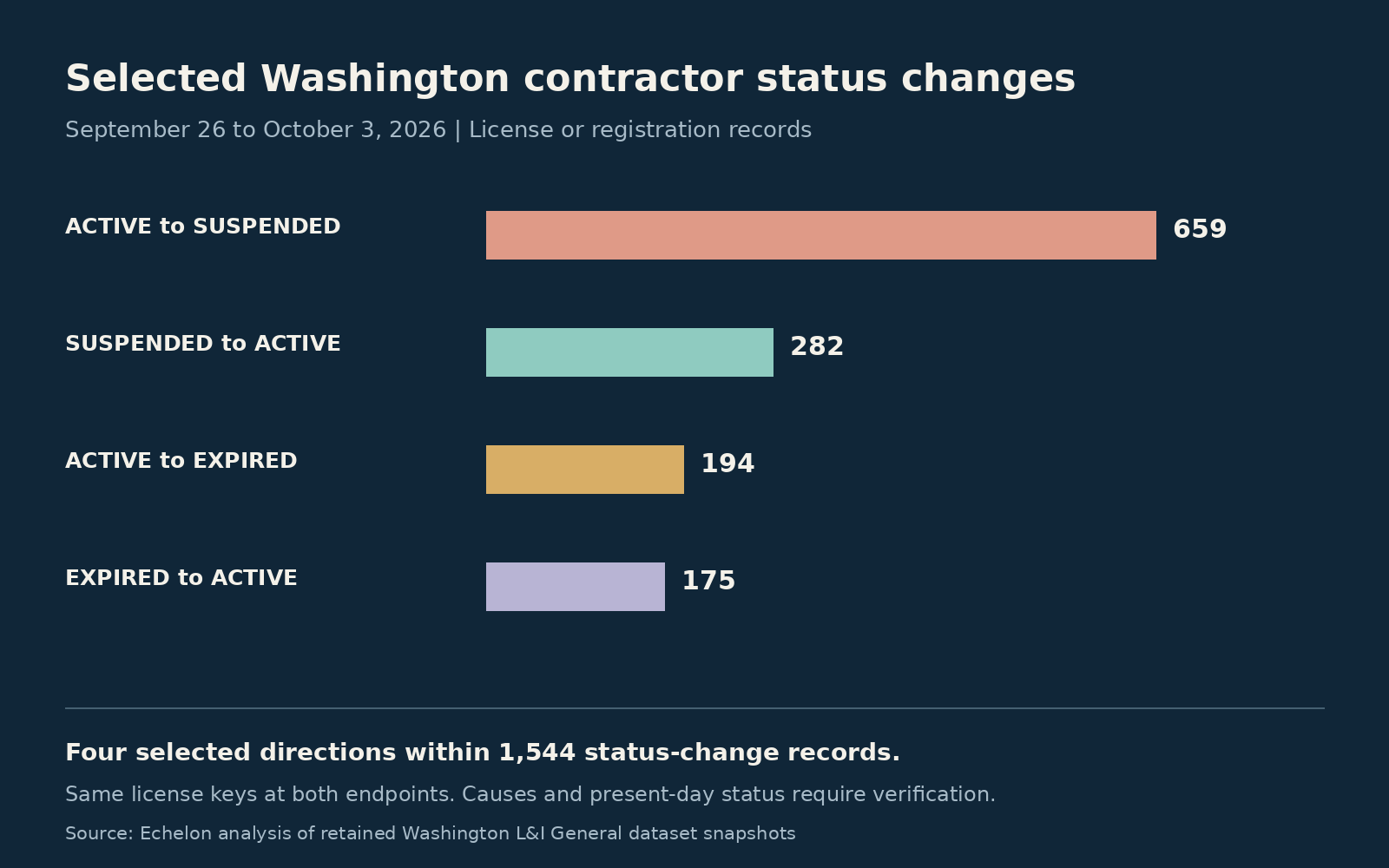
Selected Washington status changes
| Recorded status on September 26 | Recorded status on October 3 | License or registration records |
|---|---|---|
| ACTIVE | SUSPENDED | 659 |
| SUSPENDED | ACTIVE | 282 |
| ACTIVE | EXPIRED | 194 |
| EXPIRED | ACTIVE | 175 |
The table selects four directions from 1,544 status-change records. We matched each license number in the September 26 and October 3 snapshots. This is not a net count of active businesses. The reverse-direction rows involve other records; they do not show that the same 659 registrations recovered.[3]
Our read: Treat a changed status as a verification task before assigning work, extending credit or advancing a purchase. Start with the exact registration or license number, check its current record, and establish what caused the change and whether the issue remains open. Do not turn a dated suspension flag into a distressed-seller label.
L&I’s Verify tool supports searches by contractor license number, UBI and business or owner name. It also exposes information such as workers’ compensation coverage, citations and lawsuits against a contractor’s bond. L&I cautions that public information can be incorrect or not current.[2]
Principal records require a different investigation
The same Washington comparison contains ten primary-principal name-field changes on ten license records. The separate principal dataset contains 1,327 relationship or field events: 353 relationships newly observed, 958 no longer observed, 15 end-date changes and one UBI-field change. These categories can overlap at the license level and must not be added to produce a company count.[3][4]
The distinction matters. A relationship missing from the later snapshot is not a verified owner departure. A changed primary name is not a proven sale. Washington describes its principal field as the name of an owner, member, partner or corporate officer; that field is not a complete beneficial-ownership account.[4]
Our read: Keep the status investigation and the ownership investigation separate. A status change asks whether the business has the authority required for the work under consideration. A principal change asks who is represented in the record and what changed in the entity or management structure. Neither answers the other.
Before calling a principal change an ownership transition, reconcile the exact entity and UBI, the people named at both endpoints, other principals still listed, and any independent transaction evidence. This public edition makes no named acquisition claim and publishes no private target rankings or contact paths.
Rhode Island: a smaller, two-week comparison
Rhode Island’s September 19 to October 3 comparison supports 124 events in 40 of 86 expected trade/status query pairs: 54 records newly observed in comparable scope, 28 no longer observed, 41 status changes and one name change. Incomplete query pairs and unstable identity keys were excluded before comparison.
This is neither a statewide roster nor one week’s movement. It cannot be compared with a broader prior edition to claim that market activity slowed. Missing query coverage also does not establish that nothing changed. The practical use is limited to investigating the records in the comparable scope.
What was reviewed and left out
We checked records from 20 states before selecting the findings for this issue. Washington supplies the one-week findings above. Rhode Island supplies a limited two-week comparison. We do not report movement in the other states here.
| States | Editorial disposition for this issue |
|---|---|
| Washington | Accepted September 26 to October 3 contractor and principal comparisons. Record and relationship counts only. |
| Rhode Island | September 19 to October 3 comparison limited to 40 comparable query pairs. No current full-roster claim. |
| Wisconsin | October 3 collection failed. The earlier September 19 to September 26 comparison is not presented as this cycle’s movement. |
| California, Kentucky | Recovered observations span missing weeks. No current-week movement claim. |
| Florida, Nevada, Tennessee | The current collection cycle did not produce the required accepted endpoint. No new movement or no-change claim. |
| Oklahoma | Current detail evidence remains unsafe for the intended comparison. |
| Idaho | Reversing arrivals and absences remain unresolved. |
| Arizona, Colorado, Louisiana, Minnesota, Mississippi, North Carolina, Ohio, Oregon, Texas, Virginia | Movement is not cleared for this issue. Some retained or current observations remain useful for other bounded questions. |
This review does not establish a uniformly current national contractor census. It does not count acquisitions, business openings, closures or owners seeking buyers.
How to use this week’s findings
For an operating contractor, recheck a changed subcontractor record before relying on an older qualification file. Preserve the exact identifier, current status, date checked and unresolved issue. Use the regulator’s record and obtain professional advice where the work or transaction requires it.
For an acquisition team, retain separate evidence for operating authority, entity identity and ownership. Ask the target to explain a material change, then test that explanation against the underlying record. A quick reinstatement and a continuing unresolved suspension belong in different diligence notes, but neither alone determines the business’s value.
A quiet website cannot settle either question. The dated record comparison tells you where to look; the follow-up determines what the change means.
Method and source dates
Echelon calculated the Washington figures from retained L&I General and Principal dataset snapshots dated September 26 and October 3, using license-number keys for contractor records and composite license/principal/start-date keys for relationships. Both endpoint manifests were accepted and reconciled. The general dataset identifies the contractor license number as its unique identifier and notes that a UBI can have multiple associated records.[3][4]
The Rhode Island figures compare complete Department of Labor and Training query groups present at both dates. The last complete roster we accepted dates to August 22; this article does not present it as current. We kept the included groups, exclusions and event counts in the research records.
Official Washington guidance was checked October 6. The dataset links below describe the sources and their current contents; the historical counts in this edition come from Echelon’s retained endpoints, not a claim that today’s live downloads still contain the same rows. Changes that occurred and reversed between captures are outside this comparison.
Monitor the markets in your acquisition mandate
The private Deal Ledger covers five agreed markets for $500 per month, with Tuesday delivery. It maintains target histories, distinguishes confirmed events from unresolved signals, and identifies the next verification action. Coverage is subject to mandate review and conflict checks.