
The finding
Editorial update: October 14, 2026. Original reporting dates are unchanged.
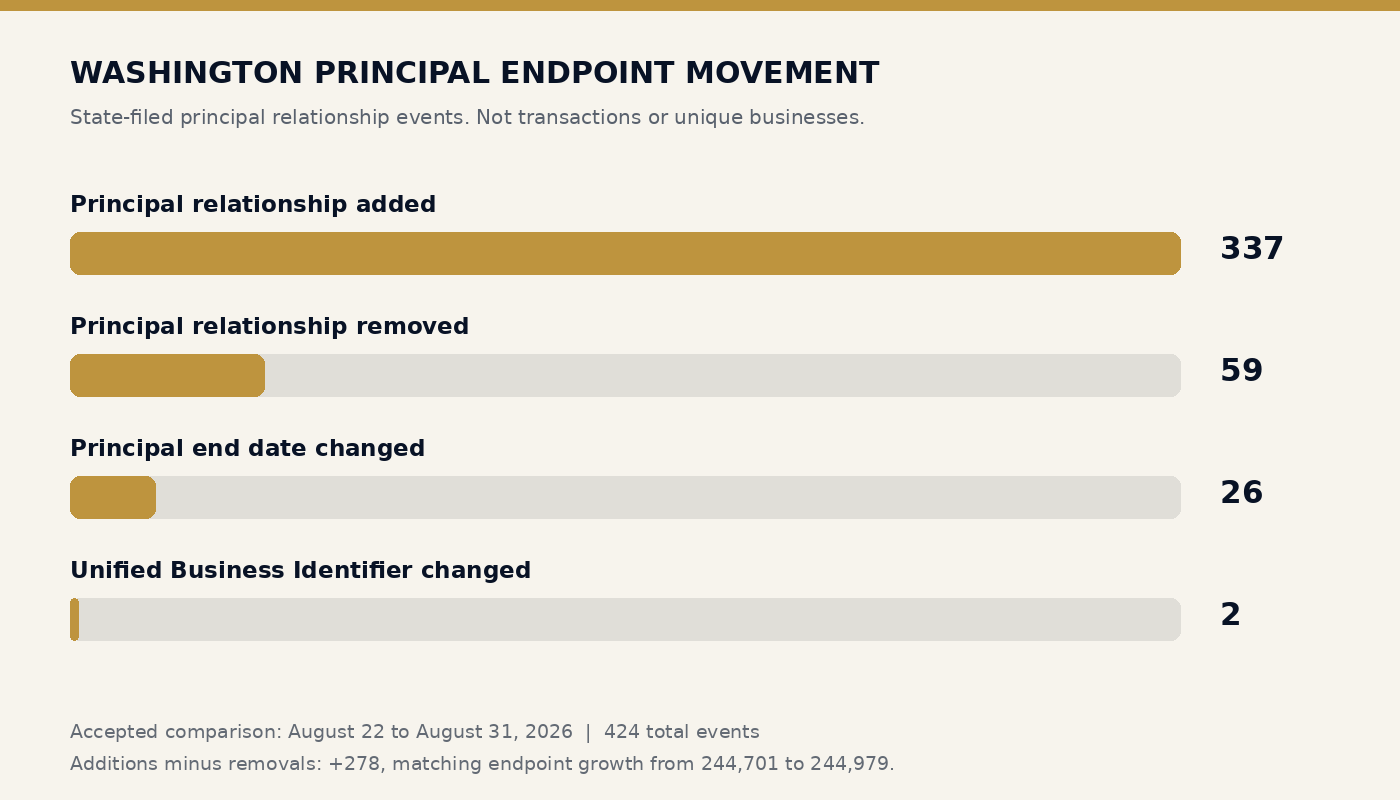
Washington’s contractor-principal file produced 396 additions and removals between August 22 and August 31: 337 principal relationships appeared and 59 were no longer present.[1]
The endpoint grew by 278 relationships, from 244,701 to 244,979. The 337 additions minus 59 removals reconcile to that growth. The same comparison also recorded 26 end-date changes and two Unified Business Identifier changes, bringing the principal event total to 424.
None of those numbers is an acquisition count. A principal relationship is a state-filed connection between a person and a contractor license. One person can appear on several licenses. One license can carry several principals. A removed relationship can reflect a departure, correction, expiration, or another filing change.
The statewide total is a starting screen. A single changed principal relationship needs verification, while several changes tied to the same contractor, address or entity can justify closer investigation of an operating change. The public edition reports the total; current target identities remain on the private action board.
Washington: the repaired endpoint held
Washington’s August 29 collection stopped at 240,000 rows after a short page was mistaken for the end of the file. A corrected pull continued past that page and checked the source count before and after retrieval. It retained all 251,090 rows available on August 31, giving the comparison a complete later endpoint.[1]
After normalization, the accepted principal endpoint contained 244,979 distinct license, principal, and start-date relationships. The prior accepted endpoint contained 244,701.
| Washington principal event | Records |
|---|---|
| Principal relationship added | 337 |
| Principal relationship removed | 59 |
| Principal end date changed | 26 |
| Unified Business Identifier changed | 2 |
| Total endpoint events | 424 |
The corrected pull matched the official source count, so the accepted endpoints could be compared. That matters because an incomplete pull would turn records missed by collection into apparent removals.
The 396 additions and removals are records to screen, not acquisitions to count. Grouping related changes and checking the underlying entities will tell a buyer more than the statewide sum alone.
Washington’s general contractor file was stable at 161,549 rows on both August 29 and August 31.[2] It still recorded 123 status changes and six expiration changes. A flat roster can contain material movement.
Rhode Island: a bounded comparison replaced the unsafe statewide claim
Rhode Island’s source did not permit a statewide comparison: 13 of 86 trade-and-status query pairs were incomplete at one or both endpoints. The analysis used only the 73 pairs complete on August 22 and August 29, excluding 11,158 records without reliable comparison keys and 154 outside the common scope.[3]
That bounded slice produced:
| Rhode Island bounded event | Records |
|---|---|
| New to the comparable slice | 93 |
| Removed from the comparable slice | 10 |
| Status changed | 18 |
| Total bounded events | 121 |
These are not statewide Rhode Island totals. They describe movement inside a declared, reproducible slice of the professional-regulation source. Electrician/Current and Plumber/Current remain outside the comparison.
This narrower Rhode Island slice can still support monitoring, provided readers can see what it excludes. Treating its movement as a statewide total would make the finding broader than the records allow.
Four additional public signals
California recorded 94 classification-change records between August 22 and August 29. Twenty-three license records added at least one core trade classification: 12 added C-10 electrical, two added C-20 HVAC, three added C-36 plumbing, and six added C-39 roofing.[4]
Florida recorded 161 normalized company-field changes in the same weekly window. Forty-five involved the screened HVAC, plumbing, electrical, alarm, or registered air-conditioning prefixes. Twenty active records replaced one nonblank company name with another.[5]
Ohio recorded six company affiliations added and six removal signals across its construction-industry credentials.[6] Removal rows require live verification because an absent relationship does not establish why the filing changed.
Texas recorded 13 normalized business-name changes across its monitored A/C and electrical credential files.[7] These remain credential-level changes. The same company can appear on more than one credential.
Arizona recorded 109 qualifying-party field changes.[8] The public issue does not treat them as 109 departures because spelling, capitalization, suffix, and abbreviation changes remain credible alternative explanations.
$500 per month, five monitored markets
What the subscriber receives
The public edition shows the movement pattern. The private Deal Ledger applies the same change history to a buyer’s five monitored markets and target criteria.
Each Tuesday’s action board identifies the companies that moved, the exact regulated relationship that changed, the legal entity and brand involved, what the evidence supports, what remains unresolved, and what the buyer should verify next.
Standard coverage is $500 per month for five monitored markets. Every market is checked each week. Actionable targets receive one active first-look assignment at a time within directly overlapping mandates. The standard first-look period is 14 calendar days.
Coverage and exclusions
All 20 approved states were reviewed. Fifteen had current or bounded usable evidence. Five were limited or excluded.
| Coverage group | States | Treatment |
|---|---|---|
| Current or bounded usable evidence | Arizona, California, Colorado, Florida, Idaho, Kentucky, Minnesota, Ohio, Oregon, Rhode Island, Tennessee, Texas, Virginia, Washington, Wisconsin | Current movement reviewed where a safe comparison existed |
| Historical or degraded | Louisiana, Mississippi, North Carolina | No current comparable weekly movement claim |
| Failed current refresh | Nevada | August 30 refresh failed with HTTP 403; August 9 endpoint preserved |
| Unsafe movement | Oklahoma | Grid and detail transport failed; partial August 21 detail endpoint excluded |
Louisiana’s latest retained snapshot is July 22. Mississippi’s latest complete snapshot is August 5. North Carolina still lacks a comparable second snapshot. Nevada remains blocked at the official gateway. Oklahoma’s latest detail movement rests on a partial watchlist endpoint.
Rhode Island is included only as a bounded slice. Oregon and Virginia had usable current rosters, but this issue does not assign them a dedicated movement finding.
Methodology
Echelon preserved source-native records and compared only accepted endpoints.
For this issue:
- Washington collection completeness was checked against the official source count before movement was calculated.
- Washington principal relationships used license number, normalized principal identity, and start date as the comparison key.
- Rhode Island movement was restricted to query pairs complete at both endpoints and to records with stable keys.
- California classifications were compared as sets by license record.
- Florida and Texas company fields were normalized before change counts were calculated.
- Ohio removals remained signals requiring live verification.
- States without a safe current comparison produced no movement claim.
Weekly diffs compare endpoints. They cannot observe a change that occurred and reversed between pulls. A license, credential, qualifier, affiliation, classification, principal relationship, or company-field change is not proof of ownership change, seller intent, closure, or a transaction.
The Deal Ledger is public-records intelligence and analytical research. It is not legal, tax, financial, investment, or brokerage advice. A public-record signal does not establish seller intent, ownership, transaction status, or investment suitability. Confirm all material facts through legal, financial, regulatory, and operational diligence.
Sources
[1] Washington Contractor Data, Principals
[2] Washington Contractor Data, General Information
[3] Rhode Island Professional Regulation
[4] California CSLB Public Data Portal
[5] Florida DBPR Public Records
[7] Texas TDLR License Data Files
[8] Arizona Registrar of Contractors Search
MIKE WARNER | ECHELON REPORTS
mike@echelonreports.com