
The Echelon Report · Issue 004 · Week of July 20, 2026
The Map Fills In
This week the Echelon Database reached both coasts. Washington, Oregon, and Virginia came online, the census crossed 1.3 million license records across eleven states, and one wording change follows the facts: those rosters cover every licensed contractor in each state, residential, commercial, and industrial, and this report now says so plainly. The index below keeps its name and its narrower discipline. ERDI measures residential demand, and it printed its first flat week.
1 · The Number
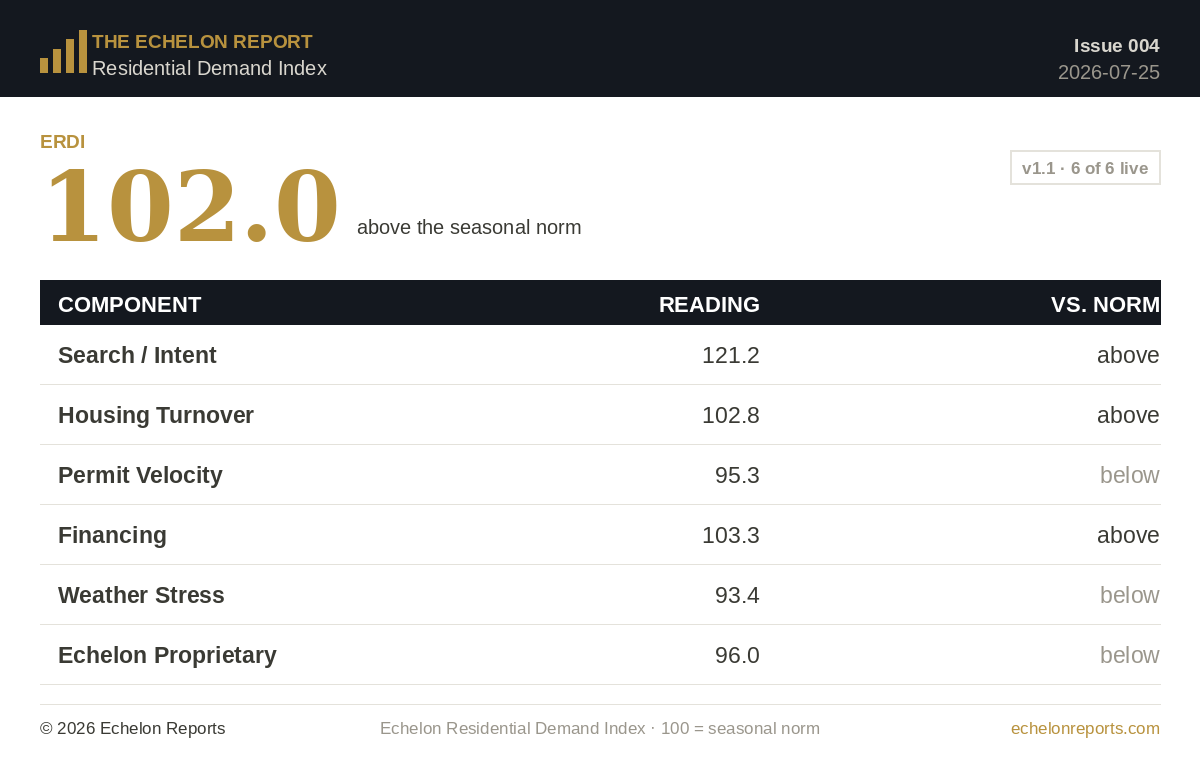
Residential trades demand runs about 2 percent above its seasonal norm, with three of six components above baseline. Four weeks of history: 105.6, 104.0, 102.0, 102.0. A flat composite, but not a quiet one, because the mix underneath rotated hard. The proprietary completed-work signal recovered 14.2 points to 96.0 in its second live print, the biggest single-component move of the week. Weather stress gave back most of last week’s restart, down 8.4 to 93.4 as the July heat failed to sustain. Search cooled another 2.5 points to 121.2 and still holds a fifth above norm. Financing slipped as the 30-year fixed moved to 6.55 percent, the second straight week away from the 6 percent trigger line. Turnover held its firm perch at 102.8, and permits sat below norm at 95.3, the split between existing-stock activity and new construction now four issues old.
| Component | Reading | WoW | vs. seasonal norm |
|---|---|---|---|
| Search / Intent | 121.2 | -2.5 | above |
| Housing Turnover | 102.8 | +0.0 | above |
| Permit Velocity | 95.3 | -0.8 | below |
| Financing | 103.3 | -2.3 | above |
| Weather Stress | 93.4 | -8.4 | below |
| Echelon Proprietary | 96.0 | +14.2 | below |
Readings are indexed so that 100 equals the seasonal norm. Search and weather are measured against their own recent baselines; financing, turnover, and permits against the same period in prior years. The proprietary component measures review-posting velocity across a 965-member contractor panel, a proxy for completed residential trades work, against the panel’s own baseline. Full methodology here.
2 · National Pulse
Last issue ended with a list of open calls. This issue grades them, because an index that never checks its own work is a horoscope.
The furnace wave is confirmed. Three consecutive weeks of off-season furnace intent, and the third was the strongest: up another 3.0 to 90, a step from its all-time reading, in the third week of July. Issue 002 flagged the anomaly, Issue 003 said a third week would confirm an early-replacement wave worth a season-long campaign, and the third week arrived. The call graduates from anomaly to trend.
The completed-work signal recovered, and we said we would tell you if the debut was noisy. It was, at least in part. The proprietary component’s first print at 81.8 suggested completed work running 18 percent under norm; its second print recovered to 96.0, review velocity at 1.67 per member per week against a 1.73 baseline. The honest read: the debut overstated the gap while the panel’s baseline settled, and the true picture is completed work running just under norm against intent running well over it. The capacity-gap thesis from last issue’s Strategic Lens survives, narrower and better measured. Two prints make a line, not a story; the third decides the trend.
The rate path went the wrong way again. The 30-year fixed moved from 6.49 to 6.55 percent. Two consecutive weeks away from the NAR’s 6 percent trigger line, and the summer drift toward it now reads as stalled. Turnover has not blinked yet, holding above norm, but the fall replacement-work thesis rests on rates resuming their slide, and this week argued against it.
The heat did not sustain. Weather stress fell back under norm to 93.4, giving back most of the prior week’s 18.7-point restart. The emergency-call engine idled again, which puts the demand picture back where the holiday week left it: planned, researched, financed work carrying the load while break-fix waits on the weather.
Search movers underneath the composite: water heater replacement is the new leader, up 26.2 to 86 and accelerating in season. HVAC replacement rose 10.8 to 67 and foundation repair 5.2 to 49. AC repair sat flat at 75 with the weather idle. And the soft end fell out entirely: roof replacement collapsed another 26.8 points to 53, the weakest reading on the board two weeks running, discretionary exterior work going quiet while urgent mechanical categories climb.
3 · Regional Spotlight: Coast to Coast
WA, OR, VA · new coverage
The spotlight follows the license engine again, because this was the week the map filled in. Three states entered the Echelon Database: Washington, with 160,899 contractor registrations layered over 488,595 principal association records, 49,838 of them carrying recorded departure dates; Oregon, with 45,574 licenses and a lapse timeline that caught 214 exits inside its debut window; and Virginia, with 89,438 regulant records and 43,504 firms wired into the operator layer across Northern Virginia, Richmond, and Hampton Roads.
The structural note that matters for readers of this report: Washington’s principal-departure layer and Oregon’s lapse mechanics are the same signal class that produced the last two flagged signals in the Deal Ledger. The engine that watched a qualifier walk off a twenty-five year telecom infrastructure contractor in San Diego County this week, before any announcement exists, now runs that watch from Puget Sound to Hampton Roads. The full flagged signal, the California pool’s first sorting week, and the succession records that came with it run with names and the complete read in the Echelon Deal Ledger, Issue 003.
4 · The Deal Desk
Three developments from our own desk, all built for the buy side.
The database crossed 1.3 million. As of this morning the Echelon Database reads 1,316,307 license records across eleven states: Ohio, Florida, Texas, Tennessee, Kentucky, Colorado, Arizona, California, Washington, Oregon, and Virginia, alongside live operator intelligence across 42 metro areas. Roughly 297,000 records and three states added in one week, ingested, verified, and on the weekly diff from here.
The transition boards had their first sorting week. California’s no-qualifier pool ran real churn for the first time under the engine’s watch: twenty entries, eight exits, two verified resolutions, and the education that a roster-file exit is not a closure until the live state board says so. Ohio’s escrow pool moved for the first time since tracking began, including the first escrow resolution printed with a visible destination. The full boards, the week’s flagged signal, and the verification chain behind both are in the Deal Ledger.
Two full public issues remain. The condensed public brief remains the open record. Private Deal Ledger coverage monitors five defined markets for $500 per month and begins with an application. Apply for Deal Ledger coverage.
5 · The Operator’s Edge
One move this week: run the furnace campaign like a season, not a promotion.
Three weeks of climbing off-season furnace intent is a confirmed early-replacement wave. Homeowners are planning winter mechanical work in July, researched and unhurried, which is the highest-margin version of that job you will ever be offered. If you ran the furnace offer we called two issues ago, extend it through August and staff for it. Pair it with the board’s new leader: water heater replacement, up 26.2 and in season, is the natural second half of a mechanical-room bundle, one truck roll, two replacements, one financing conversation.
And take spend off the roof. Roof replacement intent collapsed to 53, its second straight week as the weakest category on the board. Discretionary exterior work is going quiet while urgent mechanical climbs, so lean the marketing budget where the intent is until the exterior categories turn.
6 · Strategic Lens: The Sorting Machine
This week the license layer taught something the demand indexes cannot: how a market disposes of capacity when its operators leave.
Watch what actually happened inside one state’s distress pool in seven days. Eight companies left it. Two were saved, qualifiers seated, back to work. Several others slid deeper, bonds cancelling, files closing, one wind-down running out its final days on the state board. Twenty more entered, among them a fifty-person telecom infrastructure contractor whose founder stepped off the license after twenty-five years with no public explanation, and a pair of family companies in the Coachella Valley that lost the same man, recorded in the state file with a date. None of this is in any deal database, because none of it is a deal yet.
That is the point for the buy side. The consolidation wave is usually described as a financial story, multiples and platforms and dry powder. Underneath it is a demographic and human one: the trades are run by people, the people are aging, and the license record is where their transitions surface first, with dates, before intent becomes announcement. A pool like California’s is not a list of distressed companies; it is a sorting machine, and each week it sorts its members into successors seated, businesses sold, and doors closed. The buyer’s edge is not knowing the pool exists. It is watching the sorting happen weekly and reaching the transition candidates while their outcome is still undecided. That watch now runs across eleven states and both coasts, and it compounds every Sunday.
7 · The Watch
The furnace wave’s fourth week. A confirmed trend’s next question is its crest: does the early-replacement wave build through August or peak with the July reading.
Water heater replacement, the new leader on the movers board, watched for whether it sustains as the bundle partner.
The proprietary signal’s third print. Two prints made a line from 81.8 to 96.0; the third says whether completed work is genuinely running just under norm or still settling.
The rate path, now moving the wrong way at 6.55. The fall replacement thesis needs the slide toward 6 percent to resume.
Five Star Communications, license 789902. The successor seating, the sale, or the story. The Ledger watches weekly.
The Glendale license, expiring July 31, and the Caribou bond cancellation effective July 23, two tracked distress clocks running inside the same pool.
Washington and Oregon’s first full week-over-week diffs, printing next issue.
Go deeper on one market. The Echelon Intelligence Report is a commissioned deep file on a single market or target set: the licensed operator census, the competitive gap map, the ownership layer, and verified operator intelligence, built from the Echelon Database and delivered as a private brief. Current rate: $3,500 flat. Pricing is subject to change without notice; commissioned work is billed at the rate in effect on the date of engagement. Inquire: mike@echelonreports.com.
The Echelon Report is the weekly trades intelligence brief from Echelon Reports, built on the Echelon Database and the Echelon Residential Demand Index.
See where your market stands with the Echelon Deal Ledger · Read how ERDI is built · Get the weekly deal signals with charter access · Browse every issue
Mike Warner · linkedin.com/in/jmichaelwarner