
The Echelon Report · Issue 003 · Week of July 13, 2026
For the first time, all six components of the index are live. The proprietary review-velocity signal completed its calibration and enters the composite this week, which means the index now reads not just what homeowners intend to do, but a proxy for what actually got done. Built in the open, as promised. Three weeks of history on the board, and the trend line begins to mean something.
1 · The Number
ERDI
102.0
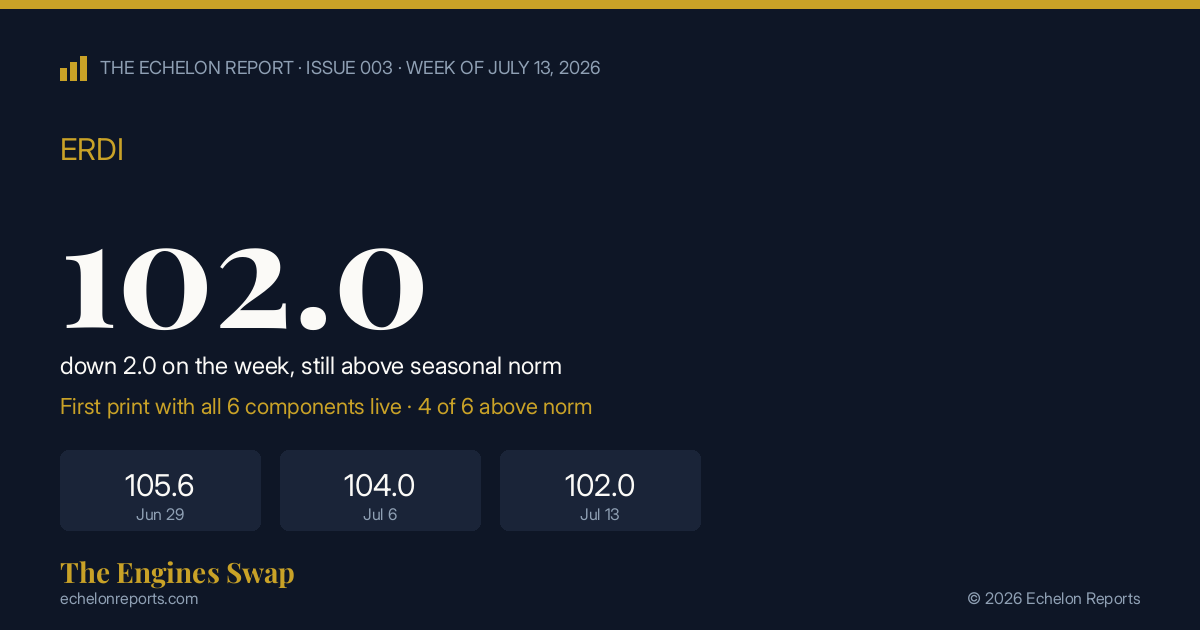
down 2.0 on the week, still above the seasonal norm · v1.1 · 6 of 6 live
Residential trades demand is running about 2 percent above its seasonal norm, with four of the six components above baseline. Three weeks of history now: 105.6, then 104.0, then 102.0. Read the decline carefully, because two different things happened at once. First, the mix rotated: weather stress snapped back above norm, up 18.7 points to 101.8, exactly the both-engines restart last issue’s Watch flagged, while homeowner search cooled 7.8 points from its extreme highs to 123.7, still nearly a quarter above norm. Second, the composition changed: the proprietary review-velocity signal printed live for the first time and entered below its norm at 81.8, which weighed on the composite in its debut week. A first print is a starting point, not a trend. What the index says underneath the arithmetic: intent remains strongly elevated, the weather engine is running again, and the new signal suggests completed work is lagging the demand. More on that gap in the Strategic Lens.
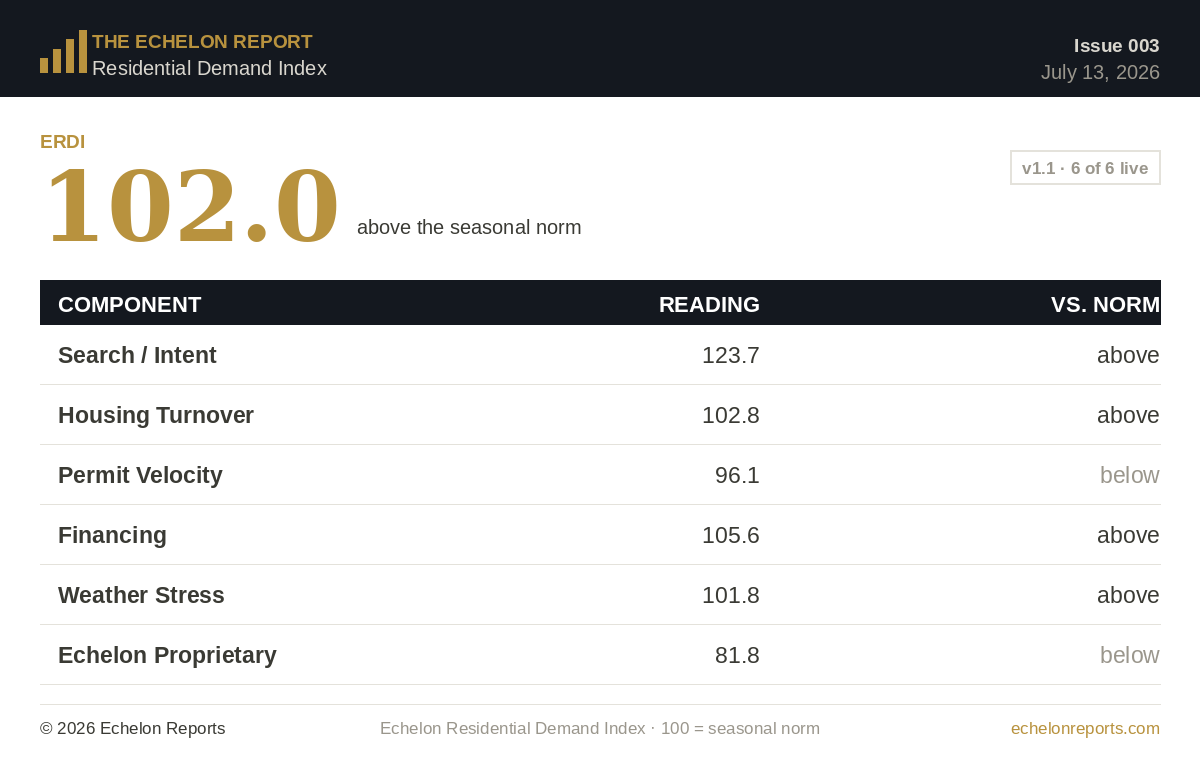
| Component | Reading | WoW | vs. seasonal norm |
|---|---|---|---|
| Search / Intent | 123.7 | -7.8 | above |
| Housing Turnover | 102.8 | -0.4 | above |
| Permit Velocity | 96.1 | 0.0 | below |
| Financing | 105.6 | -0.3 | above |
| Weather Stress | 101.8 | +18.7 | above |
| Echelon Proprietary | 81.8 | first print | below |
Readings are indexed so that 100 equals the seasonal norm. Search and weather are measured against their own recent baselines; financing, turnover, and permits against the same period in prior years. The proprietary component measures review-posting velocity across a 965-member contractor panel, a proxy for completed residential trades work, against the panel’s own baseline. Full methodology here.
2 · National Pulse
Last issue was a convert week: mild weather, elevated intent, planned demand. This week the second engine came back.
The heat returned on schedule. Weather stress jumped 18.7 points to 101.8, moving from well under norm to just above it as July heat broadened beyond the coasts. The reading is built from NOAA station records, so it measures the load the weather actually put on homes. The emergency-call engine that idled through the holiday week is running again.
Search cooled from extreme to merely strong. Homeowner search for trades work eased 7.8 points to 123.7. Some of that is the flip side of the weather: when systems start failing again, research-phase browsing gives way to phone calls. Intent nearly a quarter above norm with the emergency engine restarting is a stronger demand picture than either signal alone.
The new signal says the work is lagging the want. The proprietary component’s first live print puts panel review velocity at 1.56 reviews per member per week against a baseline of 1.91, about 18 percent under norm across 965 tracked contractors and roughly 453,000 accumulated reviews. Treat a debut reading gently. But taken at face value, it describes homeowners researching heavily while completed-job volume runs below normal, which is what a capacity-constrained or backlogged market looks like.
Financing stalled. The 30-year fixed ticked back up to 6.49 percent from 6.43. One week does not end the drift, but the move toward the NAR’s 6 percent trigger line paused. Turnover held above norm at 102.8, its firmest stretch in months, and permits sat unchanged below norm at 96.1. The split is now three issues old and counting: the activity is in the existing housing stock, not new construction.
3 · Regional Spotlight: The West Comes Online
CA, AZ · regional sub-index online soon
This week the spotlight goes where the license engine went. The Echelon Database ingested California and Arizona this window, and the West’s underlying supply structure is now readable weekly: 243,477 active California CSLB licenses layered with 404,540 personnel association records, and 83,170 Arizona Registrar of Contractors licenses with qualifying-party linkage, all verified through the same discipline as the six states already in the system.
California’s roster carries the richest distress taxonomy of any state in the system, including a status code that names companies whose qualifying individual has departed and gone unreplaced: 231 companies sit in that state today, each one legally unable to contract until it resolves. Arizona’s first weekly diff caught six suspension lifts and two qualifying-party changes inside its debut window. The first flagged signal from the new coverage, a Glendale seismic-retrofit contractor whose license record turned out to be the final chapter of a Chapter 7 liquidation, verified from the license diff all the way to the federal docket, runs with names and the full read in the Echelon Deal Ledger, Issue 002.
For the demand side of these markets, the July heat that rebuilt the national weather-stress reading ran hottest across the interior Southwest, which means the emergency-call engine and the new license coverage came online in the same region in the same week.
4 · The Deal Desk
Three developments from our own desk, all built for the buy side.
The database crossed one million. As of this morning the Echelon Database reads 1,019,084 license records across eight states: Ohio, Florida, Texas, Tennessee, Kentucky, Colorado, Arizona, and California, alongside live operator intelligence across 42 metro areas. Seven figures, built one state roster at a time, refreshed weekly.
California and Arizona are live, with the personnel and qualifying-party layers that let the engine see people leaving licenses before status changes catch up. The platform ownership map ran against both new rosters this week and produced its first candidate matches, now in the verification queue.
Washington and Oregon enter the Echelon Database this week. Both carry the owner-to-license linkage that makes the qualifier-departure signal class readable once ingested and verified through the same discipline as the eight states already in the system. When they land, the database reads the entire West Coast.
The weekly pre-announcement signal work, including this week’s Glendale flag and the standing watchlist, runs in the Echelon Deal Ledger. Private Deal Ledger coverage monitors five defined markets for $500 per month and begins with an application. Apply for Deal Ledger coverage.
5 · The Operator’s Edge
One move this week: the furnace wave is real. Ride it.
Last issue flagged off-season furnace-repair search as a genuine anomaly and said the second week would tell us whether it was a wave or a blip. It held, and then it climbed: furnace repair rose another 6.2 points to 97, a step from its peak reading, in the second week of July. Two consecutive weeks of off-season furnace intent is not noise, it is homeowners planning replacements while the system sits idle. If you ran the furnace-replacement offer we called last week, double down. If you did not, you are now a week behind competitors who did, and there is still margin in being second.
The new leader on the movers board is water heater replacement, up 12.8 to 89, in season and accelerating; it pairs naturally with the furnace offer as a mechanical-room bundle. The soft end stays soft and got softer: roof replacement fell 13.5 points to 72, the weakest mover on the board, and bathroom remodel slipped 3.0. Lean marketing spend toward urgent mechanical trades and away from discretionary exterior work until those categories turn.
6 · Strategic Lens: The Gap Between Wanting and Getting
This week the index started measuring both sides of the transaction, and the first thing the new signal did was disagree with the old ones. Search intent runs a quarter above norm. Review velocity, the completed-work proxy, runs 18 percent below it. If both readings are right, homeowners are researching more work than contractors are finishing.
That gap is worth naming, because it is the shape of a seller’s market for capacity. For an operator, a backlog is margin: it is pricing power, schedule control, and the freedom to take the researched, financed, planned jobs the intent data says are out there. For a buyer, the same gap is a diligence question with teeth. A target’s trailing revenue in a capacity-constrained market tells you what they managed to do, not what the demand offered them. The sharper questions are conversion-rate questions: how much of the phone traffic became booked work, how long is the backlog, and is the constraint trucks, techs, or licenses. The trades’ binding constraint has been skilled labor for a decade, and the license rosters we read weekly are, at bottom, a census of exactly that constraint.
One honest caveat: this is the proprietary signal’s first live print. We will not build a thesis on one reading, and neither should you. But the question it raises this week, who captures the gap between what homeowners want done and what the trades can deliver, is the question the whole consolidation wave is a bet on.
7 · The Watch
The furnace anomaly, now two weeks running and strengthening. A third week confirms an early-replacement wave worth a season-long campaign, not just a July curiosity.
The proprietary signal’s second print. One reading below norm is a data point; two begins a story about capacity. We will also say plainly if early panel readings prove noisy while the signal matures.
The rate path. The drift toward 6 percent stalled at 6.49 this week. Whether it resumes decides how much transaction-driven replacement work the fall carries.
Whether the July heat sustains. Weather stress rebuilt to just above norm; a hot back half of July would put both engines at full power for the first time since June.
Glendale, and the 231. License 1041609 has nineteen days to resolution, and the California no-qualifier pool is now on the weekly read. The Ledger is watching.
Washington and Oregon, entering the Echelon Database this week.
The Echelon Report is the weekly residential-trades intelligence brief from Echelon Reports, built on the Echelon Database and the Echelon Residential Demand Index.
See where your market stands with the Echelon Deal Ledger · Read how ERDI is built · Get the weekly deal signals with charter access · Browse every issue
Mike Warner · linkedin.com/in/jmichaelwarner